49 works in this view — arrow keys or swipe to move between them.
Dance in Art
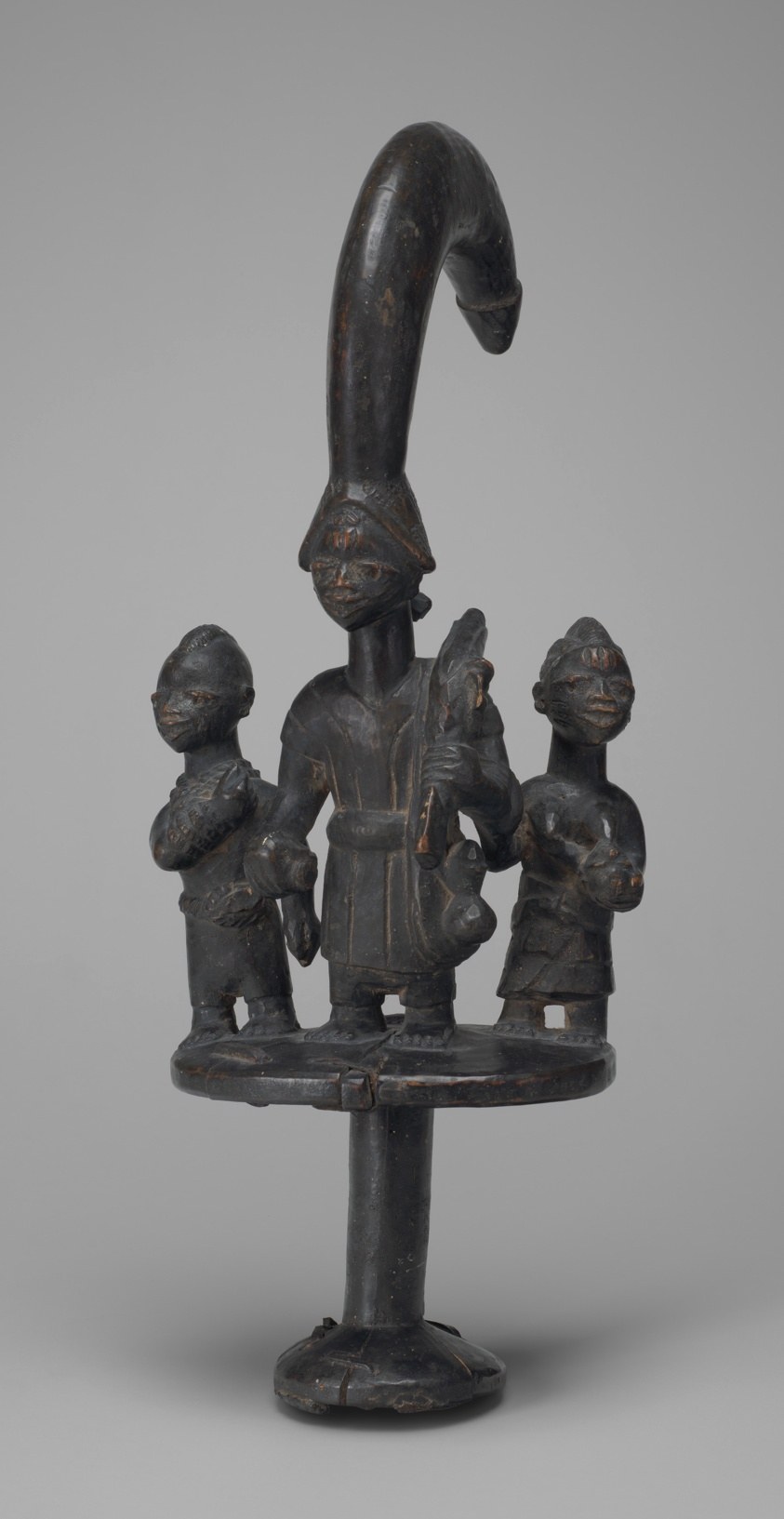
Esu Dance Staff (Ogo Elegbara)
Attributed to an unidentified Ketu master (active mid-19th century) Yoruba Nigeria Coastal West Africa
- Medium:
- Wood
- Collection:
- Arts of Africa
- Source:
- Art Institute of Chicago
- Rights:
- Public domain — free to use, share and adapt.
- Recorded as:
- CC0 (Public Domain)
For scholars of African performance and religion, this object demonstrates how dance in Yoruba culture is fundamentally tied to spiritual authority, ritual objects, and hierarchies of knowledge rather than secular spectacle. For dance historians, it shows a material culture of dance that exists outside the body itself—objects that organize, enable, and consecrate movement. The staff's presence in the Americas, whether directly or through the diaspora's knowledge of such forms, makes it relevant to understanding how African material and choreographic traditions were carried and transformed across the Atlantic.
What you are looking at
A dark wood carved staff or finial rises vertically from a circular base, standing approximately 18 inches tall. The upper portion terminates in a dramatically curved hook or crook, almost recurved, suggesting a shepherd's staff or ceremonial implement. Below this carved hook sits a carved head in profile facing left, with detailed facial features rendered in relief. Below this central head figure, a flat platform or collar projects outward, and from this platform emerge three smaller standing figures arranged in a row: two flanking figures on either side and one central figure between them. All three smaller figures are carved in the round and appear to be standing upright with arms held at their sides or slightly forward. The entire sculpture is rendered in what appears to be a single piece or skillfully joined wood, with a dark patina suggesting considerable age and use. The carving shows wear consistent with handling—the finial is particularly burnished on its upper surface.
The dancing
The three lower figures are rendered as compact human forms approximately 4–5 inches tall, with defined heads, shoulders, and legs. Their proportions are stylized rather than naturalistic. The flanking figures are nearly identical and face forward with a static, formal stance; the central figure appears similar in pose. The arms are held close to the body or extended slightly, with no indication of dynamic movement or gesture typical of active dance. The figures do not touch or form a group—they stand independently on the shared platform, their separation suggesting status differentiation or ritual arrangement rather than social dancing.
The dance depicted
This is an Esu (Elegbara) dance staff or ogo, a ceremonial object central to Yoruba religious practice and initiation ritual. The three figures below the main finial likely represent initiates or devotees in a formal, sacred context rather than performers in secular dance. While these objects appear in contexts of ritual movement and procession—forms of embodied practice allied to dance—the figures themselves are frozen in reverent stillness rather than captured mid-movement. The curved finial above may represent Esu's characteristic trickster energy or spiritual force, but the composition emphasizes stasis and ritual authority rather than kinetic dance vocabulary.
How it was made
Wood carving in a subtractive technique, likely executed from a single block or carefully fitted sections. The surface shows the texture of hand-tool work—chisels and gouges left visible marks visible in the patina. The dark finish is a combination of age, smoke exposure from use, and the natural darkening of wood over decades. The top of the staff shows particular polish from repetitive handling and contact. The work demonstrates sophisticated woodcarving skills: the proportions are deliberately distorted for spiritual effect rather than naturalistic representation, a characteristic convention of Yoruba sculpture. Such objects circulated within Yoruba communities and among diaspora populations, particularly in the Americas, but this piece appears to have remained within an African collection context.
About this work
This is an Esu or Elegbara dance staff—a sacred Yoruba ceremonial object created in the Ketu region of present-day Nigeria in the mid-19th century. The staff functioned as both a ritual implement and a symbol of spiritual authority within Yoruba religious practice, particularly in contexts of initiation and sacred dance. The carving combines a dominant upward-sweeping finial with a cluster of three smaller human figures, each frozen in formal stance rather than captured in movement. While such objects appear in ritual contexts involving procession, music, and embodied prayer, the sculpture itself emphasizes spiritual stasis—a moment of ritual presence rather than kinetic expression. It belongs in a dance gallery because dance and ritual movement in Yoruba culture are inseparable from material culture and spiritual objects; the staff was present at dances, ceremonies, and initiations even if its own form is static.
How to look at it
Begin at the top: the upward curve of the finial is the most visually dominant element, suggesting energy, spiritual force, or the trickster aspect of Esu. The sharp contrast between this dynamic curve and the static figures below creates the work's central tension. Look at the carved head just below the hook—this is Esu's face, rendered in a stylized profile with delicately carved features and decorative scarification. Only then descend to the three figures, noticing their uniform, formal stance and the way they occupy the platform as a unified group rather than as interacting individuals. The burnished wear on the top of the staff indicates this was a working object, held and raised repeatedly in ritual contexts; imagine it moving upward and outward in a procession or ceremony, the hook catching light.
The artist
The work is attributed to an unidentified Ketu master active in the mid-19th century. Ketu was a major Yoruba city-state and artistic center, known for sculptural excellence in wood, ivory, and beaded regalia. While individual names of Yoruba carvers of this period were rarely recorded in colonial or Euro-American documentation, the hand of this artist is recognizable in the proportions, the treatment of facial features, and the particular curve of the finial. The style suggests training within a lineage or workshop tradition rather than individual invention; the maker followed established conventions for Esu staffs while bringing distinctive skill and vision to this example.
The period
The mid-19th century was a period of intense religious and political transformation in Yorubaland. Yoruba city-states were fragmenting under external pressure, slave-raiding intensified, and internal religious practices—particularly devotion to orisha (spirit powers) like Esu—became simultaneously more urgent and more contested. The creation of elaborate ritual objects like this staff occurred in contexts of religious intensification and the preservation of Yoruba knowledge systems under threat. Simultaneously, in the Americas, formerly enslaved Yoruba and their descendants were developing new forms of ritual practice in Cuba, Brazil, and elsewhere that preserved and transformed Yoruba religious knowledge; objects like this staff represent the material culture those diaspora traditions would reference and recreate.
Where it lives
The work is held in the Arts of Africa collection at the Art Institute of Chicago. It arrived in Western institutional collections through the early-to-mid 20th century collecting practices that brought African sculpture to Euro-American museums, often through colonial or missionary channels. Within this context it has been preserved and studied as a sculpture rather than as a living ritual object, a classification that shapes how it is seen but does not diminish its significance to dance history.
Dance in this work
Questions about this work
Is this a dance object or a sculpture?
Both. In Yoruba culture, the distinction between sculpture and ritual implement, between visual art and embodied practice, does not hold in the same way it does in Western art history. This staff was present at dances, ceremonies, and ritual gatherings; it organized space and signaled sacred authority. Its form is static, but its function was kinetic and social. Understanding it requires accepting that objects can participate in dance without depicting dynamic movement.
What do the three figures represent?
They most likely represent initiates, devotees, or attendants within the Esu cult or a related Yoruba spiritual society. Their uniform height, identical stance, and formal arrangement suggest a group defined by shared ritual status rather than individuated identities. They may also represent the three aspects or manifestations of Esu's power, though the exact symbolic meaning would be known fully only to initiated practitioners.
Who would have used this staff and how?
A senior member of an Esu cult or a diviner (babalawo) would have held and carried this staff during rituals, processions, initiations, and dances. It would be raised, pointed, and moved in gestures that blessed, protected, or invoked Esu's presence. The polish on the upper portions shows it was handled repeatedly and with reverence, indicating active ceremonial use over time.
Why is it in an American museum instead of Nigeria?
Like many African artworks now in Western institutions, this staff was collected and removed during the colonial period or shortly after, when such objects were viewed as ethnographic specimens or artworks for sale rather than as sacred implements. Its presence in Chicago reflects both historical collecting practices and ongoing questions about cultural patrimony and repatriation that museums continue to address.
More dance artwork





