49 works in this view — arrow keys or swipe to move between them.
Dance in Art
Taxi Dance Hall
Reginald Marsh American, 1898-1954
- Medium:
- China ink on cardboard, double-sided, one side varnished
- Collection:
- Prints and Drawings
- Source:
- Art Institute of Chicago
- Rights:
- Rights reserved by the holding institution — do not reuse without permission. Source record ↗
- Recorded as:
- AIC — rights reserved
Marsh's work is rare documentary evidence of taxi dance halls, a widespread but now largely forgotten institution of working-class entertainment and sex work. The drawing challenges the assumption that all dance imagery celebrates or beautifies the body: Marsh uses the dance hall to expose exploitation. For historians of labor, gender, and commercial sexuality, this is primary-source material; for dancers and historians of dance venues, it reveals the conditions under which some performers worked and the fine line between dance, entertainment, and sex work in twentieth-century America.
What you are looking at
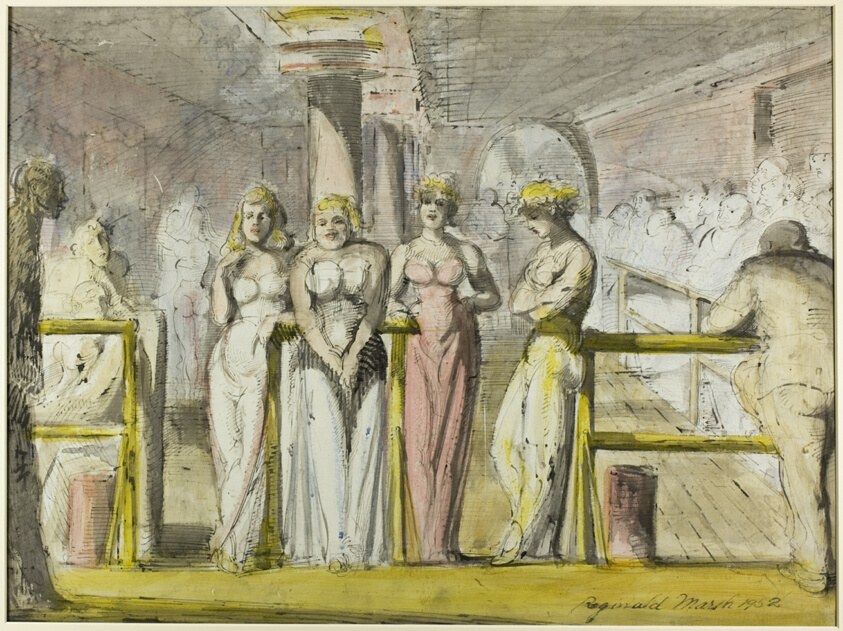
A crowded interior space—likely a dance hall or cabaret—rendered in Marsh's characteristic sketch style with ink and watercolor wash. Five female figures stand prominently in the foreground in various states of undress or semi-nude, wearing minimal clothing, flower crowns, and light drapery. They are arranged in a loose line across the composition, their bodies posed rather than in motion. Behind them, a crowd of male patrons fills the background, sketched more summarily, watching intently. The setting suggests a commercial establishment; the architectural elements—columns, arched doorways, wooden flooring—create a theatrical interior. The mood is voyeuristic and transactional: these are performers or sex workers on display for paying customers. Marsh's technique emphasizes the interaction between the objectified female bodies and the consuming male gaze.
The dancing
The five women are posed statically rather than actively dancing, their weight settled on both feet, bodies frontal or three-quarter turned to face the viewers (both in the picture and the viewer of the work). Their posture is languid and available rather than dynamic—no weight shift, no momentum, no partnered hold. Arms hang loose or rest on the body; there is no frame or extension characteristic of ballroom or theatrical dance. This is display posture, not dance posture. The male figures in the background are shown in profile or back view, leaning forward with engaged attention, their gestural language one of observation and desire.
The dance depicted
This is not a depiction of dance performance in the theatrical or social sense. The work documents the 'taxi dance hall'—a commercial venue where men paid for brief dance partnerships with hostesses, which were often a cover for sex work. The women are performers in a transaction, not dancers executing a learned vocabulary. The absence of any recognizable dance hold, frame, or technique suggests Marsh's documentary interest is in the economics and sociology of the venue rather than in dance as an art form. The static posing emphasizes the commodification of the female body and the power dynamic between customer and performer.
How it was made
China ink on cardboard, double-sided with one side varnished, executed in Marsh's signature style combining pen line with watercolor wash. The technique is sketchy and improvisational—loose hatching, gestural mark-making, areas of dilute wash creating atmospheric depth. This is a working study or finished drawing, not a formal work in oils; the immediacy and informal quality suited both Marsh's practice and the subject matter. The varnish on one side suggests it was meant to be durable, possibly for exhibition or repeated viewing. The medium allowed Marsh to work quickly, capturing the fleeting moment and social observation that drove his urban scene-painting.
About this work
Reginald Marsh's *Taxi Dance Hall* documents the working conditions and sexual economics of commercial dance venues in early 1950s America. Rather than celebrating dance as performance or social pleasure, Marsh uses the medium to expose a system of labor and exploitation. The women are rendered with anatomical attention but without agency—posed for display, not engaged in movement or interaction with partners. The crowded male gaze pressing from behind underscores the power imbalance. This is social realism with a sharp critical edge, using the dance hall setting to interrogate gender, commerce, and the male gaze in postwar urban culture. The work belongs in a dance collection not because it celebrates dance, but because it documents a now-obsolete form of paid performance and reveals what 'dance' meant in a context of economic desperation.
How to look at it
Look first at the poses of the five women in the foreground: note that none of them are dancing. They are standing still, displayed, their bodies available for inspection. Observe how Marsh has positioned them frontal to the viewer—we are positioned as customers. Then look at the sketched male figures in the background: they lean forward, watch, consume with their eyes. The composition enacts the power dynamic rather than depicting a moment of movement. Notice too Marsh's use of partial undress and flower crowns—the trappings of desirability without the agency of performance. Finally, consider the crowded, claustrophobic interior: this is not the bright, open leisure space of a ballroom or nightclub, but a compressed, transactional space where bodies are exchanged for money.
The artist
Reginald Marsh (1898–1954) was an American painter, printmaker, and muralist best known for his satirical, energetic depictions of urban life, crowds, and leisure in Depression-era and postwar New York. He trained at the Art Students League and worked as a cartoonist for The New York Daily News, which shaped his eye for social observation and caricature. Marsh was drawn to working-class entertainment venues—burlesque theaters, dance halls, amusement parks, beaches—which he depicted with unflinching realism combined with expressionist distortion. His work is often darkly humorous and morally questioning, never simply celebratory. He used ink, watercolor, and tempera with equal facility and worked across scales from intimate drawings to large murals. His technical skill and visual wit made him a major figure in American Regionalism and Social Realism.
The period
The taxi dance hall flourished in the 1920s through the 1950s, particularly in working-class and immigrant neighborhoods of major cities. These venues emerged as a commercialized evolution of social dance; men paid per dance (originally timed by tickets) to partner with a hostess. Many hostesses were recent immigrants, divorced women, or economically desperate; the work often blurred into prostitution, and the venues were frequently sites of crime and exploitation. By the 1950s, when Marsh made this drawing, taxi dance halls were declining as venues like nightclubs and later discotheques changed the economics of commercial entertainment. Marsh's interest in the taxi dance hall—shared by social photographers and documentarians of the era—reflected a broader postwar anxiety about urban vice, sexuality, and the survival of working-class culture. Artistically, Marsh's unflinching approach to sexual and commercial subjects was unusual for the period and positioned him outside mainstream critical favor.
Where it lives
The work is held in the Prints and Drawings collection of the Art Institute of Chicago. It is a double-sided work on cardboard with varnish applied to one side, indicating it was a finished or semi-finished study meant for viewing and possibly exhibition, not a preliminary sketch.
Questions about this work
What is a taxi dance hall?
A taxi dance hall was a commercial venue where men paid (originally per dance, timed by a ticket system) to partner with a hostess for a brief dance. These venues were widespread in working-class urban neighborhoods from the 1920s through the 1950s. The work was often poorly paid and unstable, and many venues were associated with prostitution, crime, and exploitation. They represent a commercialized, often coercive form of dance labor very different from social or theatrical dance.
Is Marsh celebrating or critiquing the taxi dance hall?
Marsh is critiquing it. The static, objectified poses of the women, the emphasis on their bodies as display, and the leering male gaze in the background create a uncomfortable, exposed quality. This is not a celebratory or romanticized image of entertainment. Marsh's technique—his unflinching realism and use of distortion—conveys moral questioning rather than endorsement. The work documents exploitation rather than pleasure.
Are these figures actually dancing?
No. They are posed statically for display. There is no weight shift, no partnered hold, no extension or frame—none of the physical markers of actual dance. Marsh has deliberately chosen to show them not dancing, but standing available. This absence of dance movement is crucial to the work's meaning: it emphasizes that these are commodified bodies, not skilled performers.
Why would Marsh paint this subject?
Marsh was deeply invested in documenting urban working-class life, including its darker sides: burlesque theaters, bars, amusement parks, and street corners. He was interested in the economics and power dynamics of commercial leisure, not in celebrating it. The taxi dance hall was a subject through which he could examine gender, labor, and the commercialization of the body in modern American cities.
More dance artwork





