49 works in this view — arrow keys or swipe to move between them.
Dance in Art
Male Face Mask (Chihongo)
Chokwe Angola or Democratic Republic of the Congo Central Africa
- Medium:
- Wood, raffia, burlap, turaco feathers, guinea fowl feathers, and pigment
- Collection:
- Arts of Africa
- Source:
- Art Institute of Chicago
- Rights:
- Public domain — free to use, share and adapt.
- Recorded as:
- CC0 (Public Domain)
The *chihongo* embodies a tradition of masked performance central to Central African societies, where dance, carved form, and spiritual authority were inseparable. For dancers and historians, it reveals how non-Western performance traditions used three-dimensional art to amplify the body and command ritual space—a choreographic principle as sophisticated as any Western theatrical tradition. The mask demonstrates that dance history without African masked traditions is incomplete.
What you are looking at
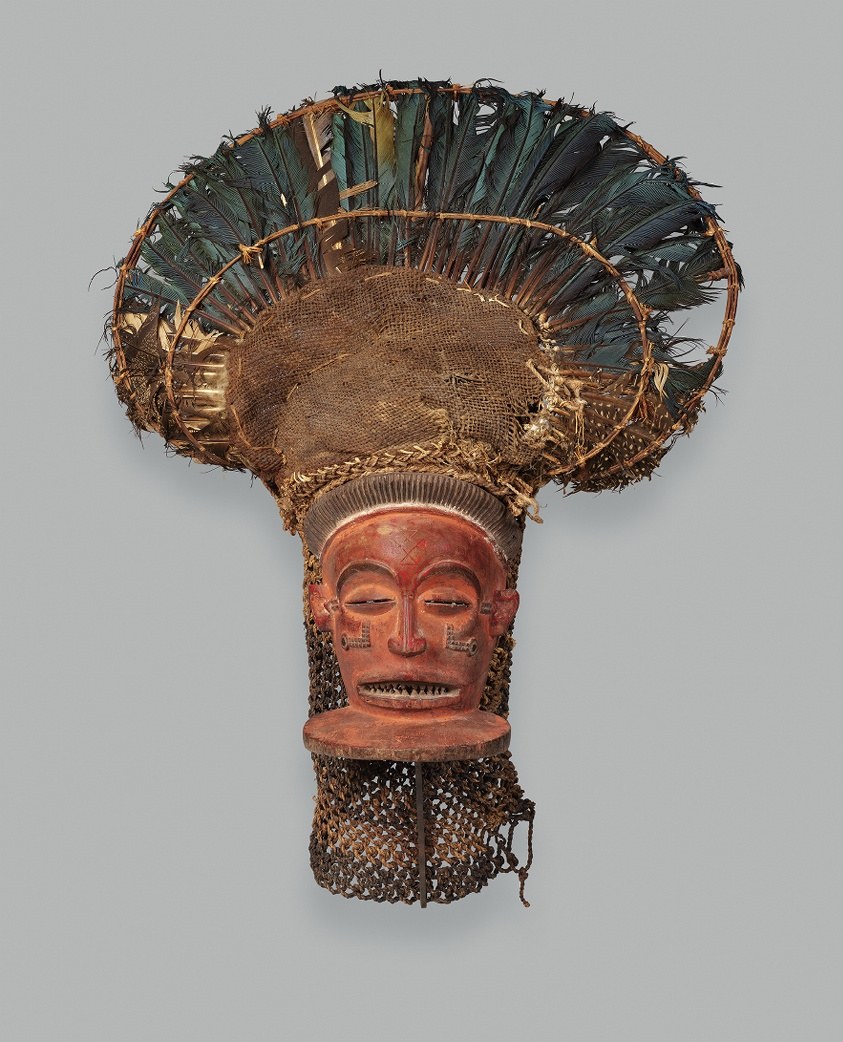
This is a monumental sculptural mask, presented frontally against a neutral ground. The face is carved from wood and painted in deep terracotta-red with black linear tattoo marks on the cheeks and chin. The expression is startling: the mouth opens wide in what reads as a grin or shout, with teeth indicated in the carving. The eyes are closed or downcast beneath heavy brows. The face tapers to a substantial cylindrical neck wrapped in dense brass or metal rings, creating a textured collar that catches light. Above the head rises an enormous headdress of woven raffia and burlap, structured to flare outward like a mushroom or enormous crown. This framework is densely trimmed with long feathers—primarily dark teal and forest-green turaco feathers, with lighter guinea-fowl feathers creating highlights and texture. The feathers radiate outward from the crown, creating a diameter that dwarfs the face below. The entire object reads as a ceremonial mask meant to be worn, transforming the wearer into something superhuman or ancestral, though the photograph presents it as a static object suspended in space.
The dancing
The mask is a single carved figure occupying the entire composition. The face's expression—open-mouthed and painted—suggests vocalization or communication rather than neutral repose. The closed eyes and frontal symmetry create a timeless quality. The metal neck rings anchor the head, while the massive headdress creates an impression of monumentality and presence that would have extended the wearer's height and visual authority significantly. The feathering is layered and dimensional, suggesting movement when worn.
The dance depicted
This is a Chokwe *chihongo* mask, a male leadership mask used in masquerade dances by the Chokwe people of Angola and the Democratic Republic of the Congo. The *chihongo* represented initiated men, chiefs, or ancestral authority and appeared in ceremonial dances and celebrations. The open mouth and vocalization-ready expression suggest the mask's role in performance—Chokwe masked dances involved sound, gesture, and elaborate movement. The wearer would have danced with fluid, controlled motion, the massive headdress amplifying every movement. These were not naturalistic representations but power objects, designed to make the wearer appear larger, otherworldly, and aligned with ancestral forces.
How it was made
The mask is carved from wood and built up in composite materials: the face is wood painted with mineral pigment (terracotta-red, black, and white), the neck rings are wound brass or copper wire, and the headdress is a framework of raffia and burlap, densely sewn with feathers. The feathers are attached individually or in small clusters, creating texture and movement. The surface shows age and handling—the paint has worn unevenly, the feathers show loss and browning, and the metal rings are oxidized. This was a working object, not a museum piece created for sale, and its condition reflects use in dance, storage, and ritual exposure.
About this work
The *chihongo* mask is a masterwork of Chokwe sculptural tradition, representing the intersection of carving, painting, metalwork, and featherwork into a single transformative object. The mask was worn by male performers in dances that marked authority, initiation, or ancestral connection. Its scale, expression, and material richness made the wearer a commanding presence in the dance circle—the headdress alone transformed human proportions into something monumental. The open mouth suggests sound and agency; the closed eyes create an ambiguous presence neither fully human nor fully spirit. This is not costume ornament but a mask that reconstitutes the wearer as a different kind of being.
How to look at it
Attend first to the expression: the open mouth and closed eyes create an uncanny quality, neither a smile nor a shout but something more commanding. The featherwork is not uniform—look at how the feathers are layered and tapered, creating depth and the suggestion of movement even in stillness. The metal rings on the neck are worn and darkened; they would have caught light and sound as the wearer moved. Imagine the mask in darkness, in firelight, in the dust of a dance ground with sound and movement around it. The photograph presents it as a museum object; the original context was performance, celebration, and the transformation of the human body into something ancestral.
The artist
The mask is attributed to the Chokwe people, whose sculptural tradition is among the most accomplished in Central Africa. Chokwe carvers were renowned for naturalistic facial features, subtle expression, and technical virtuosity in wood and metalwork. The tradition continues into the present day. Individual carvers are rarely documented in the colonial-era records by which most African art entered Western museums, but the technical sophistication of the carving, the precision of the feather application, and the quality of the pigmentation all suggest a master craftsperson working within a long-established tradition of Chokwe mask-making.
The period
The *chihongo* tradition was practiced continuously from at least the 18th century into the 20th and beyond. The mask's date of 1850 places it in the period before large-scale European colonization, though European trade goods (including brass wire) had already begun to circulate in Central African markets. The mask would have been used in dances marking rites of passage, chieftaincy installations, mortuary celebrations, and seasonal festivals. By the time this mask was created, it embodied centuries of technical refinement in Chokwe aesthetics: the proportions of the face, the subtlety of expression, the scale of the headdress, and the integration of feather and metal all follow established conventions refined over generations.
Where it lives
The mask is held in the Arts of Africa collection at the Art Institute of Chicago. It entered the collection through the standard institutional acquisition of African material in the mid-to-late 20th century; the specific provenance before acquisition is not recorded here.
Dance in this work
Questions about this work
Was this mask worn by a specific person or lineage?
Among the Chokwe, the *chihongo* mask was worn by initiated men performing a recognized role in community ritual. The mask itself might have been owned and transmitted by a particular family or association, but it was not necessarily the property of a single individual. Different men could wear the same mask on different occasions, each becoming the ancestral or authoritative figure the mask represented.
What would a dancer wearing this have looked like in motion?
The wearer would have stood substantially taller due to the headdress, which extends perhaps 18 inches or more above the head. The massive feathered crown would create an impressive silhouette and would move with the dancer's motion—feathers catching air and light. The wooden face would reflect firelight if the performance was nocturnal. Movement would have been controlled and deliberate, as the weight and bulk of the headdress required stability and precision.
What do the marks on the face represent?
The black lines on the cheeks and chin are likely scarification marks (*meno*), which represented beauty, status, or group identity among Chokwe and neighboring peoples. By carving and painting them on the mask, the artist was asserting the mask-wearer's elevated status and beauty—making the wearer not just powerful but aesthetically refined.
Why is the mouth open?
The open mouth suggests vocalization—the mask-wearer was not silent but present and commanding in speech, song, or sound. It also creates a powerful expression, neither smiling nor grimacing but assertive. The open mouth may also have allowed better visibility and breathing for the performer wearing the mask.
More dance artwork





