49 works in this view — arrow keys or swipe to move between them.
Dance in Art
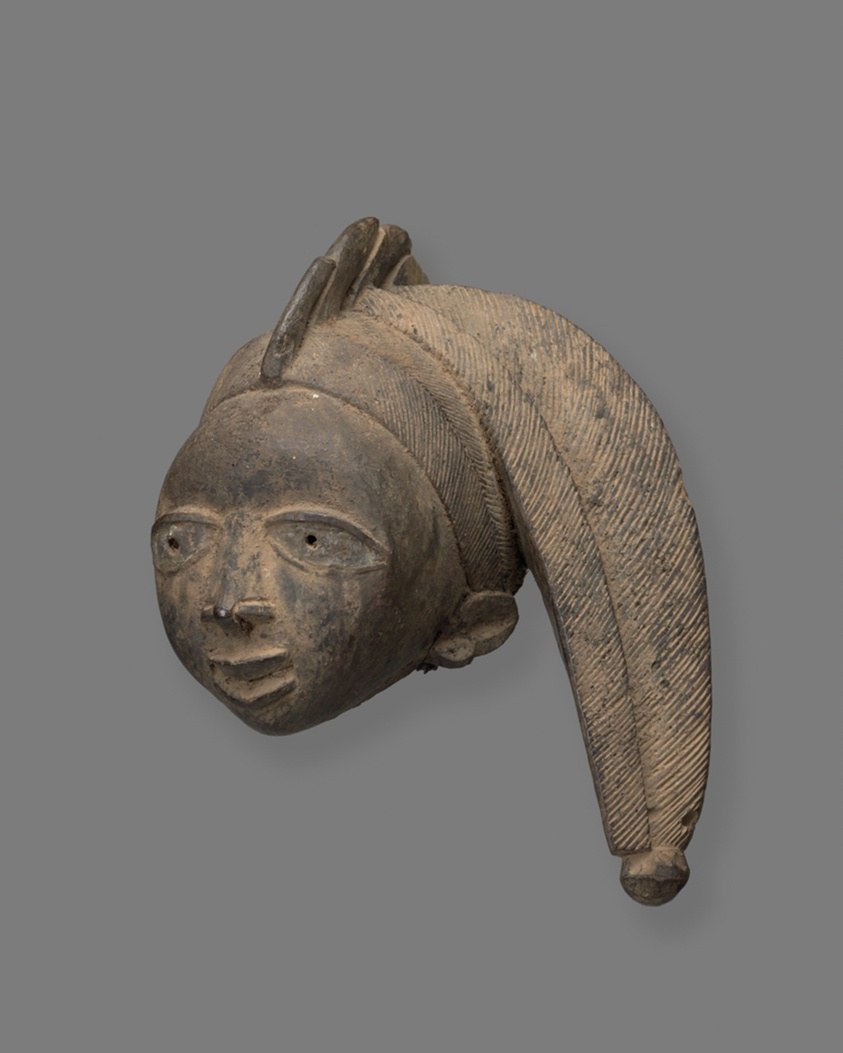
Headdress (Ago Egungun)
Ojerinde (died about 1914) Yoruba Abeokuta, Nigeria Coastal West Africa
- Medium:
- Wood and pigment
- Collection:
- Arts of Africa
- Source:
- Art Institute of Chicago
- Rights:
- Public domain — free to use, share and adapt.
- Recorded as:
- CC0 (Public Domain)
Egungun is one of Africa's most demanding and visually arresting dance forms, and the headdress itself is not mere decoration but an active component of the dancer's power and presence. For dancers and historians, this carved head and arm offer direct witness to the technical and aesthetic priorities of the tradition: how a carver interpreted and gave form to the ideal Egungun figure, what proportions and gestures were valued, and how the visible carved element supported the dancer's own movement and identity.
What you are looking at
A wooden sculptural head and arm fragment, carved in a warm tan stone or wood, depicts a human figure with simplified but naturalistic features. The face is frontal and composed: almond-shaped eyes with carved pupils, a straight nose, full lips formed in a subtle expression. The hair is rendered with fine linear striations in a style typical of Yoruba carving. Below the head, a long curved arm extends downward in a graceful arc, the forearm and hand carved with equally careful attention to anatomical form and surface pattern. The entire object reads as a fragment—perhaps once part of a full figure or mask—and displays the characteristic patina and surface wear of wood aged over a century and a half.
The dancing
The arm curves with a gentle elegance, the hand relaxed at the end of an extended reach. The posture suggests a body in motion or repose with an arm raised and extended behind or to the side—a gesture that opens the body outward. The head is set at a slight angle relative to the implied vertical axis of the torso, giving the figure a sense of turning or attention. The carving shows no sign of strain or effort; instead, the body reads as poised and controlled.
The dance depicted
This headdress is documented as Ago Egungun, a sculptural element worn within the Egungun masquerade tradition of the Yoruba peoples of Nigeria. Egungun dances are performed as part of veneration of the ancestors; the masquerader's identity is concealed beneath layered cloth and ornaments, and the dancer's movements—often rapid, spinning, and acrobatic—embody and honor the spiritual power of the dead. The carving does not show motion itself but rather a state of readiness or composure; the extended arm may reference the characteristic movements of Egungun dancers, whose limbs reach and extend in patterns that signal spiritual presence and authority.
How it was made
This is a carved wood sculpture, likely iroko or another dense Yoruba hardwood, finished with pigment (now largely faded or worn away). The work demonstrates the high technical skill of Ojerinde, a master carver whose style is characterized by precise anatomical observation within a formally simplified overall design. The carved lines that define the hair and the arm's musculature show control and patience; the sculpture was likely carved from a single block or assembled from carefully joined pieces. Objects of this caliber would have been commission work for families wealthy enough to commission elaborate masquerades.
About this work
Ago Egungun is a sculpted headdress component created by the Yoruba master carver Ojerinde in mid-nineteenth-century Abeokuta, Nigeria. It represents one element of a complete masquerade ensemble worn during Egungun celebrations—sacred dances in which ancestral spirits were invoked and embodied. The surviving head and arm fragment preserves evidence of both the formal sophistication of Yoruba sculptural tradition and the aesthetic vision that guided the making of objects meant to support some of Africa's most vigorous and virtuosic dance practices. This piece belongs in a gallery of dance in art because it was made not as an autonomous artwork but as functional equipment within an active and continuing sacred choreographic practice.
How to look at it
Examine the face closely: notice the carver's restraint—the features are simplified and geometric, yet the expression is alert and present. The almond eyes and composed mouth suggest a figure aware and dignified, not grotesque or fearsome. Now follow the extended arm: the curve is neither tense nor limp but held in a state of potential motion. This is a figure ready to move or about to complete a gesture. The Egungun dancer wearing this headdress would have embodied this same quality—controlled power, a body suspended between rest and explosive action.
The artist
Ojerinde (died ca. 1914) was a master carver of Abeokuta, in southwestern Nigeria, working during the late nineteenth century at a time when Yoruba carving traditions were being adapted and reinvigorated in response to colonial contact and new economic conditions. Ojerinde's work is distinguished by anatomical subtlety, refined surface detail, and a consistent formal language across many types of objects—divination bowls, figures, headdresses, and ceremonial equipment. His pieces are recognized by collectors and scholars as among the highest achievements of Yoruba carving and demonstrate the continued vitality of the tradition in the colonial period.
The period
The mid-nineteenth century was a time of significant transformation for Yoruba societies. Abeokuta itself was founded in the 1830s as a refuge for peoples displaced by conflict. During Ojerinde's working lifetime, the region was subject to increasing British commercial and political pressure, culminating in formal colonization in the 1890s. Despite these upheavals, Yoruba masquerade traditions remained vigorous; wealthy families continued to commission elaborate Egungun ensembles, and carvers like Ojerinde maintained high standards of technique and invention. The tradition of Egungun dancing continued uninterrupted, even as the broader political and economic context of Yoruba life changed profoundly.
Where it lives
This headdress component is held in the Arts of Africa collection at the Art Institute of Chicago, one of the major American holdings of Yoruba material culture. It was likely collected in the early twentieth century, after Ojerinde's death, as Western collectors and museums began acquiring African masquerade objects.
Dance in this work
Questions about this work
What is Egungun and who performs it?
Egungun is a sacred masquerade tradition of the Yoruba peoples of Nigeria and diaspora communities worldwide. Male members of families with Egungun lineage are initiated into the practice; they dress in elaborate costumes and perform as masked dancers during festivals and commemorations. The performances serve to honor ancestors and celebrate their continued spiritual presence and protection. Egungun dancers are known for acrobatic, rapid movements and a commanding physical presence.
How does a carver like Ojerinde relate to the dance?
Master carvers like Ojerinde were essential collaborators in the Egungun tradition. They created the headdresses, masks, and ornamental elements that made up the visible ensemble. A skilled carver understood not just technique but the aesthetic and spiritual ideals of the tradition; the carved head had to be beautiful and imposing enough to carry the dancer's authority and enhance his movements.
Is this a mask or a headdress?
Ago Egungun is technically a headdress rather than a face mask—it sits atop the dancer's head and does not conceal his face directly. It is worn as part of a complete ensemble that includes layers of woven and dyed cloth, additional carved ornaments, and regalia. The full costume renders the dancer anonymous and unrecognizable, embodying the ancestor rather than the man beneath.
Why is only the head and arm preserved?
This fragment likely represents the sculptural element of a larger object. Ago Egungun headdresses could be quite large and composite, made from multiple carved pieces. The head and arm may have been the most important carved elements, with the rest of the headdress built up from cloth, raffia, beads, and other materials that have not survived five centuries of wear and storage.
More dance artwork





