49 works in this view — arrow keys or swipe to move between them.
Dance in Art
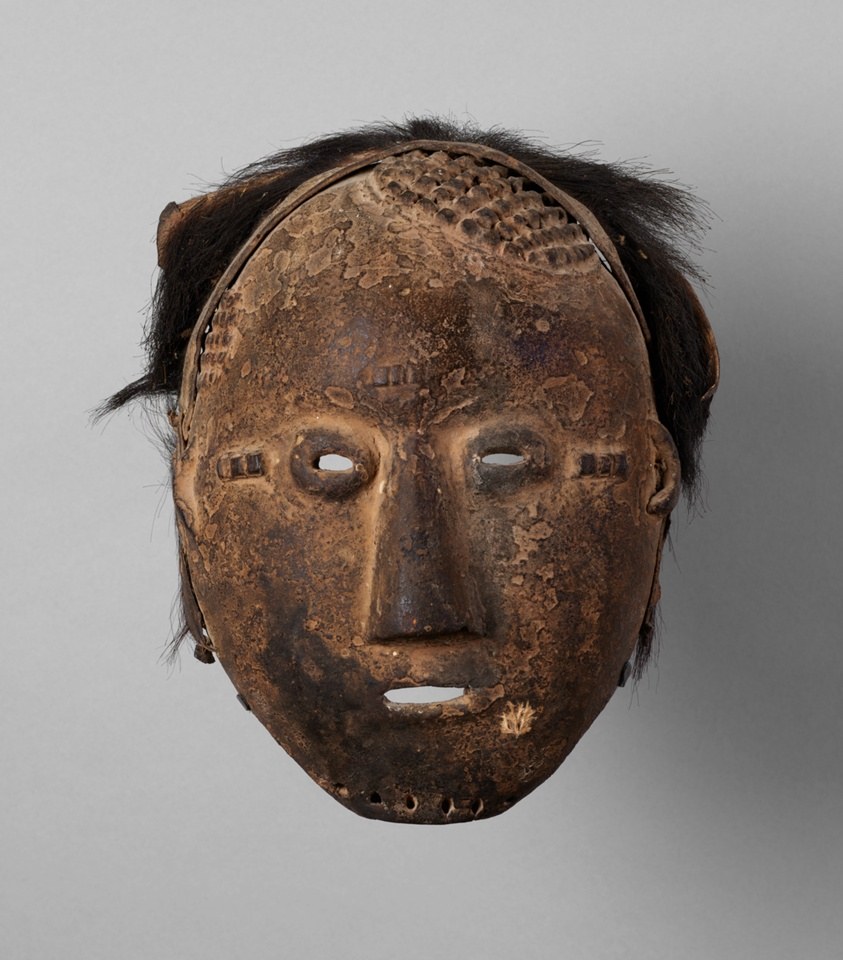
Face Mask
Possibly Attie/Atye/Akye or Adiukru Unknown Lagoons region, Côte d'Ivoire Coastal West Africa
- Medium:
- Wood, pigment, and fur
- Collection:
- Arts of Africa
- Source:
- Art Institute of Chicago
- Rights:
- Rights reserved by the holding institution — do not reuse without permission. Source record ↗
- Recorded as:
- AIC — rights reserved
This mask is evidence that in early modern West Africa, the visual and kinetic arts were inseparable: a master carver created the face that a dancer would activate through movement. It demonstrates the sophistication of African sculptural traditions at a moment when European museums were beginning to collect African art, often without understanding or crediting the dance contexts in which these objects functioned.
What you are looking at
This is a wooden face mask from coastal West Africa, carved with careful attention to human proportions and facial geometry. The face is spare and dignified: a broad, flattened plane with almond-shaped eye holes, a straight nose ridge, and a small rectangular mouth opening. The surface shows a network of finely incised linear patterns—crosshatching and geometric designs—that cover the forehead and cheeks, suggesting scarification or decorative marking. Real human hair, darkened with age, is attached at the sides and crown, giving the mask a startling presence. The wood has darkened to a rich brown, and the surface shows the wear and patina of considerable age and use. The mask was clearly meant to be worn: the internal volume and attachment points confirm this. The overall effect is contemplative and formal, less grotesque or exaggerated than many African masking traditions, instead approaching something like idealized human beauty.
The dancing
This is not a depiction of a dancer or dance movement, but rather a three-dimensional object designed to transform the wearer's head and face. The mask presents a static human countenance rather than capturing motion or a specific dance position. However, masks of this type and period were integral to masked dance performances, and the calm, frontal orientation suggests the mask was designed to be seen from the front—the viewing angle during face-to-face encounter or formal presentation within a ritual or dance context.
The dance depicted
This mask almost certainly functioned as part of a masked dance tradition in the Lagoons region of Côte d'Ivoire. The specific ethnic attribution (Attie/Atye/Akye or Adiukru) and coastal West African provenance place this within a complex region of masking cultures. Without documentary evidence of the specific dances this mask performed, we cannot name a particular dance genre. However, the refined carving, the integration of real hair, and the geometric scarification marks all suggest a mask of high status used in important ceremonial or social performances. The mask's restrained, humanistic style is consistent with West African traditions in which masks represent ancestors, spirits of place, or ideal human forms rather than caricatured supernatural beings. Whoever wore this mask moved through dance, but the mask itself shows us only the fixed face that greeted onlookers.
How it was made
The mask is carved from wood—likely a local West African hardwood—and shows the tool marks and surface finish of hand carving. The incised linear patterns were cut into the wood surface with a sharp instrument after the basic form was roughed out. Real hair (possibly human hair or animal fur) has been affixed to the sides and crown, probably using plant resin or another adhesive traditional to the region. This combination of carved wood and organic materials creates an object that bridges the sculptural and the wearable; it is designed to function as both artifact and costume piece. The craftsmanship indicates a specialist carver with considerable skill.
About this work
This mask is a West African wooden sculpture from the Lagoons region of Côte d'Ivoire, most likely created in the mid-to-late 19th century and used as the face-covering element of a masked dancer's costume. It belongs to a rich tradition of African masking in which carved face coverings transformed dancers into spirits, ancestors, or idealized human forms, allowing performers to move in ritual or social space as something other than themselves. The mask's restraint and humanity—the careful proportions, the fine geometric incising, the addition of real hair—mark it as a work of considerable artistic sophistication.
For a gallery of dance in art, this mask documents a fundamental fact: that masked dance was (and remains) central to many African cultures, and that the face worn by the dancer was a crafted artwork in itself. The mask is not a depiction of dance, but a tool of dance, and its presence in a dance collection honors the masking traditions in which carvers and dancers collaborated to create performances.
How to look at it
Approach this mask frontally, as a wearer would have presented it to onlookers during a performance. Notice the careful geometry of the face: the symmetry of the eye holes, the straight nose ridge, the proportions that aim toward idealized humanity rather than exaggeration. Look closely at the incised patterns on the forehead and cheeks—these are fine, controlled marks made by a skilled hand, suggesting either scarification marks or decorative designs that held meaning in the carver's culture. The addition of real hair transforms the mask from pure sculpture into something that mimics actual human presence. Consider that a dancer moving in this mask would have seen only through those eye holes, and that their movement would have animated the mask's fixed, contemplative expression.
The artist
The maker is unknown, as is typical for African masks of this period. The attribution to the Attie, Akye, or Adiukru peoples of the Lagoons region suggests a carver working within a specific cultural and geographic tradition, but individual names and biographical details are not recorded in the catalogue. What is clear from the mask's execution is that the carver possessed advanced technical skill, command of proportion, and familiarity with the aesthetic conventions of their region.
The period
This mask was created around 1875, a moment of profound change for West African societies. By the 1870s, European colonial presence in Côte d'Ivoire was intensifying, though the Lagoons region remained primarily under local control. Masking traditions in this region have deep historical roots and would continue to evolve and persist through the colonial period and beyond. In the 1870s, African sculptural traditions were still relatively unknown to European audiences and museums; this mask would have been part of living cultural practice in its origin context before entering a museum collection.
Where it lives
The mask is held in the Arts of Africa collection at the Art Institute of Chicago. It is documented as coming from the Lagoons region of Côte d'Ivoire and is attributed to the Attie, Akye, or Adiukru peoples, though the specific circumstances of its collection and the path by which it entered the museum are not detailed in the catalogue record provided.
Dance in this work
Questions about this work
How do we know this mask was used in dance?
Masks of this type and period from the Lagoons region of West Africa were integral to masked dance traditions. The carved face was designed to be worn, and masks served as a dancer's transformed identity. However, this particular mask's specific dance context—which dances it performed, what spirits or ancestors it represented, what movements accompanied it—cannot be determined from the object alone without ethnographic or historical documentation.
Why is real hair attached to the mask?
The hair makes the mask more lifelike and more powerful as a transformation device. In many African masking traditions, the addition of organic materials (hair, fiber, leather) enhanced the mask's ability to convince viewers that they were encountering a spirit or ancestor, not just a carved object. Hair also served practical and aesthetic purposes in costume design, allowing the mask to integrate with the dancer's body and overall appearance.
What do the incised patterns mean?
The linear patterns covering the forehead and cheeks likely represent scarification marks, which held cultural significance in many West African societies as markers of identity, status, or beauty. Alternatively, they may be purely decorative geometric designs. Without ethnographic documentation, we cannot specify their exact meaning, but their careful execution shows they were intentional and important to the mask's identity and power.
Why is this object in a dance collection?
Masks are central to the history of dance in many African cultures. A mask is not a passive artwork to be looked at; it is a tool that enables transformation and movement. Including masks in a dance collection acknowledges that the face worn by a dancer is as much a part of the dance as the body's movement.
More dance artwork





