49 works in this view — arrow keys or swipe to move between them.
Dance in Art
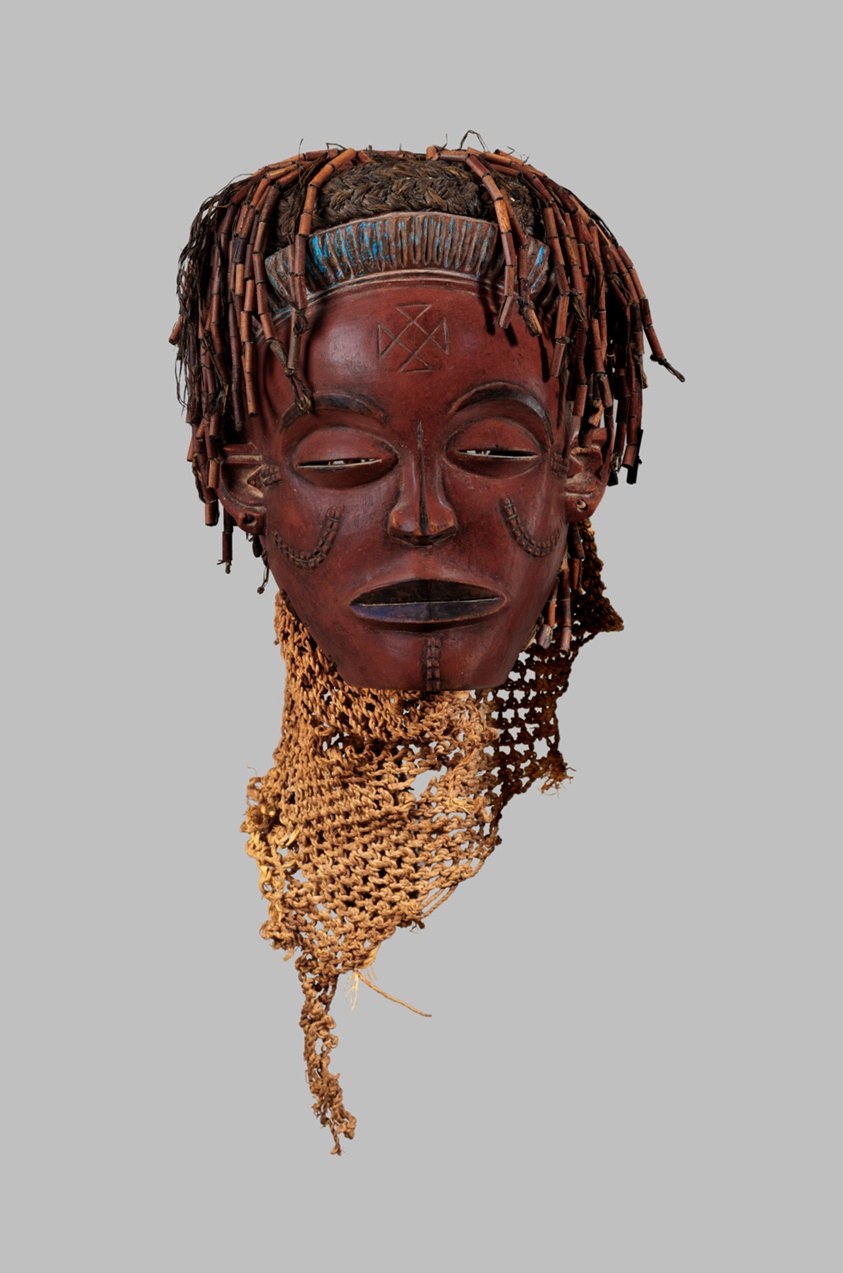
Female Face Mask (Mwana Pwo)
Chokwe Angola or Democratic Republic of the Congo Central Africa
- Medium:
- Wood, fiber, beads, and pigment
- Collection:
- Arts of Africa
- Source:
- Art Institute of Chicago
- Rights:
- Rights reserved by the holding institution — do not reuse without permission. Source record ↗
- Recorded as:
- AIC — rights reserved
For dancers and choreographers, this object demonstrates how masks function as partners in performance rather than mere disguises—the carved face is a fully realized artistic statement that constrains and shapes what the wearer's body can express. For historians, the *Mwana Pwo* mask is central evidence of gender, ritual, and artistic authority in Central African societies, revealing how women were imagined, honored, and integrated into ceremonial life through the bodies of men and the hands of male artists.
What you are looking at
This is a wooden mask representing a female face, carved and decorated with the materials and techniques of Chokwe artistry. The face is rendered in dark reddish-brown wood, with a smooth, idealized expression: closed eyes indicated by horizontal slits, a composed mouth, and scarification patterns incised into the cheeks. The forehead bears a geometric cross-hatched design in lighter pigment. Above the face rises an elaborate headdress of braided fiber—dark cordage bundled and looped to suggest an ornate coiffure or crown, with decorative elements at the apex. Below the chin hangs a long, fringed textile collar or bib, possibly raffia or plant fiber, that tapers to a point. Inlaid shell or bone beads punctuate the lower collar. The entire object is compact and deeply carved, designed to be worn rather than viewed as a freestanding sculpture.
The dancing
This is not a depiction of a moving body but a mask—a three-dimensional form meant to transform the wearer into an idealized female ancestor or spirit. The face itself shows no movement or emotion; it is composed and formal, with closed eyes and a level gaze. The naturalistic human proportions (nose, lips, cheekbones rendered with anatomical care) contrast with the abstracted treatment of the elaborate headdress and collar, which extend far beyond the human head and would impose their own silhouette and weight on the dancer wearing it.
The dance depicted
The Chokwe peoples of Angola and the Democratic Republic of the Congo created masks for several ceremonial contexts, most notably the mukanda (initiation) and the mwanangana (female initiation) societies. The *Mwana Pwo* (meaning 'maiden' or 'young woman') mask depicts an idealized female beauty and is worn by male dancers in ritual performance, often as part of a sequence that honors women, marks transitions between life stages, or celebrates fertility and social order. The mask's closed eyes and serene expression suggest a spiritual or ancestral presence rather than an active performer; the dancer's own movement and the music of attendant musicians would animate the mask's meaning. This particular example shows characteristics consistent with 19th-century Chokwe carving—the refined proportions, the integrated hair and collar elements, and the use of imported beads alongside traditional materials.
How it was made
The mask is carved from wood (likely hardwood local to the region) and inlaid with textile fibers, beads, and pigment. The face itself is carved almost fully in the round, with the eyes, mouth, and nostril carved as negative space to create shadow and definition. The hair and headdress are built up in layers of fiber—possibly raffia or other plant cordage—bundled and attached to the wooden head. The collar or bib is a separate woven or netted textile element, possibly dyed and studded with imported shell or bone beads that signal wealth and prestige. Pigment (blue, white, and red ochre visible in the photograph) was applied to highlight scarification and to define the geometric decoration on the forehead. The integration of carving, fiber work, beading, and pigmentation suggests the mask was a high-status object, likely made by a specialist carver or within a family lineage of carvers.
About this work
This is a Chokwe *Mwana Pwo* mask—a female face mask created for use in ritual and ceremonial dance among the peoples of Central Africa. It represents not a individual woman but an idealized, spiritualized female presence: an ancestor, a protective spirit, or an embodiment of feminine virtue and beauty. The mask would have been worn by a male dancer, whose movement and the surrounding music and voices would complete the performance and activate its meaning within the community. The work exemplifies a tradition of masquerade in which the boundary between human and spirit is crossed through the donning of a carved object; the stillness and composure of the mask's face stand in purposeful contrast to the kinetic energy of the dancer's body beneath it.
How to look at it
Attend to the face itself: the closed eyes and composed mouth convey a sense of spiritual presence and stillness that contrasts sharply with the elaborate, textured abundance of the headdress and collar. The scarification marks on the cheeks and the geometric pattern on the forehead are signs of human identity and beauty, yet the overall effect is abstracted and otherworldly. Notice how the carved face is relatively small compared to the mass and volume of the hair and collar—this imbalance is intentional, as it would have made the mask seem larger and more imposing when worn on a dancer's head. The beads on the collar, if examined closely, likely represent a considerable investment of labor and material wealth, marking the mask as a prestige object.
The artist
The mask is attributed to the Chokwe people, a Bantu-speaking group with a long and distinguished tradition of wood carving and masquerade. Chokwe artists were renowned across the region for the refinement and realism of their carved faces, and their masks were traded and imitated by neighboring peoples. Individual carvers worked within family lineages and guilds, accumulating knowledge and prestige over a lifetime. By the 19th century, when this mask was likely made, the Chokwe had experienced significant contact with Portuguese traders, which brought new materials (such as imported beads) and new markets for their work, without fundamentally altering the forms and functions of their masks.
The period
The mid-to-late 19th century was a period of intensive colonial contact and trade in Central Africa, yet Chokwe artistic traditions remained robust and largely autonomous until the early 20th century. Masquerade and initiation rites remained central to community identity and social reproduction, and the creation of masks continued to be governed by strict protocols and ritual specialists. In the broader context of African art history, this period marks the moment when African masks and sculpture began to be collected and removed from their communities by European traders and colonial officials—often under circumstances of coercion—and relocated to museums and private collections in Europe and America. The mask's presence in a Western collection reflects both the esteem in which Chokwe carving was held and the violence of the colonial encounter.
Where it lives
The mask is held in the Arts of Africa collection at the Art Institute of Chicago. It is catalogued as a *Mwana Pwo* face mask created by the Chokwe people, dated to approximately 1875. No information on the mask's specific route into the collection, the name of the carver, or the precise village of origin is recorded.
Dance in this work
Questions about this work
Who wore this mask and when?
The *Mwana Pwo* mask was worn by male dancers during ceremonial performances, often as part of initiation rites, funerals, or other important community occasions. The mask was not permanently owned by one dancer but was typically held by a society or family and passed on, repaired, and re-used across generations. The moment when the mask was worn was the moment of performance—a moment of transformation in which the wearer embodied a feminine spirit or ancestor.
What do the scarification marks mean?
The incised lines on the cheeks are scarification patterns—deliberate marks that served as signs of ethnic identity, lineage, and beauty. Among the Chokwe and neighboring peoples, scarification was (and is) a widespread practice, applied to infants or young people as a permanent mark of belonging. On a carved mask, these patterns identified the figure as Chokwe and as a woman of status and beauty.
Why are the eyes closed?
The closed eyes suggest that the mask represents a spirit or ancestor rather than a living person. In many African traditions, spirits and the dead are depicted with closed or abstract eyes, as they perceive and move in a realm beyond the visible. The closed eyes also give the wearer a limited field of vision, requiring the dancer to rely on hearing, proprioception, and the guidance of other performers—all of which heighten the sense of possession or transformation.
Is this mask still used in performance today?
Historical masks like this one are typically housed in museums and are no longer used in active performance, both because they are considered cultural heritage and because the social contexts that generated them have been disrupted by colonialism and modern change. However, the *Mwana Pwo* tradition continues in some Chokwe communities, and contemporary carvers create new masks in the traditional style for ceremonies and public performances.
More dance artwork





