49 works in this view — arrow keys or swipe to move between them.
Dance in Art
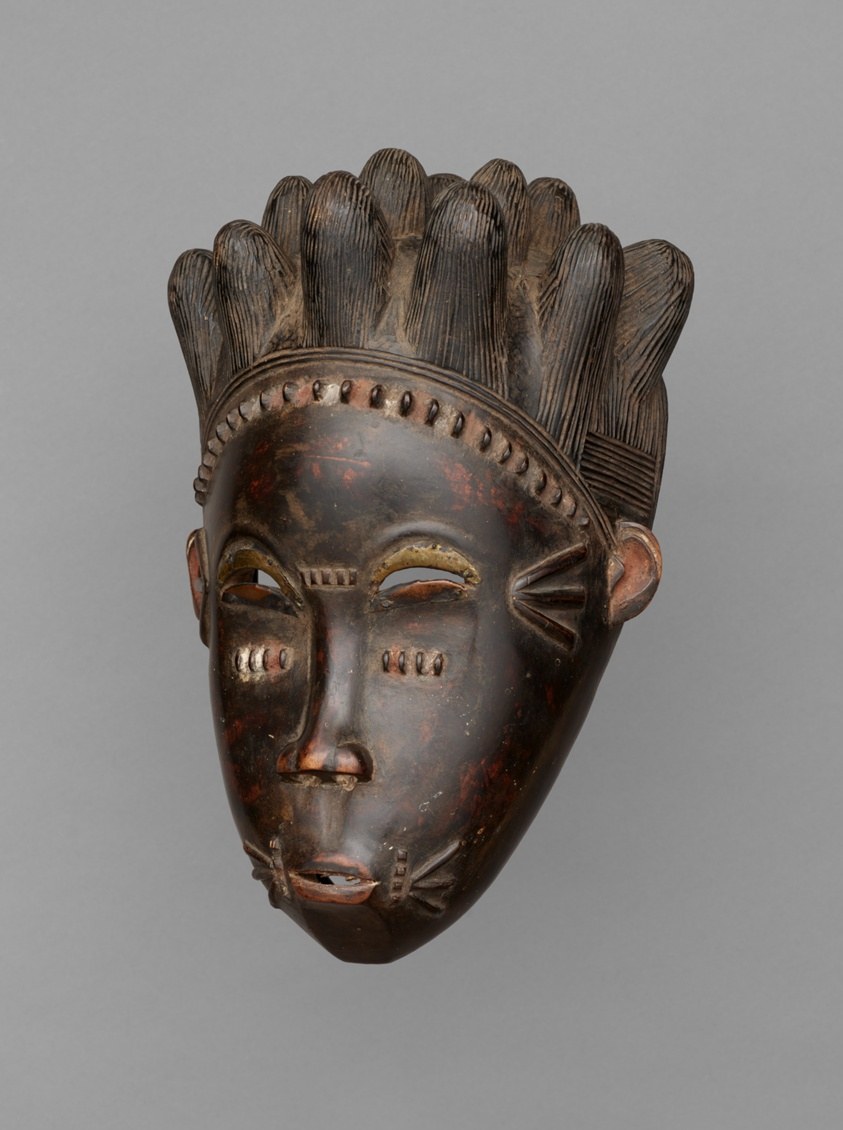
Female Face Mask (Ndoma)
Baule Côte d'Ivoire Coastal West Africa
- Medium:
- Wood, copper alloy, and pigment
- Collection:
- Arts of Africa
- Source:
- Art Institute of Chicago
- Rights:
- Rights reserved by the holding institution — do not reuse without permission. Source record ↗
- Recorded as:
- AIC — rights reserved
This mask is essential evidence of West African performance traditions that shaped global dance and theatrical practice. It shows that masquerade was not primitive or unsophisticated but a complex collaborative art form requiring skill from carver, performer, and community. The copper inlay and careful proportioning demonstrate that African sculptural traditions were not merely functional or symbolic but aesthetically ambitious on the terms of their own cultures.
What you are looking at
A wooden face mask carved in the round, displaying a stylized human countenance with an elaborate crown-like headdress. The face itself is relatively naturalistic: almond-shaped eyes with inlaid copper alloy that catches light, a straight nose, and full lips rendered with precision. Most striking is the tall, fan-shaped crown rising from the head, composed of individual carved wooden elements radiating upward like a crest or plumage. The entire surface shows evidence of use and age—darker patina in recesses, lighter wear on high points, and what appears to be red ochre or pigment residue in places. The mask is three-dimensional, designed to be worn or carried rather than viewed flat against a wall. Small holes pierced at the cheeks and around the crown suggest attachment points for costume elements or fastening mechanisms. The craftsmanship is assured: the proportions are harmonious despite the stylization, the carving clean and controlled.
The dancing
This is a mask rather than a representation of a dancer's body, so traditional movement analysis applies differently. However, the upright poise and frontal symmetry suggest a standing figure of dignity. The headdress tilts neither forward nor back but maintains vertical assertion. The expression is composed and solemn—the inlaid eyes gaze straight ahead with an almost meditative quality. The carved ears are simplified but functional. This is not a grotesque or comedic mask; the proportions and expression convey presence and authority.
The dance depicted
Baule mask traditions, particularly the ndoma type, were integral to masquerade performances central to Baule social life and ritual practice in Côte d'Ivoire. Masks danced in contexts ranging from celebrations and entertainment to initiation rites and commemoration of the dead. The elaborate crown suggests a figure of importance or spiritual authority. The ndoma mask type typically appeared in dance contexts involving sustained, dignified movement—the wearer's body moving beneath and around the mask's visual declaration rather than the mask itself moving dramatically. This mask's formal bearing and refined carving indicate a performer of rank or a spirit of consequence, likely danced by an accomplished masquerader whose movement would have been measured and controlled to display the mask's sculptural properties.
How it was made
Wood carved in relief and full volume, with inlaid copper alloy eyes and traces of pigment—red ochre visible particularly in surface recesses. The carving demonstrates command of the adze or knife, with careful attention to volumes and a finish that shows age and use. The inlaid copper (likely cast or sheet) adds reflectivity and visual interest; at the time of carving, these eyes would have been brilliant against the darker wood. The pigment application appears to have been additive rather than incised, applied to the finished form. This object shows both the skill of its maker and the wear of ceremonial use, suggesting it was not a display piece but an active tool of performance.
About this work
This is a Baule face mask from coastal West Africa, carved in wood with copper alloy and ochre inlay, dating to the late 19th century. It represents the ndoma mask type, which functioned as a central prop in Baule masquerade performances—ceremonial or celebratory dances in which the mask's wearer's body became the vehicle for a spirit or character of authority and composure. The tall, fan-like headdress and refined facial features mark it as a mask of distinction, likely worn by an experienced performer. Unlike more expressionistic mask traditions, the ndoma's power derives from formal bearing and measured movement rather than dramatic gesture. The object sits at the intersection of sculpture and performance: it is simultaneously a complete artwork when viewed as a carving and a partial artwork whose full identity emerges only when worn and danced.
How to look at it
Approach this mask as you would a theatrical prop photographed in stillness: the work you see is only part of the design. Attend to the crown's dramatic vertical thrust and the face's calm frontality—imagine how that silhouette would move through space when the wearer turned. Notice the eyes: the inlaid copper would have reflected firelight or daylight, making the mask appear to be looking back at the spectators. The proportions are naturalistic but slightly enlarged, suggesting that at arm's length or in motion, the mask would seem both human and other. The surface wear is instructive: it testifies to use and respect over generations, not to damage.
The artist
The mask is attributed to the Baule people, whose artistic traditions are among the most celebrated in African sculpture. Baule carvers (typically men) developed distinctive styles within broader regional and cultural conventions. Masks, figures, and regalia were commissioned for specific occasions or to embody particular spirits or ancestors. While individual carvers' names are rarely preserved in historical records, the quality and finish of this mask suggests training in a recognized workshop or lineage of makers. The Baule maintained a sophisticated understanding of surface, volume, and proportion that influenced European modernists upon contact.
The period
The late 19th century (circa 1875) was a period of intensive colonial contact with Côte d'Ivoire, yet Baule masquerade traditions remained vigorous and central to cultural life. At this time, the Baule were consolidating their identity and territorial control in the region. The mask's fineness suggests that despite external pressures, demand for performance regalia remained high and carvers continued to produce works of considerable refinement. In Europe and America, African masks were beginning to circulate through colonial collections and trade networks, though their function as performance objects remained largely misunderstood in Western museums until well into the 20th century.
Where it lives
The mask is held in the Arts of Africa collection at the Art Institute of Chicago. It is catalogued as a female face mask (ndoma) of the Baule people, Côte d'Ivoire, dating to approximately 1875. Such works entered Western collections primarily through colonial-era acquisition and trade.
Dance in this work
Questions about this work
Who wore this mask and when?
This mask was worn by a Baule masquerader, likely a male performer of experience and standing, during ceremonial or celebratory occasions. The wearer would have been invisible beneath a costume of cloth, raffia, or other materials; only the mask, the headdress, and the costumed body would have been visible to the audience. The mask could have been worn repeatedly across years or decades, passed down or inherited, or commissioned for a specific event.
What does the fan-shaped crown mean?
The crown likely signifies rank, spiritual authority, or a particular character or spirit in the Baule masquerade system. Similar headdresses appear in many West and Central African mask traditions, often indicating a senior or commanding figure. The specific meaning would have been understood by the Baule community in context—the mask's appearance combined with the wearer's movement and the occasion would have communicated a complex social or spiritual message.
Why does the mask have copper eyes?
The inlaid copper (likely sheet copper or cast alloy) serves both aesthetic and functional purposes. Visually, it catches and reflects light, making the mask appear alive or watchful—a crucial effect for a performance object meant to command attention and convey presence. Practically, copper is durable and stands out against darker wood, ensuring the eyes are visible even at a distance or in shadowed performance spaces.
Is this a death mask or a ceremonial mask?
This is a ceremonial mask, not a death mask, though Baule masquerades sometimes involved commemoration of the deceased. The refinement and scale suggest it was designed for performance—to be worn and moved through space—rather than to represent or contain the physical features of a specific individual after death. Its form and iconography align with ndoma masquerade traditions, which could include celebratory, initiatory, or commemorative functions.
More dance artwork





