49 works in this view — arrow keys or swipe to move between them.
Dance in Art
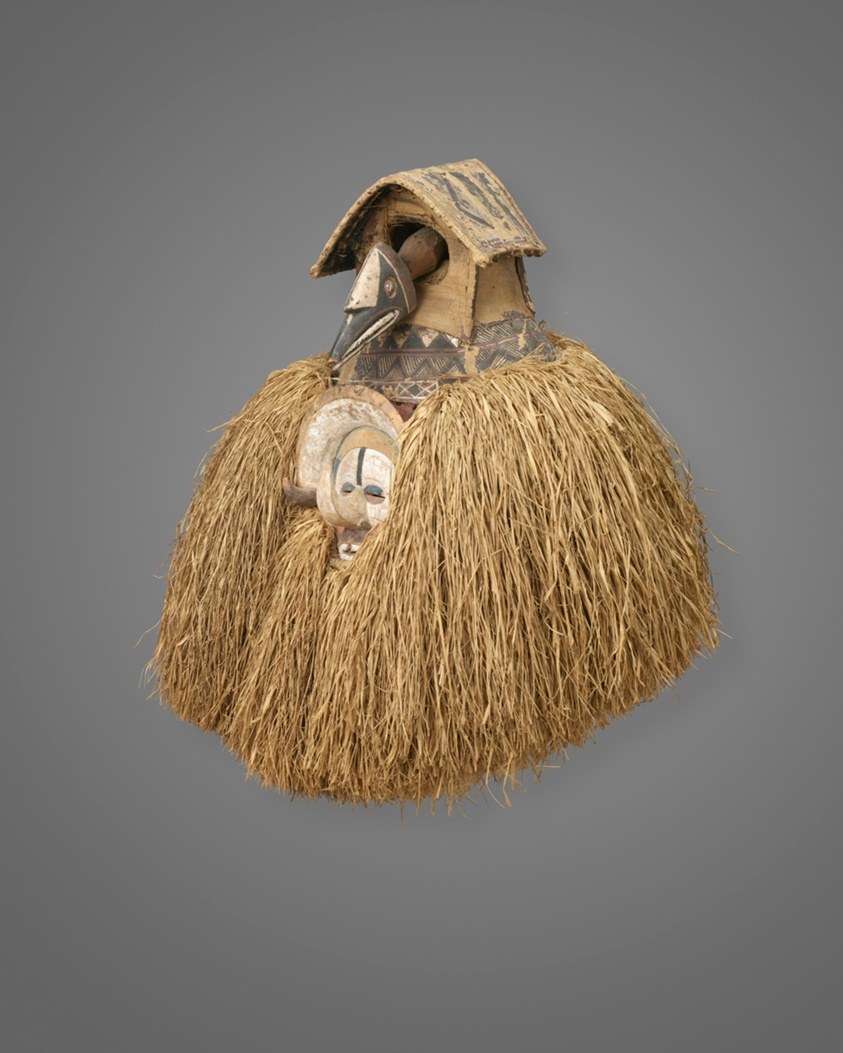
Helmet Mask (Kholuka or Mbala)
Yaka Bandundu region, Democratic Republic of the Congo Central Africa
- Medium:
- Wood, raffia, and pigment
- Collection:
- Arts of Africa
- Source:
- Art Institute of Chicago
- Rights:
- Rights reserved by the holding institution — do not reuse without permission. Source record ↗
- Recorded as:
- AIC — rights reserved
For dance historians, this object demonstrates how masquerade traditions use costume engineering to completely transform a dancer's movement vocabulary and visual presence. The volume and weight of the fiber skirt would force a particular quality of movement—slow, deliberate, stately—making the costume itself a choreographic tool. For artists and scholars of African sculpture, it shows how mask-making and textile work collaborate to create a unified ceremonial artwork that only fully 'lives' when worn and danced.
What you are looking at
This is a helmet mask, a wooden sculptural object that sits on the crown of a dancer's head rather than covering the face. The mask depicts a bird—likely an eagle or similar raptor—with a pronounced, hook-like beak, rendered in dark wood with incised linear patterns suggesting feathers or scales. The head is crowned by a roof-like crest. Below this wooden head sculpture hangs a voluminous, roughly-textured fiber skirt, woven from raffia or similar plant material in a natural tan-gold color. The fibers cascade down in a loose, shaggy fringe, creating considerable volume and visual weight. A smaller, pale wooden face mask—showing human features with geometric markings—is embedded or attached at the breast level of the costume, emerging from the fiber mass. The whole assemblage is designed to transform a dancer's silhouette into something avian and otherworldly, with the heavy fiber skirt obscuring the dancer's actual body beneath.
The dancing
This is not a figure in the conventional sense, but a complete costume object. The mask sits vertically atop the wearer's head, positioning the bird head high and forward. The fiber skirt would envelope the dancer's torso and legs, completely obscuring lower-body movement and footwork. The second mask at chest height suggests the costume carries multiple symbolic presences—perhaps representing an ancestor or spirit companion to the primary bird figure. The weight and volume of the fiber mass would constrain movement, making the dancer move deliberately and heavily rather than with quick articulation.
The dance depicted
This is a helmet mask of the Yaka people of the Bandundu region in what is now the Democratic Republic of the Congo. Such masks are worn in ceremonial dances, typically performed by initiated men. The bird form—possibly representing a powerful or sacred animal—suggests ritual purpose, likely connected to initiation rites, funerary practices, or spiritual mediation. The dual masks (bird and human face) may represent the living dancer and an ancestral or spiritual presence. Yaka masquerades traditionally featured slow, stately movements that emphasized the mass and presence of the costume rather than technical footwork, with the dancer's actual body becoming secondary to the sculptural costume.
How it was made
The object is carved from wood and assembled with raffia fiber. The wooden elements show evidence of hand-carving, with the beak, crest, and facial features shaped from solid wood, then likely darkened with pigment or stain. The linear patterns are incised by hand. The raffia is attached to a wooden support structure and arranged to create maximum volume and visual impact. This is a functional costume object designed to be worn and seen in motion during performance, not a display piece; the fiber shows wear and age, consistent with use rather than being a pristine museum object.
About this work
This is a mask-costume ensemble from the Yaka people of Central Africa, designed to be worn on the head and body during ceremonial dances. The work demonstrates the sculptural sophistication of Central African masquerade traditions, where the entire clothed body becomes a composite artwork combining carving, fiber work, and pigment. The dual masks—a bird head and a human face—speak to Yaka cosmology, likely representing communication between the visible and spirit worlds. As a functional dance costume, it belongs in dance history as evidence of how African ceremonial practice creates spectacular visual and kinetic experiences through the manipulation of the dancer's silhouette, scale, and texture, making the individual body into a vehicle for collective spiritual and social meaning.
How to look at it
Attend first to the complete silhouette: the object is designed to be seen from a distance during performance, with the elevated bird head and expansive fiber mass creating a striking visual profile. Notice how the dual masks work symbolically—the powerful bird at the top, the human face at the breast, suggesting a dialogue between species or worlds. Consider how a dancer wearing this costume could move: the weight of the fiber would pull downward, the crest would catch light and shadow, and the individual dancer would become almost invisible, transformed into an animal and ancestral presence. The incised patterns on the wooden head would become readable only at closer range, suggesting the mask performs differently depending on viewing distance.
The artist
The Yaka are a Bantu people historically located in the Kasai region of the Congo Basin. The masquerade traditions they developed, including such helmet masks, are central to male initiation rites and community spiritual practice. These masks and their associated dances have been documented as among the most visually striking examples of Central African ceremonial art. Individual carvers maintained workshop traditions passed down through apprenticeship, though specific makers' names are rarely recorded in colonial-era collecting.
The period
This mask dates to approximately 1875, a period of intense European colonial expansion into Central Africa. The Yaka had maintained independent masquerade practices for centuries; this particular object was likely collected during the early phase of European presence in the Congo. By the late 19th century, such masks were beginning to enter European museums and private collections, often removed from active ceremonial use. At the same time, within Yaka communities, these masquerades remained vital to social life, initiating young men, managing spiritual forces, and performing social commentary. The date 1875 may reflect either the object's actual making or the date of collection; this distinction matters for understanding whether the mask shows pre-colonial or early-colonial-era technique and style.
Where it lives
The object is housed in the Arts of Africa collection and comes to the museum via the Art Institute of Chicago (indicated by source code 'aic'). This is a functional ceremonial object that has entered a Western art museum, a transition common for African masquerade pieces collected in the colonial period. Its classification here reflects recognition that such masks are artworks worthy of study alongside painting and sculpture.
Dance in this work
Questions about this work
How does a dancer see and breathe while wearing this mask?
The mask sits on top of the head rather than covering the face, so the wearer's face remains visible and can breathe freely. The bird head rises above the dancer's actual head, supported by a wooden frame structure. The volume of the fiber skirt may obscure lower vision, but the dancer can navigate by looking down and relying on spatial knowledge of the performance space.
What do the two masks mean?
Yaka cosmology often acknowledges both visible and spirit worlds. The bird head at the crown likely represents a powerful spiritual force or ancestor animal. The human face at the breast may represent the living man wearing the mask, or another ancestral presence. Together, they suggest the dancer is a meeting point between worlds, not simply an individual performer.
Who would wear this mask and when?
Yaka helmet masks were worn by initiated men during specific ceremonial occasions, primarily during initiation rites for young men (the mukanda), but also during funerary rites and community gatherings. Wearing the mask was a privilege of rank and initiation, restricted to men who had completed their own initiation into secret societies.
How does the costume change the way a person moves?
The considerable weight and volume of the fiber skirt would dramatically alter movement quality. A wearer would move slowly and deliberately, with emphasis on upper-body presence and sculptural effect rather than quick footwork. The costume becomes part of the choreography, mandating a particular movement vocabulary.
More dance artwork





