49 works in this view — arrow keys or swipe to move between them.
Dance in Art
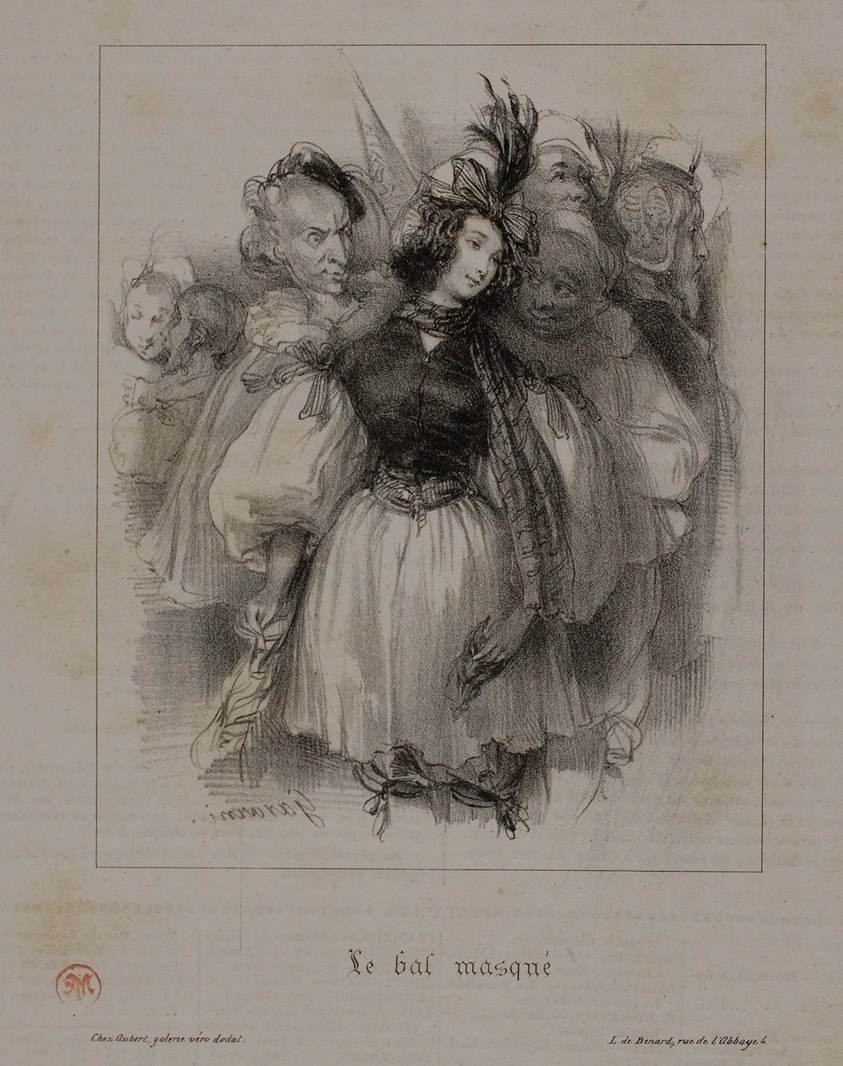
The Masked Ball
Paul Gavarni French, 1804-1866
- Medium:
- Lithograph in black on ivory wove paper
- Collection:
- Prints and Drawings
- Source:
- Art Institute of Chicago
- Rights:
- Public domain — free to use, share and adapt.
- Recorded as:
- CC0 (Public Domain)
This work is essential evidence of how non-dance specialists understood and depicted the masked ball as a dance culture occasion. Gavarni's lithograph reveals what interested visual commentators about the ball: not technical dance skill but social performance, gender dynamics, and the erotic potential of anonymity and costume. For historians of sociability and embodied culture, the image documents the aesthetic and behavioral codes that governed upper-class encounters in the era.
What you are looking at
A lithograph depicting a crowded masked ball in progress. At the center stands a young woman in a dark corseted dress with a voluminous pale skirt, wearing an elaborate feathered headdress and mask. She is surrounded by a press of male and female figures in period dress—some in light robes, others in darker coats—all wearing masks. The composition is dense and animated, with bodies overlapping and angling toward the central female figure. The lithographic technique creates soft modeling through hatching and wash, giving the scene a theatrical haze. The figures occupy a shallow pictorial space, compressed forward toward the viewer, which heightens the sense of crowded gaiety. At the bottom of the print sits what appears to be discarded flowers or greenery, a detail that suggests the revelry and disorder of the ball.
The dancing
The central woman stands in a pose of modest reserve despite her ornate costume, her body upright and frontal. The surrounding figures lean and gesture toward her in attitudes of attention and flirtation—some with arms extended or bent at the elbow in animated conversation. The male figures display a range of postures suggesting movement and social interaction: some are caught mid-gesture, others in profile. The overall effect is one of social circulation rather than coupled dancing; this is a promenade and a scene of courtship rather than a formal dance pattern.
The dance depicted
This is not a depiction of structured social dancing but rather a masked ball as a theatrical social event—a setting where courtship, disguise, and theatrical display were the principal activities. The masked ball was a central feature of aristocratic and upper-middle-class social life in 18th and early 19th century Europe, particularly popular in Paris. Dancers or musicians are not the focus; instead the image captures the social circulation, the masked anonymity, and the erotic tension of the occasion. No specific dance form is being performed; the work documents a social institution and the gender dynamics it enabled.
How it was made
This is a lithograph printed in black on cream wove paper. Lithography, a technique perfected in the early 19th century, allowed artists to work directly on stone with a greasy crayon, producing soft tonal effects through hatching and wash impossible in wood engraving. The stone's surface is visible in the plate tone, and the artist has exploited the medium's capacity for texture and atmospheric effect. As a lithograph, this would have been circulated in editions, making it accessible to a broad educated public; it is the work of a reproductive art form designed for periodical publication and album distribution, not a unique work.
About this work
Gavarni's *Le Bal masqué* is a satirical social document disguised as a theatrical scene. The masked ball—a crucial institution of upper-class sociability in early 19th-century Paris—becomes a stage for the observation of courtship ritual, social hierarchy, and gender performance. The work sits at the intersection of theater, social satire, and dance culture, documenting not a dance form itself but the social occasion in which dancing, flirtation, and masked performance converge. For the dance historian, it offers evidence of how the masked ball functioned as a site of social choreography: the unscripted circulation of bodies, the codes of approach and retreat, the theatrical display of costume and anonymity.
How to look at it
Attend first to the central female figure and the geometry of desire surrounding her: every other body angles toward her, creating a convergence that documents the social rules governing interaction at such events. Notice the range of costume: feathered headdresses, heavy robes, light gauzes—the visual excess and sartorial display that justified the occasion. The lithographic surface itself tells you something about circulation and audience: the soft tonal effects and detailed costume study suggest a work made for publication in fashion journals and albums, not for fine art exhibition. The title announces the subject plainly—this is a scene to be read as social documentation, not as a record of dance technique.
The artist
Paul Gavarni (1804–1866) was a French lithographic artist and illustrator of exceptional talent, celebrated for his satirical depictions of Parisian social life. He worked extensively for periodicals including *La Mode* and *Le Charivari*, producing thousands of lithographs documenting the manners, fashions, and follies of contemporary society. His style combined precise observation of costume and social detail with caricatural exaggeration; he was a social satirist first and foremost. The masked ball was a recurring subject in his work, as it allowed him to observe and critique the performative aspects of upper-class sociability.
The period
The masked ball experienced a major revival in European high society during the 1820s–1840s, the period of Gavarni's greatest activity. These events were partly nostalgic recreations of 18th-century aristocratic ritual, partly expressions of Romantic-era interest in costume, disguise, and theatrical identity. The ball accommodated social mobility and gender transgression in ways that ordinary society did not; it was simultaneously a site of erotic possibility and social anxiety. In visual culture, the masked ball became a standard subject for illustrators and novelists documenting modern urban life. Gavarni's print captures this moment of fascination with the ball as a social institution and visual spectacle.
Where it lives
This lithograph is held in the Prints and Drawings collection of the Art Institute of Chicago. It is a reproductive print, likely one of a numbered edition, designed for circulation through periodicals or album publication in the mid-19th century.
Dance in this work
Questions about this work
Is this depicting an actual dance?
Not a choreographed dance form. This is a masked ball, a social occasion at which dancing occurred but which was primarily structured around courtship, display, and social circulation. The image captures the promenade and social interaction, not a quadrille or waltz pattern.
What is the feathered headdress and why is it so prominent?
The elaborate feathered headdress is costume excess, a deliberate theatrical display. At a masked ball, costume and ornament were primary forms of self-presentation; the headdress marks this young woman as fashionable, sexually available (in the period's coded language), and a subject of attention. Gavarni emphasizes it to satirize the visual spectacle the occasion demanded.
Why did masked balls matter in this period?
Masked balls were one of the few social occasions where gender and class hierarchies could be partially suspended through anonymity and costume. They were sites of erotic possibility, social mixing, and theatrical play. For visual artists and journalists, they were ideal subjects for documenting modern urban sociability.
How does lithography change what we see here?
The lithograph's soft tonal range and ability to render texture allowed Gavarni to capture atmospheric effect and costume detail in ways line engraving could not. As a reproductive print, it circulated widely in periodicals and albums, making this image of Parisian social life accessible to thousands of middle-class readers. The medium itself tells us this is social documentation for a broad audience, not a unique fine art object.
More dance artwork





