49 works in this view — arrow keys or swipe to move between them.
Dance in Art
Headdress (Igi Gelede)
Fagbite Asamu (active late 19th/mid-20th century) or Falola Edun (active early/mid-20th century) Yoruba Nigeria Coastal West Africa
- Medium:
- Wood and pigment
- Collection:
- Arts of Africa
- Source:
- Art Institute of Chicago
- Rights:
- Rights reserved by the holding institution — do not reuse without permission. Source record ↗
- Recorded as:
- AIC — rights reserved
Gelede headdresses are central to understanding African masquerade as dance practice, not visual spectacle. They demonstrate that African dance traditions are composite arts integrating carving, costuming, music, movement, and spiritual authority; this object cannot be fully understood apart from its role as a moving, dancing thing worn in community performance. For dancers and historians, the work is evidence of how sculpture and dance function as a unified system of cultural meaning-making.
What you are looking at
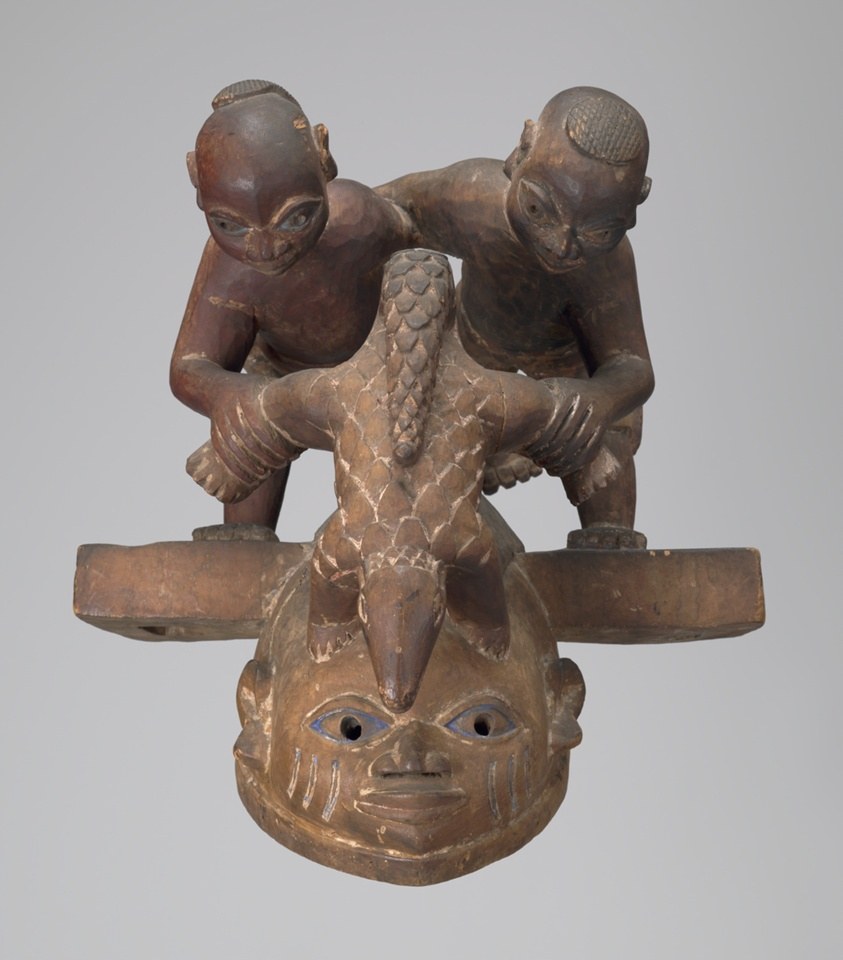
This wooden headdress presents a vertically stacked architectural composition centered on a large face at the base. The face is carved in frontal view with prominent, wide-set eyes inlaid with blue pigment, a straight nose, and a mouth rendered with parallel lines suggesting deliberate scarification or marking. Above the face rises a horizontal beam extending left and right, on which two small human figures sit facing outward, their bodies leaning slightly forward. These figures wear patterned clothing with scale-like or beaded surface treatment and have their own facial features—pointed or protruding mouths. Above them, a bird (possibly an eagle or water bird) spreads its wings and body across the composition, its surface carved with fine parallel lines suggesting feathers. The entire sculpture is rendered in dark wood with warm brown patina, showing age and use.
The dancing
The two human figures perch upright on the horizontal beam in a balanced, symmetrical pose, their bodies parallel and facing away from the central axis. Their weight appears evenly distributed on the beam, and their posture is alert rather than relaxed. The bird positioned above them has wings spread wide in an open, protective or commanding gesture. All three figures—the two humans and the bird—relate to the larger face below as though emerging from or supported by it.
The dance depicted
This headdress (igi gelede) is a sculptural form integral to Gelede performance practice among Yoruba peoples of southwestern Nigeria and Benin. Gelede is a masquerade tradition honoring female power and the mothers of the community, performed predominantly by men wearing these elaborate wooden headdresses above their heads while dancing. The stacked imagery—face, humans, bird—encodes meanings about ancestral presence, social hierarchy, and spiritual protection. The composition does not depict a frozen moment of dance but rather the symbolic load carried into performance; the wearer's body and movement activate these meanings in community ritual and celebration.
How it was made
Wood carved in relief and full round, with pigment application (blue inlay in the eyes). The work demonstrates sophisticated joinery in the construction of the horizontal beam and integration of the bird element. The carving technique shows both delicate detail work (facial scarification lines, feather patterns) and bold, confident volumetric forms. Such headdresses were created to be worn and moved, meaning the wood is relatively lightweight and the balance point would be calculated to sit on the wearer's head; the visual composition is therefore designed for three-dimensional viewing and mobility, not frontal display.
About this work
This is a Yoruba headdress carved for Gelede masquerade performance, a tradition centered on honoring female spiritual power and social authority within the community. The work dates to approximately 1900 and is attributed to one of two master carvers active in the late 19th and early 20th centuries. The layered composition—a large ancestral face supporting two human figures and a protective bird—synthesizes spiritual and social meanings that would have been activated and interpreted by the community as the headdress moved through performance space. Gelede is one of the most important masquerade traditions in West Africa, and this headdress represents the sophisticated sculptural tradition that supports it.
How to look at it
Examine the headdress as a three-dimensional object designed to move through space on a dancer's body, not as a sculpture meant to be viewed from a single angle. The blue pigment in the eyes is not decorative ornament but spiritual activation—a mark of presence and seeing. Notice how the two human figures are symmetrically placed and identically posed, suggesting balance and communal authority rather than individual narrative. The bird at the apex suggests protection, ascension, or cosmic connection. Consider what it would mean for a performer to carry this weight and height into a dancing body, and how the arrangement of forms would shift and rotate as the dancer moved.
The artist
The headdress is attributed to either Fagbite Asamu or Falola Edun, both master carvers working in Yoruba communities in the late 19th and early-to-mid-20th centuries. Both artists were recognized specialists in the carving of gelede headdresses, a highly skilled practice requiring not only technical mastery but also deep knowledge of the iconography, spiritual significance, and social context of the Gelede tradition. The specific attribution may be uncertain because such works were sometimes created collaboratively or their makers were not consistently documented in Western collection practices.
The period
Gelede masquerade reached a significant phase of elaboration and innovation during the late 19th and early 20th centuries, the period when this headdress was made. The tradition itself is centuries old, but the documented practice of individually named master carvers producing increasingly complex and ambitious headdresses dates to this era. At the same time, colonial presence was reshaping Yoruba society, yet Gelede remained a vital community institution; the sophistication of works like this reflects the tradition's ongoing cultural centrality despite external pressures. In the broader context of African art, the early 20th century saw Western collectors and museums beginning to acquire such works, often without understanding their function in live performance.
Where it lives
The work is held in the Arts of Africa collection at the Art Institute of Chicago, a major American museum with a significant collection of West African masquerade traditions. The collection dates and attributes are based on museum records; the specific circumstances of acquisition and the basis for the artist attribution are not fully detailed in the catalogue entry.
Dance in this work
Questions about this work
Is Gelede a dance or a costume?
Gelede is a masquerade tradition in which the entire performance—the headdress, the costume, the music, and the movement of the dancer's body—functions as a unified practice. The headdress alone is not Gelede, but it is essential to it. A dancer wears it, moves in it, and the community interprets its imagery in the context of that live performance. It is more accurate to call it a dance tradition that incorporates spectacular masked performance.
Who performs Gelede?
Gelede is traditionally performed by men, often younger men, who are trained in the movement, music, and meaning of the tradition. The masquerade honors female power and mothers, but male performers embody and animate these meanings through their dancing. This is not unusual in African masquerade traditions; the gender of the performer and the gender of the spirit or power being honored are not necessarily the same.
What does the stacked imagery mean?
The vertical arrangement encodes social and spiritual hierarchy: the ancestral face is the foundation, the human figures represent the community or specific social roles, and the bird suggests spiritual protection, connection to the sky, or ascension. The exact meanings would have been understood within the specific community context and might vary by region or over time. Western interpretation of the symbolism should remain provisional without community voice.
How old is this object?
The catalogue record dates it to approximately 1900. The style and carving technique are consistent with late 19th-century Yoruba practice. Like all wooden objects, its actual age cannot be precisely determined by looking at it; the date is based on stylistic analysis and (likely) accession documentation.
More dance artwork





