49 works in this view — arrow keys or swipe to move between them.
Dance in Art
Face Mask
Bete or Guro Côte d'Ivoire Coastal West Africa
- Medium:
- Wood, kaolin, monkey fur, leather, metal, and twine
- Collection:
- Arts of Africa
- Source:
- Art Institute of Chicago
- Rights:
- Rights reserved by the holding institution — do not reuse without permission. Source record ↗
- Recorded as:
- AIC — rights reserved
For dancers and choreographers, this object represents a fundamentally different relationship between mask and movement than European theatrical traditions: the mask is not a character's face pinned to an actor, but an autonomous sculptural entity that merges with the dancer's body to create something entirely new. For historians of performance, the mask is evidence of sophisticated performance technologies developed in West Africa centuries before European contact—technologies of transformation that remain central to African and diaspora dance practices today.
What you are looking at
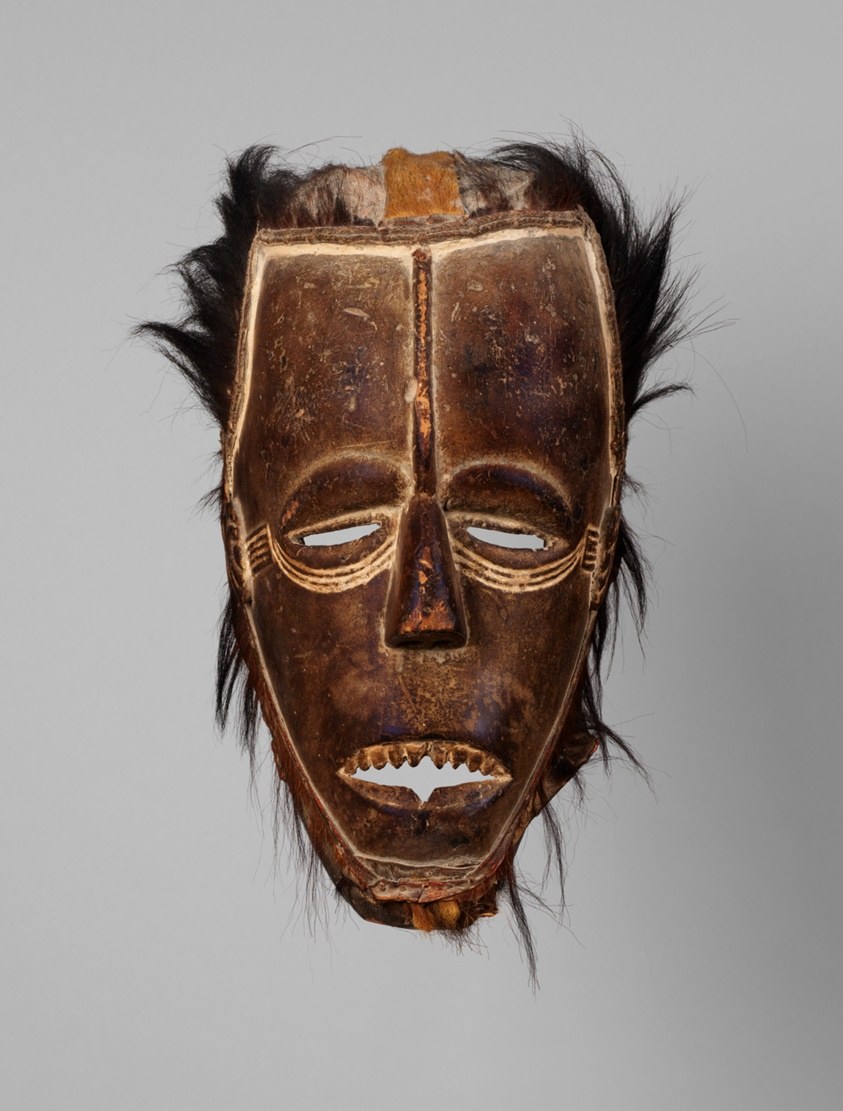
A wooden face mask carved in a simplified, geometric style dominates the composition. The face is frontal, with an elongated rectangular form divided vertically by a central ridge running from the top of the head to the tip of the nose. The eyes are large, almond-shaped recesses outlined with raised ridges of kaolin (white clay), creating a striking contrast against the dark wood. The mouth is also delineated by white kaolin, forming a horizontal slit with what appears to be inlaid shell or bone teeth. The mask is framed by long strands of dark animal hair (monkey fur according to the record) attached at the sides and top, creating a full, dramatic silhouette. The wood itself is weathered to a rich brown patina, with subtle variations in tone suggesting age and use. Metal elements and twine are incorporated into the construction, visible particularly around the attachment points for the hair. The mask is presented frontally against a neutral background, allowing the three-dimensional carved form and the tactile quality of the materials to be fully appreciated.
The dancing
This is not a depiction of a dancing figure but rather a mask object itself—a sculptural form designed to be worn on the human face and body. The mask's formal properties suggest it was created to be animated by a dancer: the frontal orientation, the exaggerated facial features (wide eyes, prominent mouth), and the dramatic surround of hair all indicate it was meant to transform and extend the wearer's presence. The precise balance of the carved wooden face and the addition of organic materials (fur, shell, metal, twine) suggests it was engineered for performance—the weight and materials distributed to move with the body rather than obstruct it.
The dance depicted
This mask is a material artifact of West African masquerade performance tradition, most likely from the Bete or Guro peoples of Côte d'Ivoire. Masquerades in this region are central to sacred and social ceremonies, with masked dancers embodying spiritual forces, ancestors, or social roles. The mask itself does not depict dance but rather serves as the primary means by which dance becomes possible: the wearer's body—their movement, posture, and gesture—becomes unified with the mask's presence to create a composite performance being. The specific style, carving technique, and materials suggest a mask used in ceremonial or initiatory contexts where the dancer's movement would activate and animate the carved face and fur surround, transforming the performer into a non-human entity. The mask participates in sacred-ceremonial performance traditions central to Bete and Guro cultural life.
How it was made
The mask is a composite construction combining carved wood (the primary sculptural element), kaolin (white clay applied to the face), animal hair (monkey fur), leather, metal fittings, and twine. The carving technique is subtractive—the wood has been hollowed and shaped to fit the wearer's face, with recessed eye sockets and mouth designed for vision and vocalization during wear. The application of kaolin creates visual contrast and may have carried symbolic significance in ceremonial contexts. The integration of perishable materials (fur, leather, twine) alongside the durable carved wood suggests this was a functional performance object designed for repeated use, with materials chosen for their visual and tactile properties as much as their durability. The object was created to be activated through human embodiment—its full meaning emerges only when worn and animated by a dancer's movement.
About this work
This is a carved wooden face mask from the Bete or Guro peoples of Côte d'Ivoire, a West African masquerade object created to be worn during ceremonial or social dances. The mask belongs to a long tradition of performance art in which the carved and decorated face, combined with the dancer's body, creates a composite being that embodies spiritual, social, or ritual significance. The geometric carving style, the dramatic frame of monkey fur, and the applied kaolin and shell details are characteristic of Central Ivorian masquerade traditions dating to the late 19th century. This object is material evidence of a performance practice in which the mask and the dancer are inseparable—the mask does not depict a dancer, but rather enables and shapes the dance itself, transforming the wearer into a non-human performer for the duration of the ceremony or celebration.
How to look at it
To understand this mask, a viewer must imagine it in motion on the face and body of a dancer. The frontal geometry and symmetrical composition suggest the mask was designed to be seen from the front as it moved through space. The large, recessed eyes would have allowed the wearer to see downward and to the sides despite the apparent blankness of the carved gaze. The prominent mouth and the dramatic surround of monkey fur would create a visual silhouette visible from a distance, important in ceremonial contexts where the mask needed to be readable from across a gathering space. The weathering and patina visible on the wood are evidence of use—this object was danced, not displayed. Notice the integration of materials: the hard carved wood provides structure and permanence, while the fur, leather, and metal elements add movement, sound, and visual drama to the dancer's motion.
The artist
The mask is attributed to the Bete or Guro peoples of Côte d'Ivoire but is recorded without a named individual artist. This reflects the collaborative, community-based nature of masquerade production in these cultures, where carving, assembly, and performance were distributed across multiple specialists and participants. Masks were often created by recognized carvers whose individual styles were known within their communities, but colonial-era collecting practices typically erased individual artist attribution in favor of ethnic or regional categorization. The mask's execution shows confident technical skill in wood carving, understanding of proportional relationships, and knowledge of the performance context for which it was designed.
The period
The mask dates to approximately 1875, a period of significant change in West Africa. This was during the early colonial period, preceding full European conquest and administration of the region. Masquerade traditions among the Bete and Guro were well-established and central to social and spiritual life, serving roles in initiation, conflict resolution, entertainment, and ceremonial occasions. The late 19th century saw increasing documentation and collection of African masks by European travelers, ethnographers, and collectors—a process that removed objects from their performance contexts and placed them in museums where their function as activated, danced performance art was often overlooked or forgotten. This mask entered a Western collection before the mid-20th century, transitioning from a performance tool to an art object.
Where it lives
The mask is held in the Arts of Africa collection at the Art Institute of Chicago. It entered the collection as part of the broader early-to-mid-20th-century Western acquisitions of African art objects, a period during which masks and sculptures were systematically collected from their source communities and placed in Western museums. The collecting history of this specific mask is not detailed in the available record.
Dance in this work
Questions about this work
How was this mask used in dance?
The mask was worn on the face by a dancer whose body movements brought it to life. The wearer could see through the carved eye recesses and would move through space—walking, turning, crouching, or gesturing—according to the ceremony or social occasion. The dancer's movements, combined with the visual presence of the mask's carved features and the monkey fur surround, created the performance. The mask was never still; its meaning emerged through motion.
What do the white clay lines mean?
The kaolin (white clay) applied to the eyes and mouth creates visual contrast and clarity, making the carved features readable from a distance. In West African contexts, white clay also carried symbolic associations with spiritual power, purity, or communication with ancestral forces. The application of kaolin may therefore have added ritual significance to the mask beyond its visual function.
Why monkey fur instead of human hair?
Animal hair—particularly from primates—was used in masquerades to create a non-human appearance and to evoke the spiritual or ancestral nature of the masked performer. The monkey fur, like the carved wood itself, transformed the wearer into something other than human. This was essential to the mask's function: the performer was no longer themselves but had become a spiritual being or embodied force.
Is this mask still used, or is it only in museums now?
This particular mask has been in Western collections since the early-to-mid-20th century and is now a museum object. However, Bete and Guro communities continue masquerade traditions with new masks and ongoing practices. The removal of historical masks to museums represents a break in the use of these specific objects, but the performance traditions they exemplified remain alive in their source communities.
More dance artwork





