49 works in this view — arrow keys or swipe to move between them.
Dance in Art
Face Mask
Dan Liberia Coastal West Africa
- Medium:
- Wood
- Collection:
- Arts of Africa
- Source:
- Art Institute of Chicago
- Rights:
- Rights reserved by the holding institution — do not reuse without permission. Source record ↗
- Recorded as:
- AIC — rights reserved
Face masks are often displayed as sculpture, removing them from their performance context. This work matters because it asks viewers to imagine the mask animated—to recognize that its formal power (the void eyes, the projecting geometry, the austere expression) is realized only in motion and in relation to a dancing body. For dancers and choreographers, it is evidence of a sophisticated tradition in which the mask is a partner, not a costume; the wearer and the mask co-create the performance.
What you are looking at
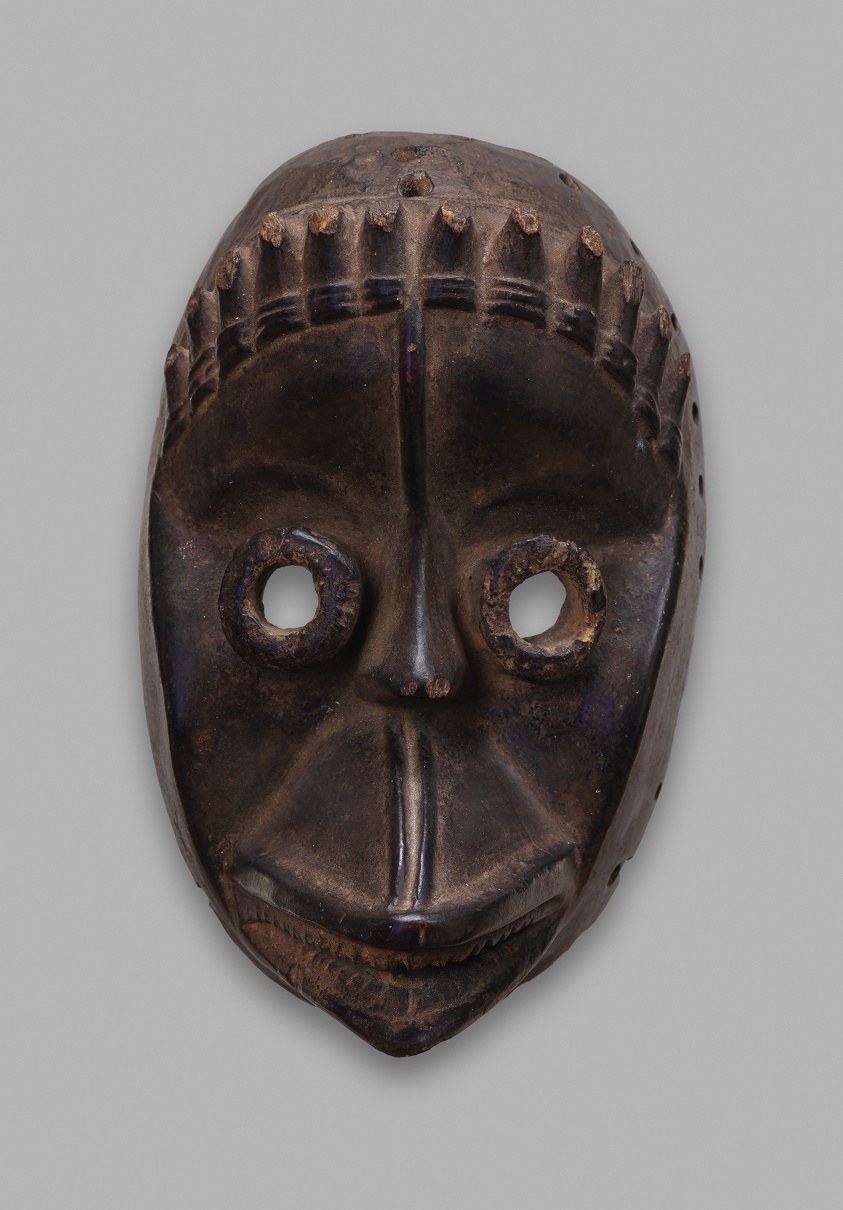
A carved wooden mask with a dark patina, presented frontally against a neutral background. The face is abstracted and geometric, with a narrow, elongated oval form. A high, ridged crest runs vertically down the center from the crown; below it, the forehead projects forward in sharp planes. Two large circular voids serve as eye holes, their rims carved with concentric rings that give them an almost hypnotic quality. The nose is a simple vertical ridge. The mouth is a straight horizontal line. Small circular perforations pierce the sides of the face, possibly for attachment or as decorative elements. The surface shows varied patination—darker in recesses, lighter where worn—suggesting considerable age and use. The carving is assured and economical, avoiding ornament while achieving expressive power through proportion and void.
The dancing
This is a mask object, not a depiction of a dancing figure, so traditional dance analysis does not apply. However, the mask's formal properties suggest it was designed to be worn and activated by a body. The weight appears centered, the eye holes positioned for human sight lines, and the lateral perforations suggest attachment to a dancer's head. The austere facial expression—neither smiling nor grimacing—and the forward-projecting planes suggest the mask was meant to present a presence rather than convey narrative emotion.
The dance depicted
This is a face mask from the Dan people of Liberia, a culture whose masquerade traditions are foundational to West African performance. Dan masks are integral to sacred and social dances, worn by initiated performers in contexts ranging from judicial proceedings to entertainment and rites of passage. The mask's form—particularly the high crest and projecting planes—is consistent with masks used in dance performance, where the exaggerated features would read clearly in motion and at distance. Without documentation of this specific mask's dance context, we cannot identify the particular performance tradition it served, but the Dan masquerade system is inseparable from choreographed movement and community ritual.
How it was made
The mask is carved from a single piece of wood, worked with hand tools to achieve its geometric planes and void spaces. The carving shows confident tool control: the ridges are sharp, the circles of the eyes are true, and the transitions between planes are deliberate. The surface patina—darker in protected areas, lighter where handling has worn the wood—indicates the mask has been used and handled extensively over time. This is not decorative sculpture intended for static display; the traces of use are evidence of its functional life in performance.
About this work
This is a face mask carved by or for the Dan people of Liberia, a West African culture whose masquerade traditions are among the world's most refined. Dan masks serve in dances and rituals that regulate community life, mark initiation, and entertain. The mask's formal properties—its geometric clarity, the commanding eye voids, the forward-projecting planes—are designed to project presence and authority when worn by a dancer. It is not a portrait or narrative image, but an instrument of transformation: the wearer becomes something other than human, and the dance becomes a vehicle for that otherworldly presence. The mask belongs in a dance gallery because masquerade is dance; the mask and the dancer are inseparable, and the form of the mask shapes the movement of the wearer.
How to look at it
Look at the eye voids first: they dominate the face and would command attention from a distance. Imagine the mask lit from below, as it would be in evening performance, and how the void eyes would seem to gaze without seeing, to hold knowledge without expression. Notice the forward projection of the forehead and nose: a dancer wearing this mask would need to adjust their posture and head carriage to balance its weight and present its form. The mask's stillness is deceptive; its power is kinetic. The circular perforations on the sides suggest it was attached securely to the wearer's head, making the mask and dancer a single animated object.
The artist
The mask is attributed to the Dan people of Liberia and Côte d'Ivoire. The Dan are renowned for a distinctive masking tradition in which different mask types serve different social functions: some masks perform in entertainment dances, others in judicial and initiatory rites. Dan carvers work within a cultural convention—masks are recognized by type and function—but individual carvers are known and valued for their skill. The anonymity of the catalogue record reflects the historical practice of collecting African masks as ethnographic objects without recording individual makers' names, a colonial-era practice increasingly corrected by contemporary scholarship.
The period
The catalogue dates this mask to 1875, a period of significant upheaval in Liberia and the surrounding region due to colonial expansion and the Atlantic slave trade's aftermath. The Dan masquerade tradition, however, has deep historical roots and continuity; masks of this era represent a living practice, not a historical one. In the late 19th century, European collectors were actively acquiring African masks for ethnographic museums, often removing them from performance contexts without documentation. The mask entered the Art Institute of Chicago's collection during an era when African objects were categorized as ethnographic or anthropological specimens rather than as art; this reclassification is now standard, but it has obscured much information about individual masks' performance histories.
Where it lives
The mask is held in the Arts of Africa collection at the Art Institute of Chicago, catalogued as a Dan face mask from Liberia, dated 1875. The source is listed as AIC (Art Institute of Chicago), indicating it is part of their permanent collection. No information on the mask's provenance before acquisition, the name of the carver, or its specific performance context is recorded.
Dance in this work
Questions about this work
How do we know this mask was used in dance?
The Dan masquerade system is inseparable from performance and dance; masks serve in ritual, judicial, and entertainment contexts, all of which are danced. The mask's formal properties—the eye holes positioned for the wearer's sight, the lateral perforations for secure attachment, the weight distribution centered on the face—are all designed for a wearer's body in motion. Without documentation of this specific mask's use, we infer its dance context from the Dan tradition and the mask's construction.
Why is the mouth just a line?
The Dan aesthetic favors abstraction and geometric clarity over naturalistic representation. The simple horizontal line serves multiple purposes: it reads clearly at distance, it avoids the expressionistic overtones of a carved smile or frown, and it allows the mask's power to rest in the eye voids and the projecting planes rather than in facial affect. The restraint is intentional and culturally specific.
What do the circles around the eyes mean?
The concentric rings around the eye voids may be decorative, may serve a spiritual or symbolic function within Dan culture (documented in some masquerade traditions), or may simply follow a formal convention of the carver's workshop. Without ethnographic documentation or the mask's performance history, we cannot say definitively. The circles are, however, a signature feature of some Dan mask types.
Who carved this mask?
The catalogue record does not name the carver. This reflects a historical practice in which African masks were collected and catalogued as anonymous ethnographic objects, with individual makers' names and reputations often unrecorded. Contemporary scholarship seeks to recover carvers' names and practices where possible, but for many masks in Western collections, that information is lost or inaccessible.
More dance artwork





