49 works in this view — arrow keys or swipe to move between them.
Dance in Art
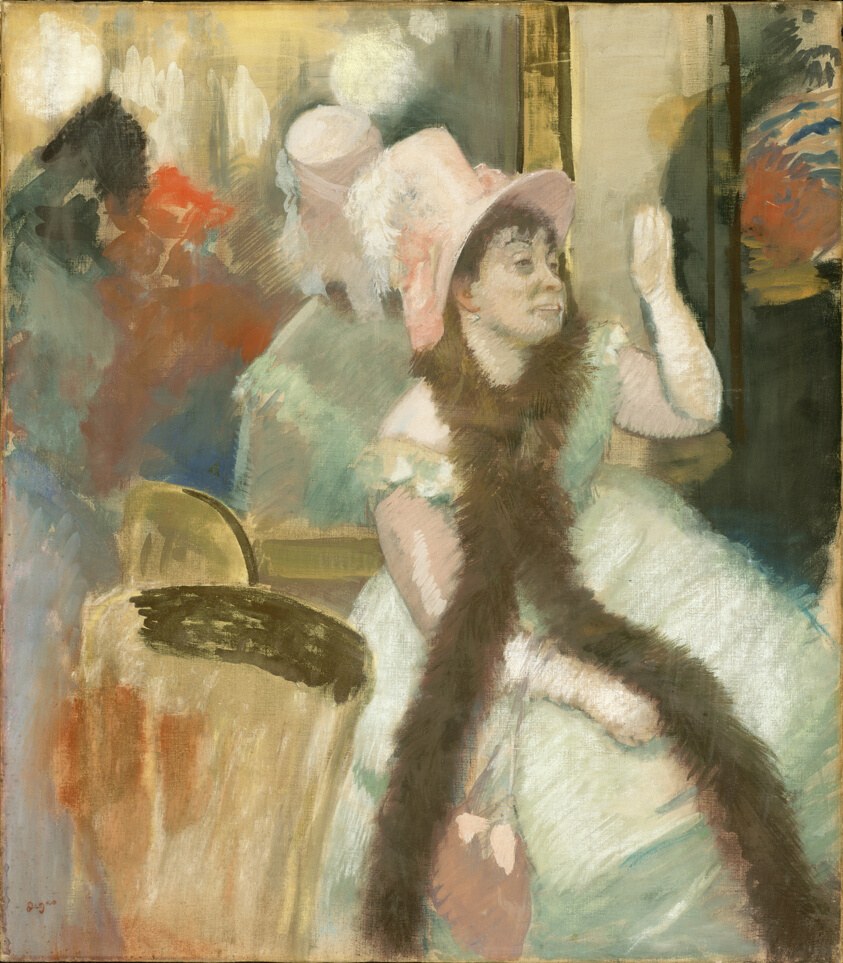
Portrait after a Costume Ball (Portrait of Madame Dietz-Monnin)
Edgar Degas (French, 1834–1917)
- Medium:
- Distemper, metallic paint, and pastel, on canvas
- Collection:
- Painting and Sculpture of Europe
- Source:
- Art Institute of Chicago
- Rights:
- Public domain — free to use, share and adapt.
- Recorded as:
- CC0 (Public Domain)
For a dance historian, this work exemplifies how Degas captured the culture of the ball—not primarily as choreography but as social theater and display. It reminds us that the history of dance includes the spaces around dancing: the costume, the spectation, the feminine leisure that made balls possible. The work also shows how Degas's experimental mixed media allowed him to render the transient, glittering, evanescent quality of Parisian evening culture.
What you are looking at
A woman in an elegant pale green dress with fur trim sits in the foreground, her head tilted back in a moment of repose or reverie, her white-gloved arm raised. She wears a large, ornate white feathered hat. Behind her, the composition dissolves into loose brushwork suggesting an interior space—we glimpse other figures in evening dress, a woman in coral-red fabric on the left, and hints of architectural elements including what appears to be a doorway or mirror frame. The paint is applied with Degas's characteristic broken, impressionistic touch, the background figures and setting rendered in soft yellows, greens, and grays that create atmospheric depth. The title indicates this was drawn after a costume ball, and the woman's fashionable dress and the formal setting of what appears to be an elegant salon confirm the context of high society leisure.
The dancing
The primary figure is seated in a relaxed, almost languid pose—weight settled into her chair, spine curved, one arm raised with an air of studied nonchalance. Her gaze is directed upward and to the side, suggesting a moment of distraction or conversation with an unseen companion. The secondary figures in the background are sketchily rendered but suggest a gathering: at least one other woman is visible in warm-toned dress. The spatial relationship is ambiguous—we cannot read a formal dance posture here, and the seated position of the main figure places her outside the typical engagement of active dancers.
The dance depicted
This work does not depict active dance, despite its costume-ball context. The woman is seated and at rest. The painting captures the interval or social moment of a ball—the spectating, flirtation, and repose between dances—rather than the dance itself. Costume balls of the 1870s-80s were theatrical social events where fashionable dress, performance, and social display mattered as much as any choreographed movement. The work is documentation of the leisure culture and gendered display associated with balls rather than of ballroom technique.
How it was made
The work combines distemper, metallic paint, and pastel on canvas—a mixed-media approach typical of Degas's experimental practice in the 1870s. This combination allowed Degas to build luminous, delicate surfaces with rich textural variation: the opaque matte quality of distemper underlaying areas of brilliant pastel, with metallic accents (likely gold or silver) catching light in the feathered hat and fabric details. The technique suits the subject—the fragmented, glittering, somewhat ephemeral quality of the evening's social spectacle. The mixed medium also made the work more portable and experimental than large academic paintings, aligning with Impressionist and independent artists' practice.
About this work
This is Degas's portrait of Madame Dietz-Monnin, a society woman, caught in a moment of fashionable repose at a costume ball around 1879. The work belongs to Degas's broader investigation of modern leisure, theatricality, and the feminine sphere of Parisian high society. It is not a dance image in the strict sense—no bodies are in motion, no ballroom hold is depicted—but it documents the social and sartorial context in which dance happened: the elaborate costume, the staged self-presentation, the moment of spectation and social interaction that framed the actual dances. The painting is a record of how dress, posture, and setting constructed feminine identity and social performance in this era.
How to look at it
The viewer should notice the contrast between the sharply observed foreground figure—her specific posture, the precise rendering of her dress and hat—and the dissolving, sketchy background. This hierarchy guides the eye and emphasizes the woman's interiority: she is withdrawn, absorbed, self-contained despite being in a social setting. The broken color and loose brushwork in the background suggest the bustle of the ball continuing around her, but she is momentarily apart from it. Degas has chosen the moment of repose, not of engagement, which is the more psychologically interesting choice.
The artist
Edgar Degas (French, 1834–1917) was drawn throughout his career to modern leisure, performance, and the female figure in spaces of display—the café, the theater, the concert, the ballet studio. Though best known for his ballet scenes, Degas was equally interested in the social world of Paris: the opera, the races, the millinery salon. He worked obsessively in pastel, a medium he revitalized, and frequently combined media to achieve luminous, unstable surfaces. His approach was documentary and observational rather than moralizing, recording the textures of modern life with apparent casualness but rigorous composition.
The period
In the 1870s-80s, the costume ball was a major social ritual in Paris, especially in literary and artistic circles. These events were occasions for theatrical self-fashioning and modern leisure. At the same time, Impressionist and independent artists were moving away from academic salons toward smaller galleries and private sales; Degas exhibited with the Impressionists but maintained a more formal, observational approach. The 1870s saw a fascination with modern fashion, interior life, and the psychology of leisure—all central to Degas. Ballroom dance in this period was still dominated by waltzes, polkas, and quadrilles, but the costume ball was more about display and social performance than formal choreography.
Where it lives
The work is held in the Painting and Sculpture of Europe collection at the Art Institute of Chicago. The catalogue identifies it as a portrait of a specific sitter, Madame Dietz-Monnin, suggesting it was a commissioned or semi-commissioned work for a member of Parisian society.
Questions about this work
Is this actually a dance painting?
Not in the sense of depicting choreography or technique. It is a portrait set at a costume ball, capturing a moment of social leisure and feminine display rather than active dancing. For Degas, the ball was as much about the spaces around dancing—the costumes, the postures, the psychology of the participants—as about the dances themselves.
What is a costume ball and what dances happened at them?
A costume ball was a fashionable social event where guests wore elaborate costumes and masks, common in Paris in the 19th century. They typically included formal ballroom dances—waltzes, polkas, quadrilles—but the emphasis was on theatrical costume and social display rather than specialized technique. They were events where modern leisure, art, and performance culture intersected.
Why did Degas paint this woman?
The catalogue identifies her as Madame Dietz-Monnin, likely a client or member of Parisian artistic circles. Degas was interested in portraiture as a vehicle for studying modern social types and modern leisure. Her fashionable dress and the specific setting indicate she was a woman of means and taste, exactly the kind of modern subject that fascinated him.
More dance artwork





