49 works in this view — arrow keys or swipe to move between them.
Dance in Art
The Last Masquerade
Petr Ashotovich Sarkisian (Born Moscow, 1922; died Moscow, 1970) Vasilii Ivanovich Lebedev-Kumach (Born Moscow, 1898; died Moscow, 1949)
- Medium:
- Stencil
- Collection:
- Prints and Drawings
- Source:
- Art Institute of Chicago
- Rights:
- Rights reserved by the holding institution — do not reuse without permission. Source record ↗
- Recorded as:
- AIC — rights reserved
The masquerade was a central image in Russian culture—danced, painted, written about, and performed for centuries. This print shows how Soviet artists repurposed that symbol to mark its burial, turning dance history into political rhetoric. It documents a moment when the visual language of dance was conscripted into ideology.
What you are looking at
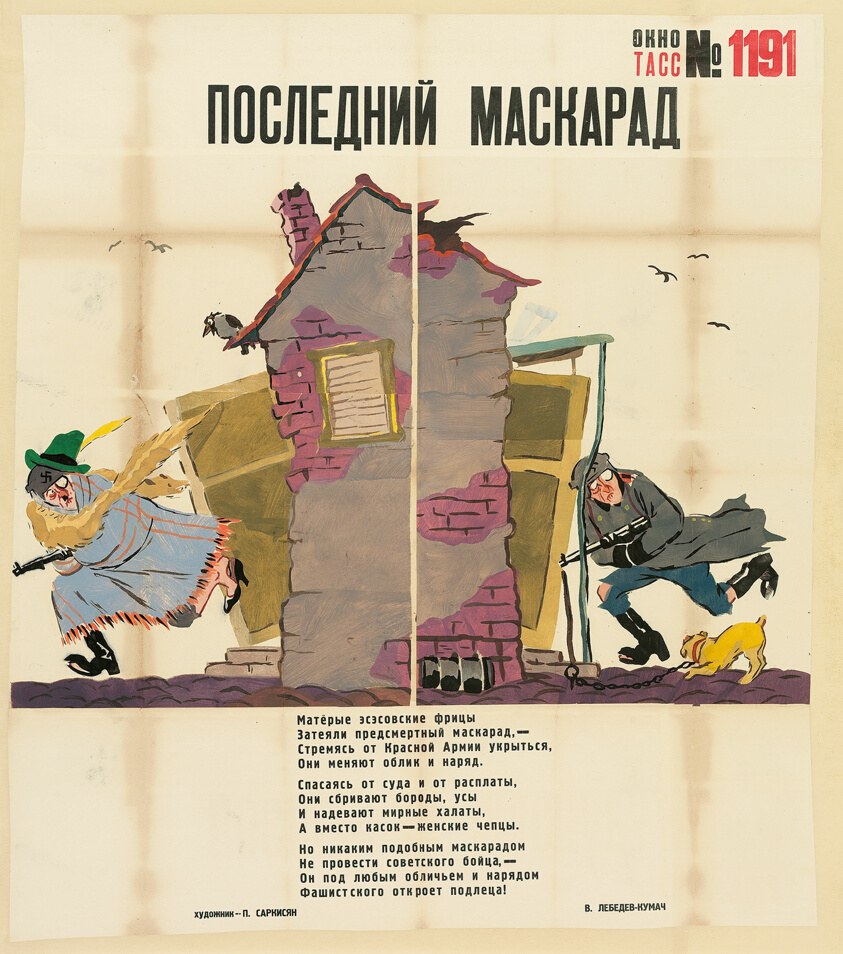
A crumbling brick structure—part fortress, part dwelling—dominates the center of this stencil print. The building is rendered in muddy purples and grays, with a boarded window and a single open door. Two figures in period costume flank it: on the left, a man in a blue coat and green hat lunges forward with exaggerated motion, one leg extended high; on the right, a second man in dark clothes crouches or leans into the structure with equal energy. A small yellow dog races between them. The ground is bare and purplish; birds fly in the cream-colored sky. The composition is split vertically by a central axis, creating a mirror-like tension between the two figures' opposing movements. The print's title, in bold Cyrillic capitals, reads "Последний маскарад" (The Last Masquerade), and Russian text fills the lower half of the page—verse that appears to describe the scene's political meaning.
The dancing
Both male figures are depicted in exaggerated, almost caricatured poses that suggest farce or slapstick rather than ballroom technique. The left figure's lunge is wide and unstable, his leg kicked high and his torso pitched forward; the right figure similarly contorts himself toward the building. Neither demonstrates the upright carriage, closed position, or controlled partnering associated with formal dance. Their movements suggest struggle, urgency, or comic desperation. The small dog participating in the scene adds to the sense of chaos and degradation. This is physical comedy, not dance proper.
The dance depicted
This is not a representation of an actual dance style but a political allegory using the *masquerade*—a historical costume ball or fancy-dress gathering—as its metaphor. The verse (by V. Lebedev-Kumach, a Soviet poet and librettist) describes this as the final masquerade, with the building standing for something that must be destroyed or abandoned. The grotesque, contorted postures of the figures suggest that whatever "dance" this represents is already broken, falsified, or dying. The masquerade itself was a form of social performance associated with the Russian aristocracy and the pre-Soviet past; this print records its ideological demolition.
How it was made
This is a stencil print (pochoir), a labor-intensive hand-coloring technique that allowed for bold, flat areas of color and fine linear detail. Each color—the blue coat, the purple brick, the yellow dog—was applied through a separate stencil, which explains the crisp edges and the graphic, poster-like quality. Stencil printing was favored for Soviet agitprop and political art because it was legible from a distance, reproducible in small runs, and possessed an inherent graphic boldness. The technique's flatness emphasizes the allegorical nature of the image: these are not naturalistic figures in a realistic space but symbols.
About this work
This 1945 stencil print is a Soviet political allegory depicting the symbolic destruction of the masquerade—a metonym for pre-revolutionary aristocratic culture, bourgeois decadence, and the social rituals of the Old Regime. Created near the end of World War II, it represents the triumph of Soviet ideology over the past. The two figures are not dancers in any technical sense but comic actors or allegorical agents destroying a relic. The print's partnership with verse by a prominent Soviet librettist confirms its status as high-culture political art: a moment when dance-adjacent imagery (the masquerade) served Soviet graphic propaganda. It belongs in a dance collection because it weaponizes the masquerade as a symbol and because its visual language depends on the viewer's recognition of that form.
How to look at it
Read the composition as a political diagram: the building is what is being destroyed, the two figures are the agents of destruction, and their grotesqueness is intentional—they are not beautiful dancers but workers, clowns, or soldiers smashing a relic. The stencil technique flattens everything into ideological clarity: no atmosphere, no ambiguity, no sentiment. The dog, unexpected and absurd, prevents the viewer from taking the destruction solemnly—this is a farce, a carnival of the old world's ending. The vertical axis of symmetry is not a dance frame but a stage set split open.
The artist
Petr Sarkisian (1922–1970) was a Moscow-born graphic artist and illustrator who worked primarily in stencil and lithography. He was active during the late Stalinist and early post-Stalin periods, creating illustrations, book designs, and political prints. His collaboration here with Lebedev-Kumach (1898–1949), one of the Soviet Union's most prolific and official poets and librettists, confirms Sarkisian's standing as a state-sanctioned artist. The work reflects the style of Soviet graphic art of the 1940s: bold forms, political clarity, and the marriage of visual and textual propaganda.
The period
In 1945, the Soviet Union was consolidating its victory in World War II and asserting ideological control over culture and memory. The masquerade—long a symbol of aristocratic frivolity and pre-revolutionary excess in Soviet discourse—was being historically weaponized as a symbol of what Communism had superseded. Simultaneously, Soviet ballet was being rehabilitated as a national art form; the masquerade in this print is pointedly *not* that. The print belongs to a body of agitprop and political graphic art that used costume, gesture, and architectural metaphor to narrate Soviet triumph over the past.
Where it lives
Held in the Prints and Drawings collection of the Art Institute of Chicago, this work is catalogued as TASS No. 1191, indicating it is part of a larger collection of Soviet newspaper and poster art distributed by TASS (the Soviet news agency) and its predecessors. Such prints were designed for mass circulation, wall display, and propaganda campaigns, making them documents of state-directed visual culture.
Questions about this work
Is this actually a dance?
Not in the technical sense. The figures are performing grotesque, exaggerated postures that parody or reject dance. The image uses the masquerade—a historical form of costume ball and social dance—as an allegorical symbol of pre-Soviet culture being destroyed. The contorted, slapstick movements are intentionally undignified and broken.
What is the building supposed to represent?
Most likely the old aristocratic order, imperial Russia, or the bourgeois past. The building is being demolished, literally and symbolically, by the two figures. Soviet art often represented historical destruction architecturally, and the boarded window and decayed brick signal abandonment and ruin.
Why is there a dog?
The dog adds to the sense of chaos and degradation, and possibly ridicule. Its presence prevents the viewer from seeing the destruction as tragic or heroic—instead it becomes farcical, a carnival of the old world's ending. In Soviet graphic art, such unexpected details often undercut bourgeois sentiment.
Who were Sarkisian and Lebedev-Kumach?
Sarkisian was a Moscow graphic artist specializing in stencil and lithographic prints for Soviet publications. Lebedev-Kumach was one of the Soviet Union's most prolific and state-favored poets, librettists, and songwriters. Their collaboration on this print indicates official status and wide intended circulation.
More dance artwork





