49 works in this view — arrow keys or swipe to move between them.
Dance in Art
Face Mask (Kanaga)
Dogon Bandiagara region, Mali Northern Africa and the Sahel
- Medium:
- Wood, pigment, and fiber
- Collection:
- Arts of Africa
- Source:
- Art Institute of Chicago
- Rights:
- Rights reserved by the holding institution — do not reuse without permission. Source record ↗
- Recorded as:
- AIC — rights reserved
For dancers and choreographers, the Kanaga demonstrates that mask-making and dance are a single unified practice: the form of the object literally dictates the movement vocabulary of the wearer. For historians, it documents how knowledge of dance was embedded in material form across West African cultures, transmitted through the object itself across generations. The work shows that understanding African dance requires looking at the masks, costumes, and sculptural forms that dancers wore, not at representations of dancers made by outside observers.
What you are looking at
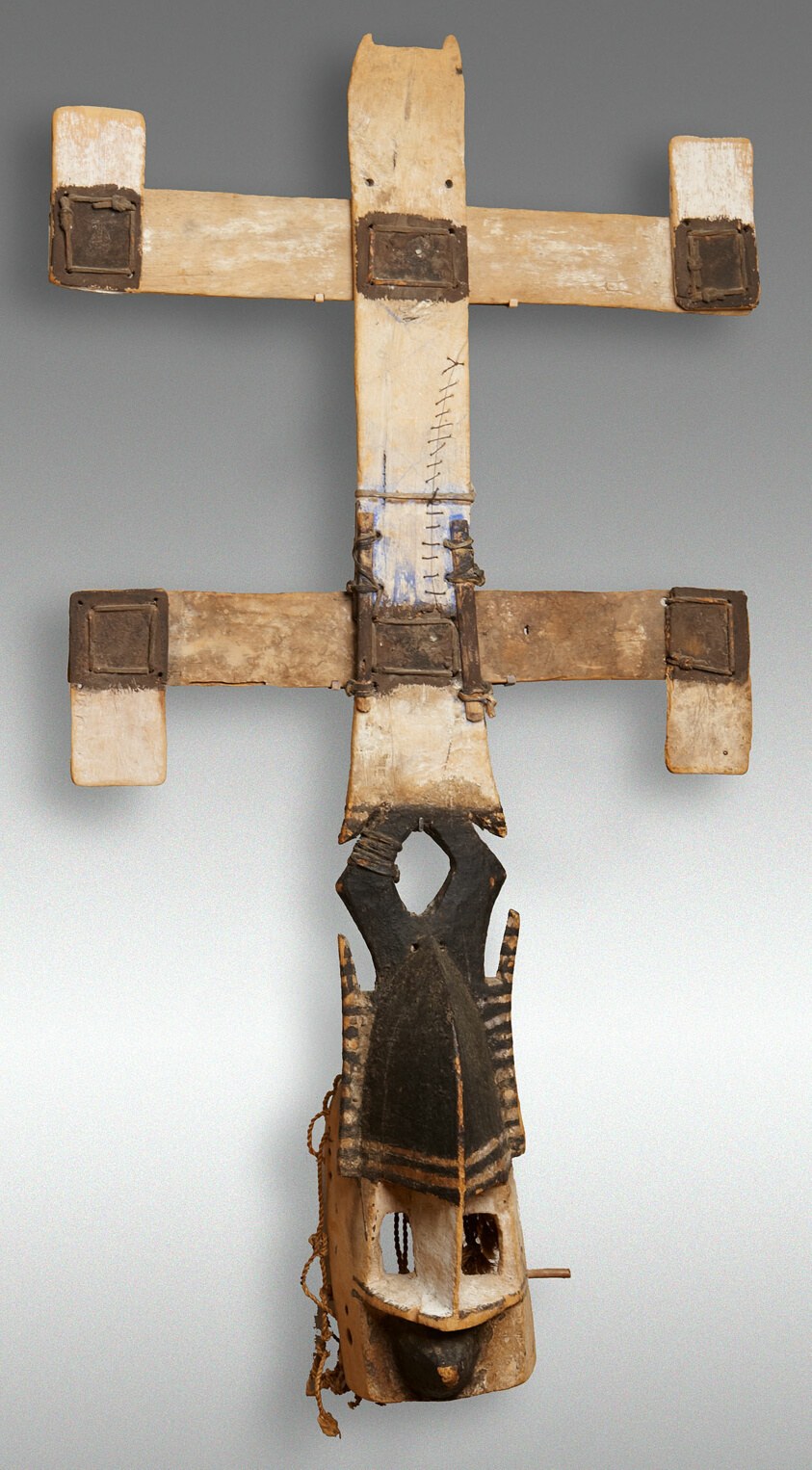
This is a wooden face mask of the Kanaga type used in Dogon masquerade performance from the Bandiagara region of Mali. The object is constructed from light wood with dark patina on certain surfaces, assembled from carefully carved and shaped pieces. The mask features a striking geometric abstraction: a vertical central face with a pronounced mouth opening and an angled nose ridge, crowned by a pair of upright horns. The most distinctive feature is a large openwork geometric form extending horizontally from the face—a broad, flat rectangular plane with carefully cut rectangular void in its center, creating a second face or shield-like element. Two additional rectangular planar elements project horizontally from either side at shoulder height, suggesting the scale and bearing of a fully costumed performer. The wooden surfaces show age and use-wear, with visible tool marks and fiber attachments suggesting textile components once hung from the base. The mask is designed not as a facial covering alone but as a complete three-dimensional sculptural apparatus meant to sit atop the head, with the horizontal arms providing a massive, arresting silhouette during performance.
The dancing
This is not a depiction of a dancing figure but a mask object itself. When worn, the Kanaga mask would have created an elongated, imposing vertical and horizontal frame around the wearer's body, extending both upward with the horns and laterally with the broad rectangular arms. The mask's geometric severity—the void in its center, the sharp angles, the architectural quality of its planes—suggests a sculptural presence rather than a human face, designed to transform the wearer into an abstract, non-naturalistic form. The attachment points for costume and the evidence of fiber work indicate the full masked figure integrated the wooden apparatus with elaborate cloth and possibly additional ornaments.
The dance depicted
The Kanaga mask is one of the most iconic elements of Dogon masquerade performance, central to the Dama ceremony, a collective rite that honors the dead and reinforces community bonds. These masks appear in coordinated group processions and structured performances where the masked figures enact prescribed patterns of movement, typically in linear formations and with deliberate, often forceful gestures. The geometric austerity of the mask—its planes, voids, and monumental proportion—reflects a conceptual rather than naturalistic approach to representation, common across West African masking traditions. The horizontal arms that extend from this example are characteristic of Kanaga masks and may reference cosmic or architectural concepts central to Dogon philosophy.
How it was made
This object is carved and assembled from wood, with multiple components joined together to create the final form. The mask shows evidence of hand-carving with stone or metal tools, visible in the directional tool marks on the wood surfaces. The light wood has darkened selectively through age and use, suggesting the mask has been exposed to elements and worn extensively. Fiber attachments, now fragmentary, indicate the original mask was completed with organic materials—cloth, cordage, or raffia—that extended the visual and kinetic presence of the object during performance. The technique demonstrates sophisticated woodworking knowledge specific to creating objects that function both as sculpture and as wearable apparatus within a dynamic performance context.
About this work
This Kanaga mask is a carved wooden face and architectural frame from the Dogon people of Mali, created as ritual apparatus for masquerade performance. Rather than a representational portrait, it is a geometric abstraction designed to be worn atop the head during Dama ceremonies, where it transforms the wearer into a non-human, spiritually charged entity. The mask belongs in a dance gallery because it is inseparable from the performance tradition it enables: the masked figure's movement, gesture, and spatial presence during collective ritual was structured and meaningful, and the mask's monumental form—particularly the horizontal rectangular arms—fundamentally shaped what the performer's body could express and how the audience would read that expression.
The Kanaga exemplifies a widespread African principle that masquerade is a complete apparatus joining object, body, costume, and movement into a single performative event. The mask is not art about dance; it is a tool of dance, as essential as pointe shoes or a stage floor in other traditions.
How to look at it
This mask was not designed to be viewed frontally and statically as it appears in this photograph. To understand it, imagine it three-dimensioned in space, worn atop a costumed figure moving through a ceremonial procession or performance arena. The vertical horns and the two horizontal rectangular planes would create a massive, highly visible silhouette against the body and landscape. The geometric voids and the sharp angles between planes create a non-representational, abstract presence that dominates the visual field. The openwork in the center—the negative space—is as important as the carved wood surrounding it; the void both lightens the structure and creates an additional visual plane. Attend to how the mask would cast shadow and how light would move across its facets during the motion of the wearer.
The artist
This mask was created by Dogon woodcarvers whose names and individual identities are not preserved in the historical record. Kanaga masks were produced across the Bandiagara region by multiple carvers working within a recognizable formal tradition—the monumental geometry, the openwork rectangles, the upright horns appear across many examples, indicating a shared conceptual and technical vocabulary. Dogon woodcarvers maintained and transmitted their knowledge within family and community structures, and their masks were kept and used by masquerade societies within the Dogon community. The creation of these masks was a specialized practice tied to the ceremonial calendar and to the authority structures of Dama performance.
The period
This mask dates to around 1900, a moment when Dogon communities in the Bandiagara region were navigating the imposition of French colonial administration across West Africa. The mask represents a tradition that long predates colonialism and persisted despite it. In the early twentieth century, Dogon masquerade performance was a living ritual practice organizing community life, social hierarchy, and relationships with ancestors and the spiritual world. The object reached Western institutional collections during this period of colonial presence, often through purchase or appropriation rather than through any consensual exchange. Simultaneously, modernist European and American artists and collectors were beginning to recognize African sculpture as formally innovative art, a recognition that eventually transformed how these objects were understood and displayed—sometimes to their benefit in terms of preservation, sometimes obscuring their original performative context.
Where it lives
This mask is held in the Arts of Africa collection at the Art Institute of Chicago. It was likely acquired during the early-to-mid twentieth century, a period when African sculptural works entered Western museums in significant numbers, often without detailed documentation of their original ownership, use context, or the circumstances of their removal from their communities of origin.
Dance in this work
Questions about this work
How did Dogon dancers actually perform while wearing this mask?
The mask was worn on top of the head, often with its horns extending upward and its horizontal arms projecting laterally from the figure. The wearer was fully costumed in cloth, raffia, or other materials, completely obscuring the dancer's body and identity. Dama ceremonies involved coordinated group processions and prescribed movement patterns—the masked figures often moved in lines or circles with deliberate, strong gestures rather than the flowing movements of some other dance traditions. The heavy, geometric mask would have shaped the kinetic possibilities available to the dancer, encouraging upright, frontal, architecturally precise movement.
What does 'Kanaga' mean, and what role did this mask play?
The name Kanaga refers to the distinctive form of the mask itself; the term may have associations with flight or cosmic concepts in Dogon philosophy, though interpretations vary. The mask appeared in Dama ceremonies, large collective rituals organized by masquerade societies to honor the dead, reinforce social bonds, and regulate community life. Multiple Kanaga masks would appear together, their coordinated presence and movement creating a powerful visual and spiritual impact. The masks were kept and controlled by specific societies within Dogon communities, and access to wearing them was restricted by age, gender, and social status.
Is this mask still in use, or is it an historical artifact?
Dogon communities continue to maintain masquerade traditions, though colonial disruption, missionary activity, and economic change have altered the frequency and scale of ceremonies. This particular mask, now in a Western museum collection, is no longer available for use in its original context. Its presence in a museum raises important questions about cultural patrimony, the ethics of collecting, and the relationship between Western institutions and the communities from which these objects originated. Many African countries and communities are now working toward the repatriation of such objects.
Why is the central opening so large? What does it represent?
The openwork void at the center of the horizontal plane is a characteristic feature of Kanaga masks and may have multiple meanings or functions—it could represent a cosmic principle, a specific architectural or natural form, or simply serve a practical purpose of reducing weight and allowing the mask to move more dynamically. The void is visually striking and creates a secondary face or plane within the overall composition. Without detailed ethnographic documentation or testimony from Dogon carvers and performers, the precise meaning remains open to interpretation.
More dance artwork





