49 works in this view — arrow keys or swipe to move between them.
Dance in Art
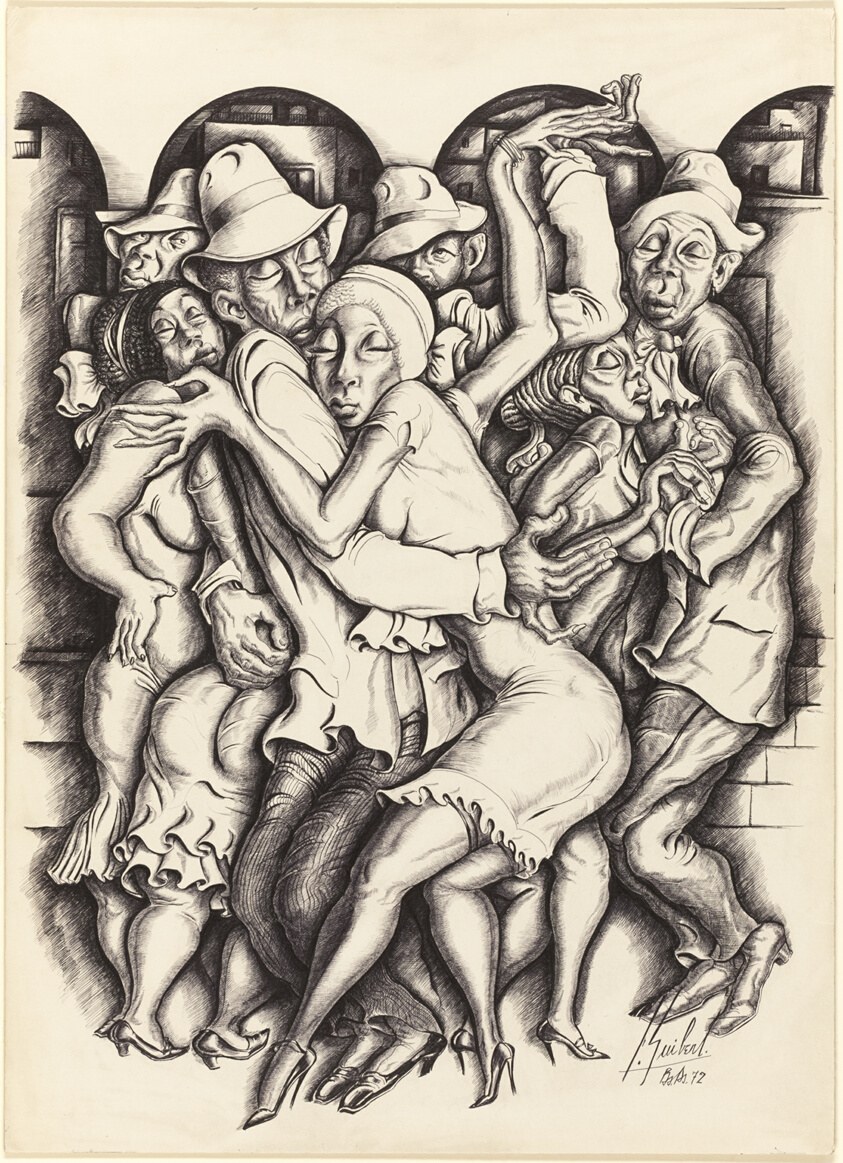
Negros Milongueando
Fernando Guibert Argentine, born 1912
- Medium:
- Black ball-point pen, with black fiber-tipped pen, on off-white laminate board
- Collection:
- Prints and Drawings
- Source:
- Art Institute of Chicago
- Rights:
- Rights reserved by the holding institution — do not reuse without permission. Source record ↗
- Recorded as:
- AIC — rights reserved
The milonga is foundational to tango but is often overlooked in favor of the dance itself; this image insists on the social context and gendered dynamics that shape how tango is actually danced. Guibert's formal choices—the centering of the woman's movement, the ring of witnesses, the compressed space—make visible the social choreography of the milonga as much as the dance steps themselves. For historians of tango and of working-class cultural life, the image is documentary evidence of how the dance was lived.
What you are looking at
A crowded interior scene rendered in black ink on pale board, depicting a tightly packed group of figures in what appears to be a working-class or street setting. The composition is structured around a central female figure in white, wearing a headscarf and light dress, who is the focal point of the composition. She is surrounded by numerous male figures wearing hats—fedoras, wide-brimmed hats, and caps—rendered in darker tones. The setting suggests an urban interior: architectural elements including what appears to be doorways or windows with small rectangles suggesting panes frame the upper edges. The figures are densely overlapped, their bodies pressing against one another in a compressed, almost claustrophobic arrangement. The artist has used strong contrasts between the white of the central woman's clothing and the darker hatched shading covering the male figures, creating visual emphasis despite the crowding. The overall mood is one of physical proximity and social intensity—whether celebratory, confrontational, or transactional remains ambiguous.
The dancing
The central woman's body is angled and mobile, her arms raised and limbs in motion suggesting active movement or dance. Her posture is open and engaged. The surrounding men lean inward, their bodies oriented toward her, creating a circle or vortex of attention. Several male figures display forward-leaning stances and bent arms, suggesting they are responding to or participating in whatever the woman is doing. The density of overlapping forms makes it difficult to discern individual footwork, but the overall composition conveys kinetic energy radiating from the center outward. The woman's isolation by color and position reads as the locus of action, while the men function as witnesses, participants, or pursuers.
The dance depicted
The title *Negros Milongueando* explicitly identifies this as a milonga—the social dance tradition and gathering associated with Argentine tango culture. The milonga is both a dance and the venue where tango is danced; it emerged in late 19th-century Argentina among working-class communities. This image appears to document a street or basement milonga, emphasizing the working-class character of the scene through the dress (hats, simple clothing) and the compressed interior setting. The central woman's animated posture and the circle of men watching and engaging with her aligns with milonga tradition, where women and men negotiate partnership and perform both formally and socially. The artist's choice to emphasize the woman's movement while surrounding her with intent male figures captures a key social dynamic of the milonga: the interplay of autonomy and desire, performance and partnership.
How it was made
The work is executed in black ball-point pen with black fiber-tipped pen on off-white laminate board, a mixed-media approach using readily available writing instruments rather than fine-art media. This technique allows for both precise line work and areas of dense hatching and shading that create volume and shadow. The laminate board suggests this may be a sketch or study rather than a finished artwork, or alternatively, the artist's deliberate choice of accessible materials reflecting the subject matter's working-class character. The technique creates a graphic, urgent quality—more akin to drawing from life or reportage than to polished printmaking, though the high contrast and bold compositional structure suggest intentional design.
About this work
This 1972 drawing by Fernando Guibert documents a milonga—the social dance gathering central to Argentine tango culture—with a focus on the tension between the autonomous, dancing woman and the circle of men around her. The work captures not a formal performance but the lived social reality of the dance: the spatial and erotic dynamics, the class character of the milonga, the gendered attention and negotiation that shape the space. Guibert's choice of drawing technique and composition emphasizes the immediacy and social density of the moment rather than idealized grace. The work belongs in dance history as a record of how tango culture organized bodies, desire, and public space in mid-20th-century Argentina.
How to look at it
Attend first to the compositional geometry: how the artist has used the woman's white clothing and raised, moving limbs to create a visual vortex that organizes all the surrounding male figures around her. Notice how the hatching and shading render three dimensions in a compressed space—the overlapping bodies and the use of light and dark create the sense of physical crowding that is the actual condition of a milonga. Look at the woman's posture and the direction of the men's gazes and bodies; the artist has frozen a moment of social interaction, not a dance step. The choice of a sketch medium and accessible materials (ballpoint pen) is itself significant: it suggests reportage, immediacy, and accessibility rather than fine-art preciousness.
The artist
Fernando Guibert (Argentine, born 1912) was a visual artist working in Argentina during the mid-20th century. His practice focused on social subjects drawn from working-class and street life, executed in graphic media that prioritized accessibility and immediacy over fine-art refinement. His engagement with tango culture and milonga scenes reflects the artist's interest in capturing lived experience and social dynamics rather than romanticized or theatrical versions of Argentine culture. The date of 1972 places this work late in Guibert's career and in the context of significant political and cultural change in Argentina.
The period
In 1972, Argentina was in political upheaval during the Dirty War era; tango culture and the milonga carried deep symbolic weight as expressions of working-class identity and national culture. The milonga itself had evolved significantly since the late 19th century when tango emerged, becoming institutionalized as a social institution while remaining rooted in working-class neighborhoods. By the 1970s, tango was simultaneously celebrated as a national treasure and lived as an everyday social practice. Visually, mid-20th-century Argentine art was increasingly turning to realist and expressionist modes that could capture social conditions and working-class experience, moving away from earlier aesthetic formalisms. Guibert's graphic, densely composed style aligns with this shift toward social documentation.
Where it lives
The work is held in the Art Institute of Chicago's Prints and Drawings collection, catalogued as a drawing on laminate board rather than as a print. Its classification within the prints and drawings collection suggests it circulated within art-world contexts, though the accessible medium and socially engaged subject matter indicate the artist's intent to reach beyond gallery audiences.
Dance in this work
Questions about this work
What is a milonga?
A milonga is both a style of Argentine music and dance and the social gathering where tango is danced. Milongas are typically held in dedicated venues (dance halls, basements, street spaces) and function as social events where people gather to dance, socialize, and participate in tango culture. The milonga is governed by distinct social codes and etiquette that shape how partners meet, choose, and dance together.
Why is this image centered on a single woman surrounded by men?
The composition reflects the actual social dynamics of the milonga, where men traditionally invite women to dance. The woman's central position and active movement emphasize her agency and desirability, while the surrounding men represent the community of potential partners and witnesses. This arrangement was typical in milonga culture and Guibert's image documents that social fact visually.
What does the title 'Negros Milongueando' mean?
*Negros* refers to Afro-Argentine and working-class communities; *milongueando* means 'engaging in milonga' or 'dancing the milonga.' The title situates the scene within a specific social and racial identity. Tango and the milonga emerged from multiracial working-class culture in Buenos Aires, though this history is often erased in later celebrations of tango as a national treasure.
Why is this drawn rather than photographed?
Drawing allowed Guibert to compress and intensify the social relationships and spatial dynamics of the milonga in ways a photograph could not. The overlapping forms, the use of white and black to create emphasis, and the rhythmic repetition of hats and bodies create a visual composition that conveys the felt experience of the crowded, intimate space more powerfully than documentary realism could.
More dance artwork





