49 works in this view — arrow keys or swipe to move between them.
Dance in Art
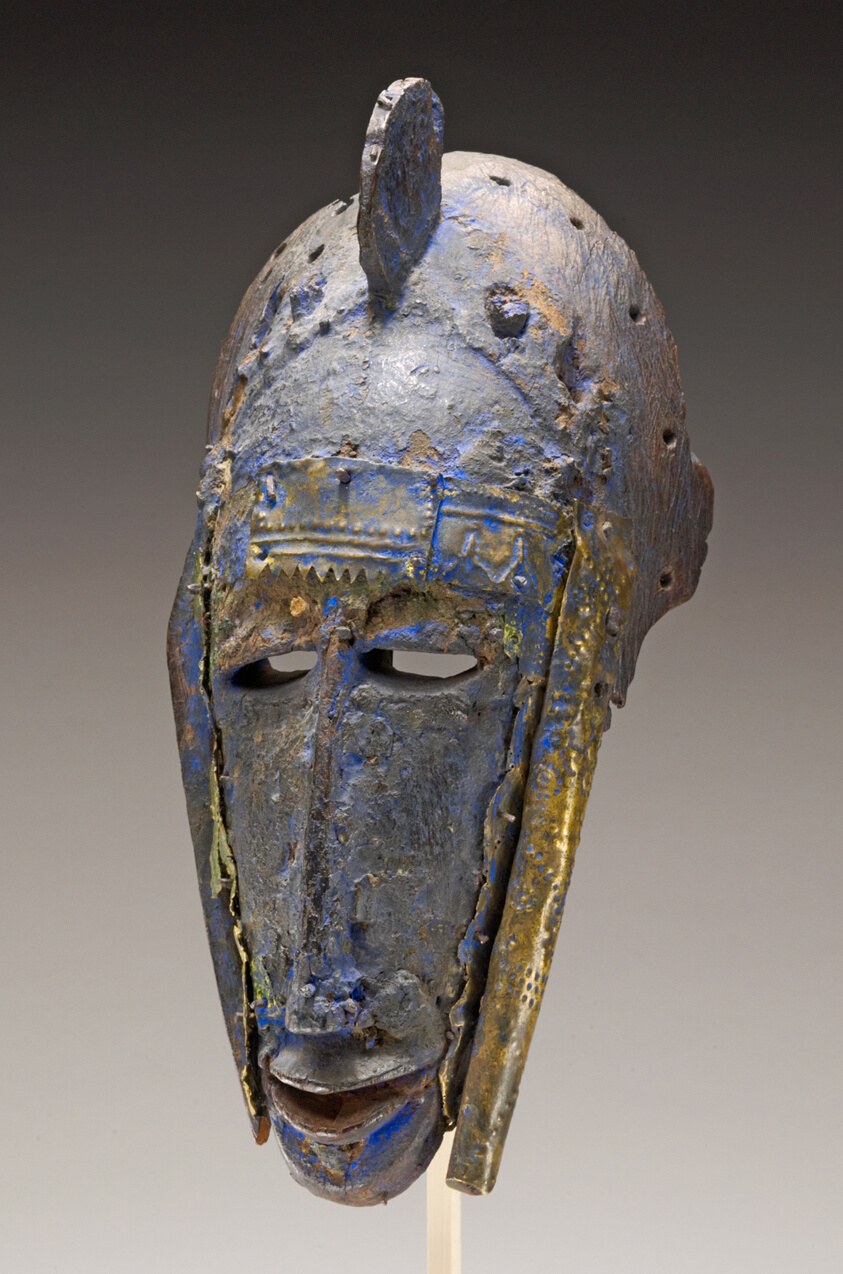
Female Face Mask
Bamana, Marka, or Sorogo Eastern Segou region, Mali Northern Africa and the Sahel
- Medium:
- Wood, copper, and indigo
- Collection:
- Arts of Africa
- Source:
- Art Institute of Chicago
- Rights:
- Rights reserved by the holding institution — do not reuse without permission. Source record ↗
- Recorded as:
- AIC — rights reserved
This mask is material evidence of West African masked dance in the 19th century. It shows how skilled craftspeople designed masks not as static sculptures but as wearable objects engineered for performance—and the visible wear patterns prove it was actually danced in. For historians of African dance, particularly before the era of video recording, such objects are among the few remaining traces of how movement was practiced, costumed, and valued.
What you are looking at
A wooden mask carved in the round, darkened by age and use, its surface incised with geometric patterns and embellished with copper and indigo inlay. The face is broad and mask-like, with a long rectangular form tapering downward. Two horizontal eye openings are cut through the wood. Above the face, a tall vertical projection rises like a crest or headdress, its edges faceted and sharp. The mouth is carved as an open O, suggesting vocalization or song. Small circular perforations dot the surface across the cheeks and crown—possibly for the attachment of fibers, raffia, or feathers, or to reduce weight. The patina shows deep browns and blacks from handling and age; traces of vivid blue indigo remain visible in the recessed areas and along the edges, with warm golden-bronze copper showing on the raised surfaces and around the mouth and eyes. The mask is presented as a three-dimensional object, and its form suggests it was meant to be worn over the face or carried prominently in movement.
The dancing
This is not a representation of a dancer but a material object—a mask itself. However, the mask's design and finish suggest it was worn on the face and body of a performer. The tall crest projects upward from the crown, which would extend the dancer's vertical line and increase visual presence. The open mouth and forward-facing eye holes indicate that the wearer could both see and vocalize or sing while masked. The lightness suggested by the perforations and the balanced proportions of the face to crest suggest the mask was designed to be worn in movement without excessive weight or impediment.
The dance depicted
This is a face mask from the Bamana, Marka, or Sorogo peoples of the Eastern Segou region in Mali, made in the mid-19th century. Among these West African cultures, carved wooden masks were worn in sacred ceremonies, initiation rites, and social dances, often by members of masked societies such as the Kore, Komo, and others. The tall vertical crest is characteristic of certain Bamana mask types. Masks of this form were worn during choreographed dances that involved the masked figure moving among spectators, performing prescribed steps and gestures. The visible wear and patina indicate this mask saw actual use—it was danced in, not merely displayed. Without further documentation, the specific dance or ceremony it belonged to cannot be named with certainty, but the form and finish are consistent with masks used in rites that combined dance, music, and community participation.
How it was made
The mask is hand-carved wood, finished with incised linear patterns and inlaid with copper and indigo. The copper (likely copper sheets or wire) would have been cold-hammered or attached into recesses, creating the warm metallic highlights visible on the face and mouth. The indigo, a plant-based dye, was applied to the wood—possibly as a paste or stain—and has survived in the recessed areas and along carved edges. This technique of combining wood carving with precious metal and deep-blue inlay was a mark of high status and skilled craftsmanship in West African mask-making. The intentional perforations suggest the maker planned for the mask to be augmented with ephemeral materials (fiber, feathers, cloth) that would have moved with the dancer. The weathering and darkening of the wood over time has given it a rich patina that emphasizes the carved relief and the lingering traces of the inlay.
About this work
This is a 19th-century Bamana or related Mali mask carved and inlaid with copper and indigo—not a depiction of dance, but a dance object itself. It belonged to a masked performer and was worn during communal or sacred ceremonies that combined choreographed movement, music, and social participation. The mask's design—its tall crest, open mouth, and light weight—was engineered for wear in movement. Its survival in collections places it among the most significant material evidence of West African dance practice in the colonial and pre-colonial periods, when these masks were still in active ritual use.
The mask sits at the intersection of sculpture, material culture, and performance history. To scholars of African dance, it represents a moment before many such masks left Africa and before the ceremonies they served were disrupted or lost. To art historians, it documents techniques of wood carving and metal inlay. To dancers and choreographers, it is a record of how movement was costumed and enhanced—how a person's body was transformed into something other-than-human through combined craft.
How to look at it
Examine the mask's weight distribution and balance. The tall crest is narrow and would not have impeded the wearer's sight; the eye holes are positioned to allow forward vision. The open mouth suggests the dancer could sing, call, or breathe audibly. Notice the perforations across the face—these would have held fibers or feathers that moved independently of the wood, multiplying the visual effect of the dancer's own movement. The patina and wear marks, especially around the mouth and eye edges, show how the mask was gripped and adjusted during use. The interplay of blue (indigo) in the recesses and gold (copper) on the raised surfaces means the mask would have caught light and color differently as the wearer moved, making the mask's presence visible from a distance.
The artist
The mask is attributed to the Bamana, Marka, or Sorogo peoples of the Eastern Segou region in Mali, but the specific carver is unknown. These cultures maintained rich traditions of mask-carving within formal societies (such as Kore and Komo), where carving knowledge was transmitted through apprenticeship and family lines. Masks were typically made to order for specific ceremonies and dancers, and the carver's identity mattered less than the mask's effectiveness in ritual and performance. The high quality of the inlay work and the balanced proportions suggest the maker was an accomplished craftsperson with access to materials (copper and indigo) that required trade networks or wealth.
The period
In the mid-19th century, the Bamana and related peoples of Mali were experiencing significant political and economic change. The Bamana kingdoms had fractured; the region was contested by expanding empires and European colonial interest; and the slave trade and its aftermath still shaped regional economies. Despite these pressures, masked societies and ceremonies continued. Masks of this period show the continuation of long-established aesthetic and functional traditions—geometric incised patterns, the integration of metal and dye, and the engineering of masks for movement. At the same time, this mask was made during the early period of European collection and museum acquisition, meaning its survival may owe as much to removal from Africa (in some cases by colonial officials or traders) as to its own cultural preservation. The presence of such masks in museum collections today is a reminder of the history of cultural appropriation alongside the value of preservation.
Where it lives
The mask is housed in the Art Institute of Chicago's Arts of Africa collection. The record provides no acquisition date, donor, or prior history. Many masks of this type entered Western collections during or after the colonial period (late 19th and 20th centuries), though this example's early 19th-century date suggests it may have been collected earlier. The source attribution to the Art Institute's records does not indicate how or when the mask left Mali.
Dance in this work
Questions about this work
Was this mask actually worn in dance, or is it a sculptural artwork?
It was worn in dance. The worn edges, patina, and visible handling marks show this mask saw active use in performance. It is not a carved sculpture made for display, but a functional costume object engineered for a dancer's body and movement.
What dance was this mask worn in?
Without more documentation, we cannot name a specific dance. The form is consistent with masks used in Bamana masked societies (such as Kore or Komo), which performed in communal and initiation ceremonies. The mask's design and wear suggest the wearer performed in structured, repeated movements—a choreography—rather than improvisation.
What are the holes and perforations for?
The two large oval openings are for the wearer's eyes. The smaller circular perforations across the surface likely held fiber, raffia, or feathers that would move with the dancer. These additions would have made the mask visually larger and more dramatic in motion, while also lightening the overall weight.
Why is the mask inlaid with copper and indigo?
Copper and indigo were precious materials—copper had to be traded or worked from ore, and indigo (a plant-based dye) was laborious to produce. Their use marked the mask as valuable and the wearer as important. The materials also served an aesthetic function: the warm bronze and deep blue would catch light and stand out during performance, especially in outdoor or firelit ceremonies.
More dance artwork





