49 works in this view — arrow keys or swipe to move between them.
Dance in Art
Australian Ballet Club
Australian Ballet Club
- Collection:
- Fan
- Source:
- Victoria and Albert Museum
- Rights:
- Rights vary by item — check the source record before reusing this image. Source record ↗
- Recorded as:
- V&A — check rights per item
This fan documents a specific moment in late-twentieth-century ballet history: the European touring prominence of the Arolsen Ballet, the role of royal patronage in validating classical dance institutions, and the Australian Ballet Club's participation in the international ballet world. It is a tangible reminder that dance history is preserved not only in photographs and programs, but in the objects that attended major cultural moments.
What you are looking at
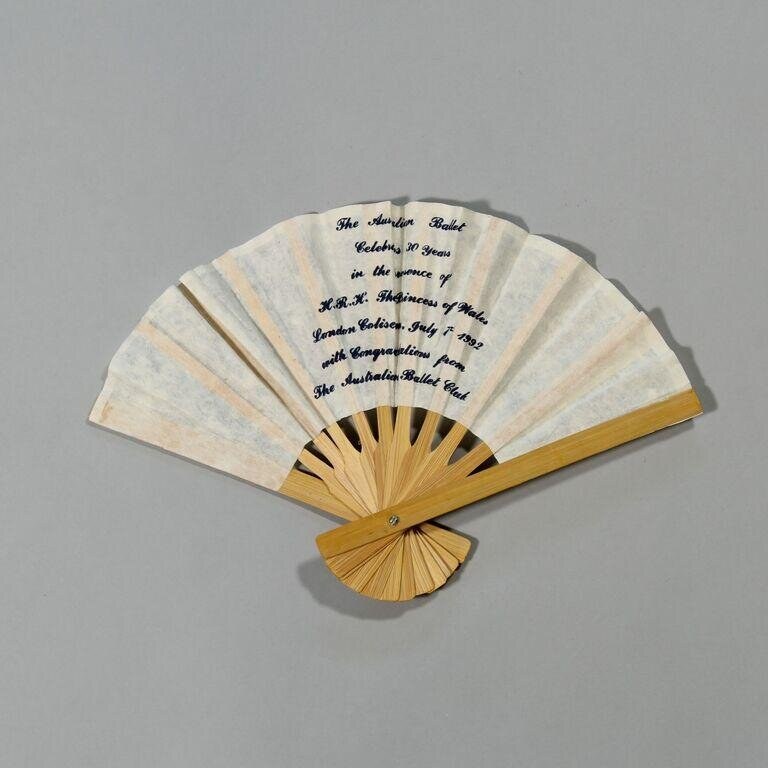
A cream-colored silk or linen folding fan, mounted on light wooden staves, bears an inscription in navy blue script on its upper leaf. The text reads: "The Arolsen Ballet / celebrates 30 years / in the presence of / H.R.H. Princess of Wales / London Coliseum, July 4 1987 / with congratulations from / The Australian Ballet Club." The fan is photographed flat against a neutral gray background, casting a subtle shadow. The wooden frame—visible where the fabric ends—is pale honey-colored, and the staves radiate from a simple fastening point at the base, creating the characteristic semicircular form of a folding fan. The inscription is centered across the open leaf in a flowing, elegant hand.
The dancing
No figures or dancers are depicted. This is an inscribed object rather than a scene of dance, though it references the Arolsen Ballet's institutional anniversary and the patronage of royal attendance.
The dance depicted
This is a commemorative fan, not a depiction of dance. It documents the Arolsen Ballet's thirtieth anniversary celebration held at the London Coliseum on 4 July 1987, attended by H.R.H. the Princess of Wales, with congratulations offered by the Australian Ballet Club. The fan serves as a souvenir of this institutional milestone rather than as a record of choreography, costume, or performance technique.
How it was made
This is a folding fan, a functional object made from cream-colored fabric (likely silk or linen) stretched over light wooden staves. The inscription is hand-lettered in ink rather than printed, suggesting either manuscript inscription at or near the time of the event, or a high-quality calligraphic treatment suitable for a commemorative gift. The fan's structure—with radiating wooden supports and a fastening mechanism—is typical of late-twentieth-century folding fans, designed for both use and display. The choice of a fan as the vehicle for commemoration reflects its traditional role as an object of prestige and formality.
About this work
This is a commemorative folding fan inscribed to mark the thirtieth anniversary of the Arolsen Ballet, celebrated in London in July 1987 with royal patronage. The Australian Ballet Club offered this souvenir to document the occasion. As an artifact, it belongs in a dance gallery not because it depicts dance, but because it is a material record of institutional dance history and international cultural exchange—evidence of how ballet companies celebrated milestones and how audiences and peer organizations marked such events through gifts and ceremonial objects.
How to look at it
Attend to the quality of the hand-lettering, which conveys both the formality of the occasion and the care taken in creating the gift. Note the choice of the fan itself—a classical object of ceremony and elegance, conferring prestige through tradition. The specific details inscribed (the venue, the date, the royal attendee, the contributing organization) transform a functional object into a historical document, one that records not the performance itself but the institutional and social context in which it was staged.
The artist
Unknown. The fan was created as a gift from the Australian Ballet Club to commemorate the Arolsen Ballet's anniversary. The hand-lettering suggests a calligrapher or skilled scribe, but no artist is identified in the record.
The period
In the 1980s, European and British ballet companies undertook major international tours, and royal and institutional patronage remained central to their prestige and funding. The Arolsen Ballet, based in Detmold, Germany, had achieved sufficient international standing to celebrate its thirtieth anniversary with a London season and royal attendance. The Australian Ballet Club's commissioning of a commemorative fan reflects the transnational networks of ballet appreciation and the tradition of formal souvenirs marking institutional anniversaries. This was an era when ballet remained a formally celebrated art form, and such occasions were marked with objects of elegance and restraint.
Where it lives
Held in a dance-related collection with source designation 'va', likely indicating a museum or archive with dance holdings. The fan is identified as a commemorative artifact created in 1987 or shortly thereafter, presented as a souvenir of the London Coliseum event.
Questions about this work
Who was the Princess of Wales who attended this performance?
The record does not specify. Given the date of 4 July 1987, this would have been Diana, Princess of Wales, who was active in patronizing the arts during that period.
Is this object a fan you could actually use?
Yes. The construction—cream fabric stretched on wooden staves with a functioning pivot—is that of a working folding fan. However, its commemorative inscription and historical significance mean it would typically be preserved rather than used.
Why would a ballet fan be a fitting souvenir?
Fans have long been associated with theater-going, elegance, and court culture. By the 1980s, while no longer essential, a commemorative fan evoked that heritage and conferred a sense of formality and occasion appropriate to a major ballet anniversary.
More dance artwork





