49 works in this view — arrow keys or swipe to move between them.
Dance in Art
Illustration
White, Ethelbert
- Collection:
- Illustration
- Source:
- Victoria and Albert Museum
- Rights:
- Rights vary by item — check the source record before reusing this image. Source record ↗
- Recorded as:
- V&A — check rights per item
This work documents how early 20th-century British artists visualized non-Western ceremony and ritual, often through a lens of formal beauty rather than ethnographic accuracy. For dance historians, it offers insight into what visual forms—procession, matching dress, ceremonial bearing—were read as inherently 'other' or exotic by the modernist avant-garde. The spare, graphic style also demonstrates how the formal language of modernism was applied to subject matter far removed from European ballroom or theatrical convention.
What you are looking at
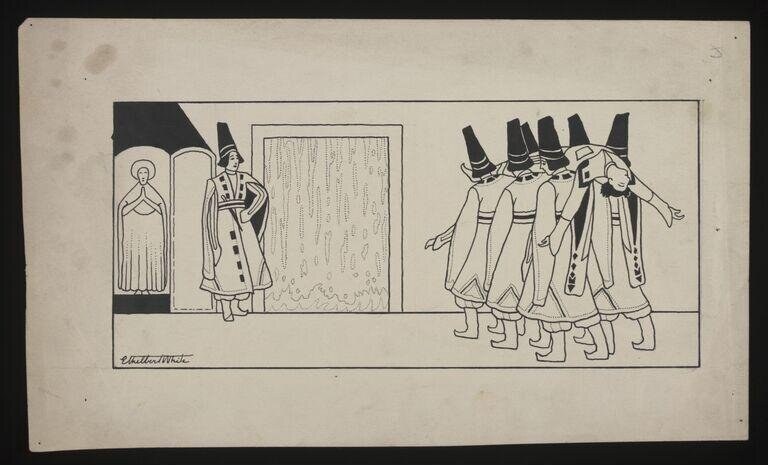
A black-and-white illustration divided into two scenes. On the left, a tall figure in an ornate tall headdress and decorated robe stands beside a doorway, gesturing toward the interior where a second figure in similar dress is visible. On the right, five figures in matching tall headdresses and long decorated robes stand in a line, their bodies angled slightly inward as if forming a unified group. The composition is spare and elegant, with bold outlines characteristic of early 20th-century graphic design. The tall headdresses dominate each figure, rising well above the head, and the robes fall in straight lines to the ankles. The interior space suggested by the doorway on the left is rendered with simple parallel lines indicating drapery or a curtain.
The dancing
The figures are rendered in profile and three-quarter view, with little articulation of joints or musculature; bodies are simple, elongated forms. The five figures on the right lean inward subtly toward a common center, their arms hanging or held close to the body, suggesting a processional or ceremonial formation rather than active dance movement. The gesture of the figure on the left—one arm extended, palm up—appears to be directing or presenting the group rather than dancing. There is no visible footwork or complex limb position; the emphasis is on the stillness and uniformity of the line.
The dance depicted
This appears to depict a ritual or ceremonial procession rather than theatrical dance. The tall cylindrical headdresses, the formal matching robes, and the processional arrangement suggest either a religious ceremony, a court ritual, or a formal pageantry. The 1919 date and the graphic style suggest this may be inspired by historical or ethnographic imagery rather than a living dance practice the artist observed directly. Without inscription or further context, the specific tradition cannot be identified with confidence, though the formality and repetition suggest sacred or ceremonial purpose.
How it was made
This is a line drawing or illustration, likely created for print reproduction. The even black lines, the absence of shading or tone, and the simplified forms are consistent with lithographic or engraved illustration of the period. The technique allowed rapid, economical reproduction suitable for publication in a magazine, book, or portfolio—reaching a broad educated audience. The stark graphic quality gives the work a modern, almost decorative quality despite its ethnographic or historical subject matter.
About this work
This 1919 illustration by Ethelbert White depicts a formal procession of five figures in ceremonial dress, introduced by a sixth figure who gestures toward them from a doorway. The artist has captured a moment of ritual presentation through bold outlines and elegant simplification. The work sits at the intersection of early modernist graphic design and documentary interest in non-Western or historical ceremony—a common concern of British artists and designers in the early 20th century. It belongs in a gallery of dance as a record of how ceremony and pageantry were understood and aestheticized by contemporary visual artists.
How to look at it
Attend to the compositional balance between the single presenter on the left and the unified line on the right—White has chosen a moment of introduction or revelation rather than active movement. Notice the uniformity of the headdresses and robes, which strips individual identity and emphasizes collective ritual identity. The simplicity of the outline and the absence of anatomical detail create a sense of formality and remove the figure from naturalism into the realm of symbol or design. The figure's gesture—open-palmed, outward—is the only moment of dynamic direction; everything else is still, ceremonial, presented.
The artist
Ethelbert White (1891–1972) was a British painter, printmaker, and illustrator associated with the Camden Town Group and later with neo-Romantic landscape and figure work. He was known for decorative line drawings and woodcuts, often with literary or theatrical subjects. His work appeared regularly in periodicals and books of the 1910s and 1920s, and he was active in the design and illustration world of Bloomsbury-adjacent circles. The elegance and economy of this drawing is typical of his graphic output.
The period
In 1919, the year after World War I ended, interest in ritual, ceremony, and non-European culture was surging among European avant-garde artists and designers. The Ballets Russes, founded in 1909, had already demonstrated the commercial and artistic power of exoticist spectacle and non-Western movement vocabularies. Simultaneously, British and Continental artists were engaged with primitivism, folk traditions, and historical pageantry. Illustration and graphic design were at the forefront of modernist practice, and the cleanly outlined figure was a dominant formal language. White's illustration belongs to this moment of cultural enthusiasm and formal innovation.
Where it lives
The work is held in the Victoria and Albert Museum as a catalogued illustration. The artist's signature appears in the lower left. The work is identified as an illustration rather than a finished fine art work, suggesting it may have been created for publication or as part of a design portfolio rather than as a standalone artwork.
Questions about this work
What dance form is this?
The image does not depict an active dance, but rather a formal procession or ceremonial presentation. The tall headdresses, matching robes, and processional arrangement suggest a ritual or court ceremony rather than a choreographed dance form. Without further context or inscription, the specific tradition cannot be identified.
Why are all the figures identical?
The repetition and uniformity reflect the artist's interest in pattern, formal design, and collective ritual identity rather than individual expression. This was a common approach in modernist graphic design, and it emphasizes the ceremonial and impersonal nature of the scene.
Is this from a real tradition?
The work appears to be inspired by ethnographic or historical sources available to White in 1919, but the simplified, decorative approach suggests the artist prioritized formal beauty over documentary accuracy. It likely reflects early 20th-century Western perception of non-Western ceremony rather than a faithful record of any specific practice.
More dance artwork





