49 works in this view — arrow keys or swipe to move between them.
Dance in Art
Illustration
White, Ethelbert
- Collection:
- Illustration
- Source:
- Victoria and Albert Museum
- Rights:
- Rights vary by item — check the source record before reusing this image. Source record ↗
- Recorded as:
- V&A — check rights per item
The work documents early 20th-century theatrical costume and formation practice, showing how historical or exotic dress was imagined and presented on stage. For historians of costume, staging, and theatrical spectacle, it is a precise record of a moment that would otherwise be known only through texts or photographs.
What you are looking at
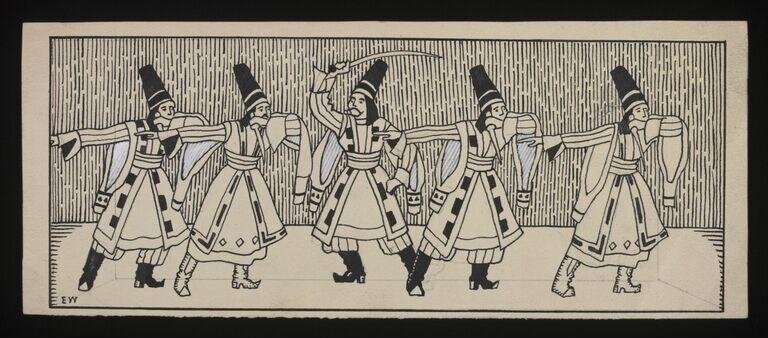
Five figures in classical or pseudo-classical dress stand in a line across the composition, each holding a large curved axe or halberd-like weapon. They wear tall plumed headdresses, decorated tunics with geometric patterns, and dark boots or leg wrappings. The foreground is bare; the background is entirely filled with fine parallel hatching lines that create a neutral, emphatic backdrop. The figures are evenly spaced and symmetrical, facing forward or turned slightly outward with their weapons raised at varied angles. This is a formal, staged arrangement rather than a narrative moment—more like a ceremonial or processional display than a combat or labor scene.
The dancing
All five figures stand upright with similar posture and weight distribution. Their arms are raised and extended to hold the weapons at shoulder height or above; the limbs are long and somewhat stylized. The bodies face forward or show only shallow profile turns. There is no interlock or partnership hold; each figure is autonomous. The stance is rigid and formal, with legs planted firmly rather than suggesting movement through space. The raised weapon position and parallel stance suggests either a ceremonial presentation or a synchronized formation rather than social or theatrical dance.
The dance depicted
This appears to be a choreographed or ceremonial formation rather than a recognizable dance tradition. The formal line, identical costume, symmetrical spacing, and raised weapons suggest a processional, martial, or court ceremonial from a historical or fantastic setting. The pseudo-classical dress and weaponry could reference 19th-century historical or orientalist staging, or could be drawn from theatrical or operatic costume conventions of the Edwardian era. Without inscription or clearer context, the specific dance form cannot be identified with confidence; the work may represent a processional moment, a tableau, or a scene from a theatrical work rather than a named dance style.
How it was made
This is a line engraving or wood engraving, identified from the parallel hatching lines, crisp black-and-white contrast, and fine linear detail throughout. The technique allows precise representation of fabric texture, decorative detail, and the formal geometry of the composition. The uniform line weight and detailed cross-hatching suggest professional reproductive work, likely created for reproduction in a publication or portfolio. The formal composition and technical finish indicate this was not a sketch but a finished work intended for wide circulation.
About this work
This is a formal engraving depicting five figures in ceremonial or theatrical costume arranged in a symmetrical line, each holding a large curved weapon or ceremonial object. The work is dated 1919 and attributed to Ethelbert White, a British artist known for illustration and printmaking. The image presents a moment of formation or processional display rather than kinetic dance, but its ceremonial and staged character, formal costume, and theatrical framing place it within the visual culture of historical dance documentation and costume design of the early 20th century. The work belongs in a dance archive as a record of theatrical staging, costume convention, and the formal aesthetics of early 20th-century dramatic or operatic spectacle.
How to look at it
Attend to the perfect symmetry and spacing: this is not a moment of movement but of formal presentation. Notice the costume detail—the plumed headdresses, the geometric patterns on the tunics, the dark wrappings on the legs—which grounds the image in a specific theatrical vocabulary. The raised weapons and forward-facing stance create a ceremonial or martial register rather than a dance register. The fine hatching in the background emphasizes the geometric purity of the formation and suggests this is a documentary record of a staged arrangement rather than an observation of moving bodies.
The artist
Ethelbert White (1891–1972) was a British painter, printmaker, and illustrator active from the 1910s onward. He was known for precise linear work in engraving and etching, and for book and periodical illustration. His practice often engaged with historical, literary, and theatrical subjects, and he was part of the generation of British printmakers working in revival techniques (wood engraving, line engraving) in the early 20th century.
The period
In 1919, British theatre and visual culture were engaged with historical pageantry, classical and exotic costume drama, and the visual spectacle inherited from 19th-century grand opera and orientalist stage practice. The formal symmetry and raised-weapon formation seen here reflect theatrical staging conventions of the period and the influence of classical (Greek and Roman) revival aesthetics on theatrical costume and composition. Early 20th-century illustrators like White often documented stage design and costume as part of their professional work.
Where it lives
The work is held in an illustration collection (designation 'va' suggests a museum or library with visual arts holdings). It is catalogued as an illustration rather than a fine art print, suggesting it may have been created for or published in a periodical, book, or theatrical program of the 1919 period.
Dance in this work
Questions about this work
Is this actually a dance?
This depicts a formal, synchronized formation in theatrical costume, presented as a line with raised weapons. It may represent a processional moment, a ceremonial tableau, or a scene from an opera or historical drama rather than a social or concert dance. The formal stasis and military-ceremonial aesthetics place it at the border between dance, theatre, and spectacle.
What does the costume tell us?
The tall plumed headdresses, decorated tunics, and dark leg wrappings follow early 20th-century theatrical conventions for historical or 'exotic' dress. The pseudo-classical style and formal symmetry suggest a stage production drawing on Greco-Roman or orientalist aesthetics popular in opera and historical pageantry of that era.
Why is this an engraving?
Engravings and etchings allowed precise reproduction for publication in periodicals, books, and portfolios. An artist like White would have created such a work to document a stage design or production, or to provide illustration for a literary or theatrical text. The fine line work and formal composition suggest this was intended for wide circulation.
More dance artwork





