49 works in this view — arrow keys or swipe to move between them.
Dance in Art
Illustration
White, Ethelbert
- Collection:
- Illustration
- Source:
- Victoria and Albert Museum
- Rights:
- Rights vary by item — check the source record before reusing this image. Source record ↗
- Recorded as:
- V&A — check rights per item
For dance historians and costume researchers, this work documents the visual currency of non-Western ceremonial dress in early 20th-century European theatrical and documentary contexts—showing not how the dress functioned in its source culture but how it was understood, simplified, and presented for British and European audiences.
What you are looking at
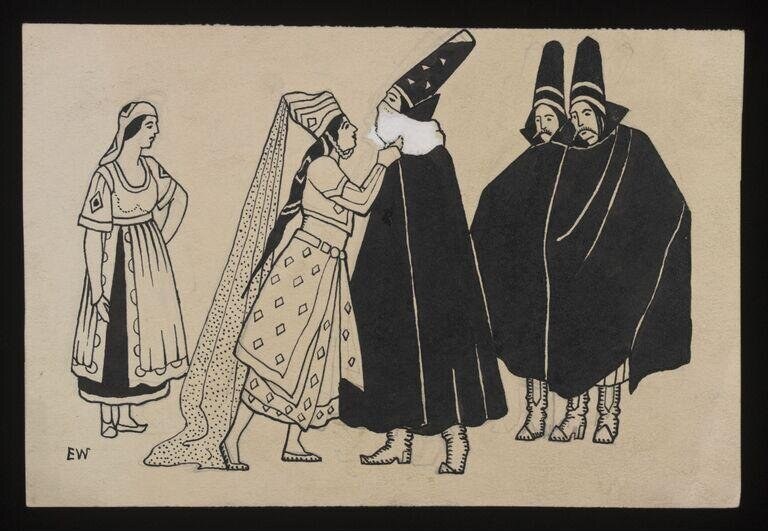
Five figures stand in a single-plane composition against a plain background, depicted in stark black line against cream. The work reads as a costume study or theatrical character sheet. On the far left stands a woman in a simple draped dress with geometric embroidery at the hem, her hair bound. To her right, a figure wears an elaborate costume with a tall geometric headdress (patterned with dark and light diamonds), a fitted bodice decorated with geometric shapes, and a long veil or shawl of patterned fabric draped from the shoulders and held aloft—this figure dominates compositionally. To the right of center, two figures in dark cloaks or heavy wraps stand close together, both wearing distinctive tall, composite headdresses resembling stacked forms or ceremonial crowns; their faces show frontal gaze and serious expression. The style is documentary illustration with strong outlines and minimal interior modeling, consistent with early 20th-century theatrical or ethnographic draftsmanship.
The dancing
None of the figures are in active movement; all stand in static, frontal or near-frontal pose with neutral weight distribution. The figures do not touch or form a group; they are isolated units arranged for display rather than caught in action. Arms hang at sides or are positioned only as required to hold the draped veil. This is not a dance scene in action but a costume plate—a presentational format common to theatrical or anthropological documentation.
The dance depicted
The image does not depict dance or dancers in motion. It is a costume or character study, most likely documentary illustration of ceremonial or folk dress from a specific culture. The tall headdresses, geometric patterning, and heavy drapery suggest Central Asian, Eastern European, or Caucasian ceremonial dress. The composition and style suggest ethnographic or theatrical documentation rather than the representation of an active dance practice.
How it was made
This is a pen or ink line drawing on paper, likely created as an illustration for publication or costume documentation. The stark, even line weight and clear silhouettes suggest it was made to be reproduced—either as an engraving, woodcut, or lithograph, or prepared for one. The minimal modeling and reliance on silhouette and outline are economical and direct, suited to black-and-white reproduction and economical printing. The style is consistent with early 20th-century theatrical or anthropological illustration.
About this work
This is a costume or character study, not a dance scene—a documentary illustration of five figures in ceremonial or folk dress, likely from Central Asia, Eastern Europe, or the Caucasus. The work is drawn in spare, clear line and shows no movement or interaction; instead it functions as a plate presenting costume variants for reference or study. It reflects early 20th-century theatrical and ethnographic practice of recording dress and appearance through simplified, frontal illustration. The artist has organized the figures to display costume elements—headdresses, veil construction, drape, and geometric patterning—rather than to show how these clothes moved or were worn in action.
How to look at it
Look first at the headdresses: each is a separate engineered form, rendered in pattern rather than modeled in depth. The second figure's veil is shown held aloft—a moment of display, not wear—emphasizing its construction. Notice the repetition of geometric shapes throughout the textiles. The artist is not interested in movement or embodiment; instead, these figures are vehicles for showing costume components and how they stack, drape, and pattern. The plain background enforces that this is a study, not a scene.
The artist
Ethelbert White (1891–1972) was a British printmaker, illustrator, and painter known for wood engravings, watercolors, and line drawings. He worked extensively in book illustration and created studies of landscape, theater, and ethnographic subjects. His practice combined careful observation with economical draftsmanship suited to reproduction. He was active in early 20th-century British print culture and theatrical design circles.
The period
In 1919, European theater and visual culture were deeply engaged with non-Western costume and dance forms, shaped by Ballets Russes productions (which peaked 1909–1929), ethnographic exhibitions, and colonial collecting. Costume studies and character sheets like this one were standard in theatrical practice and in the ethnographic documentation that circulated in museums and design schools. The simplified, frontal presentation reflects both theatrical convention and the graphic economy of early 20th-century illustration.
Where it lives
The work is held by the Victoria and Albert Museum (indicated by the 'va' source code), where it is catalogued as an illustration. It belongs to the museum's collection of theatrical design, costume studies, and applied art documentation.
Questions about this work
Why are these figures just standing still?
This is a costume study, not a dance performance. The artist was documenting clothing, headdresses, and textile patterns for theatrical or reference purposes—the same way a fashion plate works. Movement would distract from the clothes themselves.
What culture or region is this dress from?
The image does not identify the source culture. The tall headdresses, geometric patterns, and heavy draped wraps suggest Central Asian, Caucasian, or Eastern European ceremonial dress, but the work is a British illustration from 1919, not a primary source from those regions. It reflects how these forms were understood and represented in European theatrical contexts.
Is this connected to the Ballets Russes?
It is from the same period and cultural moment as the Ballets Russes (1909–1929), and reflects the widespread European interest in non-Western costume and stagecraft that the company helped popularize. However, there is no evidence in the image itself that it was created for or connected to that company.
More dance artwork





