49 works in this view — arrow keys or swipe to move between them.
Dance in Art
Jacket
Stevenson, Hugh
- Collection:
- Jacket
- Source:
- Victoria and Albert Museum
- Rights:
- Rights vary by item — check the source record before reusing this image. Source record ↗
- Recorded as:
- V&A — check rights per item
Costume garments are primary documents of dance history: they show how bodies were shaped, ornamented, and moved in performance. A surviving jacket of this specificity reveals the labour of costume-making and the conventions of a theatrical moment—in this case, the mid-twentieth-century fascination with Spanish dance on the London and Broadway stage. For a costume historian or dance researcher, the detail of construction, the choice of materials, and the placement of ornament tell a story about how performers were dressed to read as a particular kind of dancer to an audience.
What you are looking at
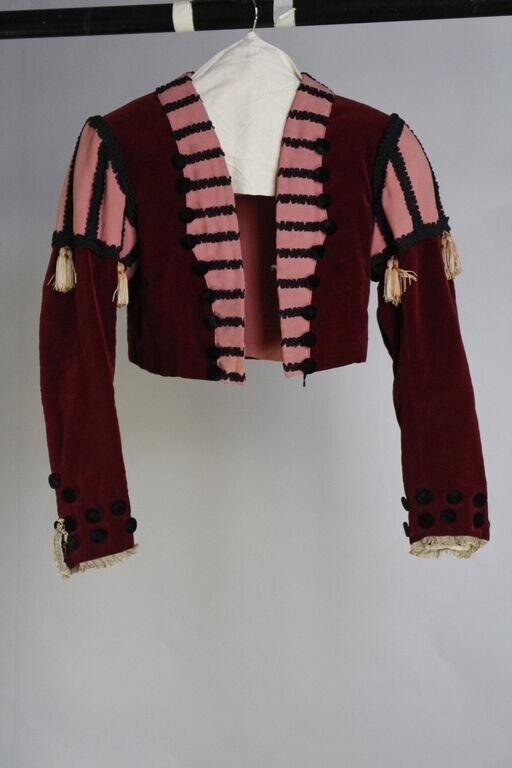
A cropped jacket survives on display, hanging empty on a hanger against a pale background. The garment is a cropped bolero or shrug in deep burgundy velvet, constructed to end well above the waist. The front edges are faced with horizontal stripes in a lighter dusty rose or mauve, creating a structured frame for an open front. The sleeves are three-quarter length, also bordered in the same striped fabric and finished at the cuffs with applied rounds of black buttons—at least four visible on each cuff. The most distinctive feature is the pair of cream or ivory silk tassels that hang from the upper arm area, one on each side, positioned where the sleeve meets the shoulder. The garment appears to be a stage costume or performance piece, made for a dancer rather than street wear.
The dancing
There are no figures or bodies in this image; the jacket is displayed flat and empty. The construction itself speaks to the wearer's body: the cropped waist and three-quarter sleeves suggest a dancer of modest height or an adolescent performer. The placement of the tassels at the shoulder implies a garment designed to move with the upper arm and torso, catching light and air during performance.
The dance depicted
This appears to be a theatrical dance costume jacket, likely from mid-twentieth-century theatre or revue performance. The construction and ornament—the tassels, the striped facing, the button trim—suggest Spanish or Latin-influenced theatrical dance, possibly for a flamenco, Spanish dance, or character number in a musical or ballet. The cropped bolero form is characteristic of Spanish dance costumes. Without the full context of the production for which it was made, the specific dance cannot be determined, but the garment's construction indicates it was built for visibility and movement on stage.
How it was made
This is a surviving costume garment, not a representation of dance. It is constructed velvet fabric, hand-sewn or tailored. The horizontal striping of the facing appears to be woven or printed, and the tassels are hand-attached. As a material object, it preserves the scale, construction methods, and design choices of mid-twentieth-century theatrical costume-making. Such garments survive in museum collections primarily because they are associated with notable productions or performers, or because they represent significant design work.
About this work
This is a burgundy velvet bolero jacket from 1946, identified as a theatrical dance costume. The garment survives as a document of performance practice and costume construction at a specific moment in twentieth-century theatre. The cropped silhouette, striped facing, button trim, and silk tassels are all consistent with Spanish-influenced theatrical dance costumes of the period—a convention shared across ballet, revue, and musical-theatre productions of the era. As a three-dimensional object, it reveals details of construction, fit, and ornamentation that photographs or drawings of a performance could not capture: the precise weight of the velvet, the placement of the tassels relative to the body, the scale of the buttons, the hand-finishing of seams. It belongs in a dance archive because it is an instrument of performance, evidence of how choreographers and costume designers translated the aesthetics of Spanish dance into wearable form for the theatrical stage.
How to look at it
Look at the precision of the construction: the horizontal stripes are regular and controlled, the buttons are deliberately placed and matched, the tassels are positioned symmetrically. These details are not accidental. They are designed to catch light and movement. When the wearer danced, the tassels would have moved with the arm and shoulder, creating visual interest and emphasizing the line of the movement. The cropped waist creates a high, lifted silhouette and exposes the hips—essential for a dancer, as it allows the spectator to read the movement of the lower body clearly. The three-quarter sleeve leaves the forearm free. Every choice here is in service to visibility and movement on stage.
The artist
Hugh Stevenson (1910–1973) was a British theatre designer, notably associated with ballet and theatrical design. He designed costumes and scenery for productions including work with the Sadler's Wells Ballet and other major mid-century theatrical productions. Stevenson was known for his sophisticated approach to costume construction and his ability to marry visual elegance with practical stage requirements.
The period
In 1946, in the immediate postwar period, European and especially British theatre was experiencing a revival of classical forms—ballet had grown in popularity and reach, and Spanish or Latin-influenced dance was a recurrent theme in revue and musical theatre. The cropped bolero as a costume form had a long genealogy in Spanish dance and in European theatrical borrowings from Spanish dress. By the 1940s, it was a familiar shorthand for Spanish or flamenco-influenced dance on the stage, familiar enough to audiences that the form itself carried meaning. Wartime restrictions on fabric had only recently begun to lift, making elaborate costume construction once again feasible.
Where it lives
The jacket is held in a theatre or dance costume collection (the record indicates the collection as "Jacket" and the source as "va"—likely the Victoria and Albert Museum or a similar institutional collection). It survives as a single garment, separated from its original production context. The label or inscription identifying it as Hugh Stevenson's design establishes its attribution and date.
Questions about this work
Is this a complete costume?
No. This is a single jacket. A complete costume would have included a skirt, trousers, or other lower garment, and possibly a blouse or other upper piece. The jacket is a fragment of the original performance costume, preserved because it was made by a notable designer and may have been associated with a significant production.
Why are the buttons and tassels placed where they are?
The buttons trim the cuff and serve both as ornament and to define the line of the sleeve. The tassels hang from the shoulder area where the sleeve meets the bodice—a position where they would move visibly with arm and shoulder movement during dance. Both are design choices intended to enhance the visual impact of the performer's movement on stage.
What dance would have been performed in this jacket?
Based on the construction and ornament, most likely a Spanish dance, flamenco-influenced character dance, or a theatrical number incorporating Spanish dance movement. The cropped bolero silhouette is a theatrical convention for this genre. Without documentation of the specific production, the precise dance cannot be identified.
Why is a costume jacket in an art museum?
Costume garments are now recognised as significant historical and material documents, and major art and theatre museums collect them. They preserve information about historical bodies, labour, materials, and the aesthetics of performance that cannot be captured in photographs or written description alone.
More dance artwork





