49 works in this view — arrow keys or swipe to move between them.
Dance in Art
Watercolour drawing
Cecil Elizabeth Drummond
- Collection:
- Watercolour drawing
- Source:
- Victoria and Albert Museum
- Rights:
- Rights vary by item — check the source record before reusing this image. Source record ↗
- Recorded as:
- V&A — check rights per item
Historians and dancers of the Regency period need to understand not only the dances themselves but the social setting, dress codes, and spatial conventions in which they took place. This image shows the furnishings, the postures, the fashion, and the strict ordering of a society gathering that would culminate in—or be interspersed with—formal dances like the quadrille or cotillion. It is a rare contemporary record of how bodies were arranged and displayed in polite space.
What you are looking at
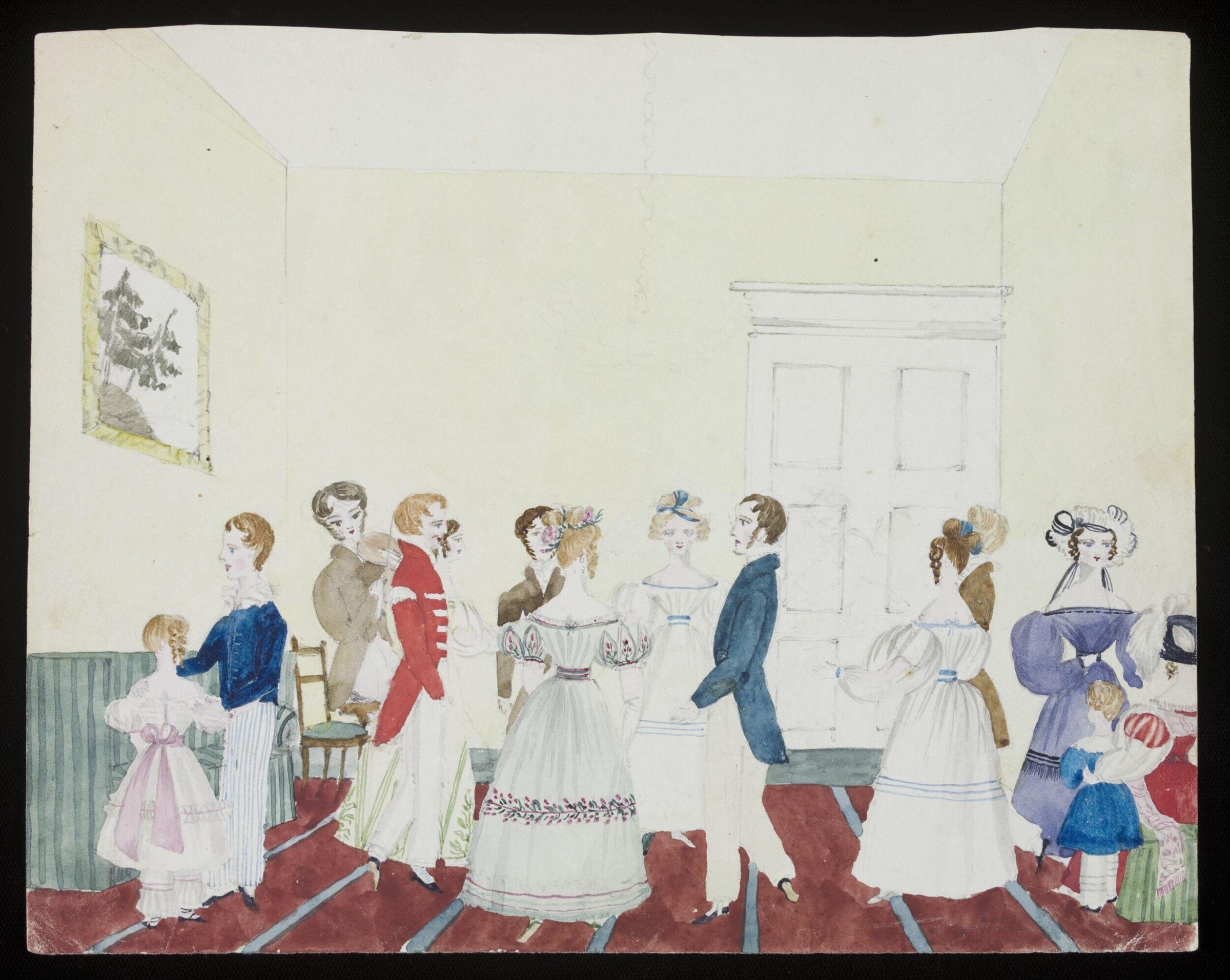
A watercolour drawing depicting an elegant interior gathering of approximately twelve figures in Regency dress, arranged in a loose procession or promenade across the length of a spacious room. The setting is minimally rendered: plain walls with a simple fireplace and door-frame visible in the background, a red floor that grounds the scene in perspective, and what appears to be a window or blind (greenish) on the left. The figures are predominantly women in high-waisted white muslin gowns with coloured pelisses and spencers (short jackets) in red, brown, and blue, their hair dressed in the high-piled curls and decorated with ribbons and flowers characteristic of the 1820s. Several men in dark tailcoats and breeches punctuate the group. A small child appears in the lower left. The moment captured seems to be a formal visiting hour or at-home, a carefully posed arrangement of fashionable society, rather than an active dance in progress. The composition is narrative rather than documentary: the artist observes a social ritual rather than recording movement.
The dancing
The figures are predominantly upright and posed, arranged in a shallow frieze across the room with minimal overlapping or depth. Those in the centre of the composition face or angle toward the viewer, presenting their fashions for inspection. The postures are restrained and decorous: arms hang at sides or rest on companions' arms, weight is still or shifted subtly. A few figures turn toward one another as if in conversation. No figures are in a dance hold; no heels are lifted off the ground. The small child in the foreground, standing alone, creates a reading point for the eye. This is a gathering of stationary, fashionably dressed figures rather than an enactment of movement or choreography.
The dance depicted
The image does not depict an active dance. It shows a Regency-period social gathering or receiving room visit, the sort of formal at-home where the display of dress, status, and manners was the point. Regency society did dance—cotillions, quadrilles, and country dances were essential social activities—but this scene captures the moment before or after, or the formal moment of greeting and display. No hold, footwork, or movement framework is visible. The work may document social choreography in the broadest sense: the ritual arrangement of bodies in fashionable space.
How it was made
This is a watercolour drawing, as stated in the record. The technique is careful and observational: the artist has rendered faces and dress in fine detail, using delicate washes of colour (blues, reds, browns, ochres) applied over a careful pencil foundation. The pale walls and floor are left largely bare, allowing the dressed figures to stand out. The handling is controlled rather than fluid; this appears to be a finished drawing intended for exhibition or collection, not a rapid sketch. Watercolour on paper allowed the artist to produce a portable, collectable work suitable for display in a polite household—the very setting depicted here.
About this work
This watercolour depicts a Regency-period gathering of fashionable society in an interior space, arranged as a promenade or at-home visit. The work is primarily a document of dress, manners, and the social performance of respectability rather than an active dance scene. It sits in the tradition of observational genre watercolours of the 1820s, which recorded everyday (if highly refined) social life. For a gallery of dance in art, it is important because it captures the social context—the clothing, the formality, the spatial arrangement—within which dancing occurred, and because it documents how Regency society displayed itself in ordered, almost processional formations. The work shows that social order and the choreography of standing, facing, and presenting oneself were as carefully managed as the dances that punctuated such gatherings.
How to look at it
Observe the absolute stillness and formality of the scene, despite its title suggesting gathering or socialising. Note how the artist has rendered each figure's dress with meticulous care—the colours, the details of bonnet and pelisse, the drapery. The spatial arrangement is almost heraldic: the room is shown in a flattened perspective that emphasises the lined-up presentation of bodies rather than a three-dimensional space. Look at the small child alone in the foreground: a reading point that establishes scale and suggests an observer's eye within the scene. This is not a moment of action or feeling but a moment of display and order—the visual language of respectability. The absence of animation or movement is itself the point.
The artist
Cecil Elizabeth Drummond is a little-documented artist of the early 19th century. The inscription 'va' in the record may indicate a holding in the Victoria and Albert Museum or a similar British collection. The careful, observational watercolour technique and the subject matter (fashionable interior life) suggest a woman artist working within the acceptable domestic and social subjects available to female practitioners of the period. The precision of dress and facial features indicates either professional training or close familiarity with the circles depicted.
The period
The 1820s were the height of the Regency and early Georgian social season. Formal gatherings, balls, and at-homes were central to the social calendar of the gentry and aristocracy. The dress codes were strict: women wore high-waisted muslin gowns (as shown), men wore dark tailcoats. Dancing—especially the quadrille, which arrived from France around 1815, and the older cotillion—was a essential skill and a primary occasion for courtship and social display. Watercolour had become an increasingly respectable medium for capturing such scenes; there was a market for small, portable pictures of contemporary society among the same people who lived it. The image belongs to a tradition of Regency social observation shared with novelists like Jane Austen (writing 1811–1816) and later artists like Thomas Rowlandson.
Where it lives
The record indicates the work is held in a collection with the source tag 'va', likely referring to the Victoria and Albert Museum or a similar British institutional collection. It is catalogued as a watercolour drawing but without an accession number or further provenance detail provided.
Questions about this work
Is this depicting a dance?
Not an active dance, but a Regency-period social gathering—an at-home or receiving hour where fashionable people assembled. Dancing was central to Regency social life, but this image captures the formal moment of greeting and display rather than the dances themselves. It is nonetheless important for understanding the social context in which dances took place.
Why are the figures so still and posed?
The artist has captured a moment of formal social display, not action. Regency society was highly codified: the arrangement of bodies, the distance between them, the direction of the gaze, and the display of fashionable dress were all carefully managed. This stillness reflects the social order of the period.
What does the dress tell us?
The women's high-waisted white muslin gowns with coloured pelisses and spencers, and the men's dark tailcoats and breeches, are characteristic of 1820s Regency fashion. The care with which the artist has rendered each figure's dress suggests that fashion and status were central to the occasion being depicted.
Who was Cecil Elizabeth Drummond?
Very little is recorded of Drummond's life or career. The precision of her work, the subject matter (fashionable interior life), and the technique (watercolour) suggest professional training or close familiarity with the circles she depicted. She appears to have worked in the early 19th century, likely in Britain.
More dance artwork





