49 works in this view — arrow keys or swipe to move between them.
Dance in Art
Hart's Royal Gallopades
Unknown artist
- Collection:
- Source:
- Victoria and Albert Museum
- Rights:
- Rights vary by item — check the source record before reusing this image. Source record ↗
- Recorded as:
- V&A — check rights per item
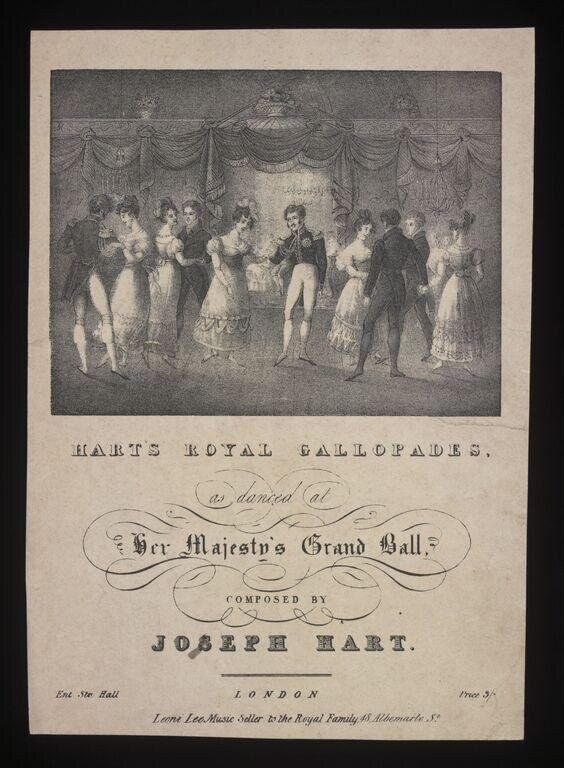
For dance historians, this engraving is a rare and precise visual record of how the gallopade was actually danced in its period of peak popularity, showing the posture, spacing, dress, and group dynamics of early-nineteenth-century ballroom practice. The attribution to Joseph Hart, a known dance master and music publisher, and the commercial context of the publication make it a document of how dance instruction and fashion were distributed and consumed in the era.
What you are looking at
This is a crowded ballroom scene rendered as a fine engraving, depicting a formal social dance at what the title identifies as 'Her Majesty's Grand Ball.' The composition is densely populated with figures arranged in a shallow stage-like space defined by elaborate draped curtains and swags suspended overhead. In the center and foreground, couples in evening dress engage in the gallopade—the women in white muslin gowns with puffed sleeves and decorative hems, the men in dark tailcoats. The movement is captured mid-step, with couples scattered across the floor in various positions of the dance, some nearly frontal to the viewer and others receding into depth. The engraver has achieved atmospheric effect through careful use of shadow and cross-hatching; the interior is brightly lit from an unseen source, creating a sense of elegant, controlled gaiety. The scene is ordered despite its crowding—this is a fashionable assembly of the kind patronized by the aristocracy, not a rowdy tavern or public ballroom. Every figure wears formal attire appropriate to a court or high-society occasion.
The dancing
The dancers move in pairs with moderate spacing between couples. The holds are relatively open and upright, characteristic of early-nineteenth-century ballroom protocol—men and women maintaining formal distance and posture rather than the closer embrace of later periods. Several women are caught with their skirts flaring and hems elevated as they turn or step forward, an effect the artist has rendered with particular attention to the texture and movement of the fabric. The men's bodies are held stiffly erect, their arms positioned to guide their partners. The footwork is not clearly articulated in the engraving's style, but the forward momentum and the angle of the bodies suggest the quick, gliding progress characteristic of the gallopade step-pattern.
The dance depicted
The gallopade was a spirited couple dance popular in ballrooms across Europe and Britain during the 1820s–1850s, performed to lively music in 2/4 time. It resembled the polka in its bounding, progressive character, though it predated the polka's wider vogue. The title's attribution to Joseph Hart and its explicit reference to 'Hart's Royal Gallopades' suggests this is a published dance instruction or a commemorative image of a particular performance or ball. The image shows the gallopade in its social, ballroom context rather than as a choreographed stage piece—multiple couples dancing simultaneously in a formal setting, which was the dance's primary venue. The engraving serves as both visual documentation and advertisement for a published collection of dance music or instructions.
How it was made
This is a fine engraving on paper, printed from a steel or copper plate. The technique allows for the precise linear detail visible in the rendering of costume, the architecture of the ballroom, and the facial features of the figures—hallmarks of the engraving medium. The high finish and the careful modeling of light and shadow through cross-hatching and stipple suggest a skilled professional engraver, likely working from a drawing or sketch. As a printed sheet, this work was intended for mass circulation among the literate public and, particularly, among those interested in dance, music, and fashionable social practice. The imprint notes 'London' and credits 'Lewis Lee, Music Seller to the Royal Family, Albermarle St'—establishing this as a commercial music and dance publication aimed at amateur dancers and musicians in the home market.
About this work
Hart's Royal Gallopades is a printed engraving documenting the gallopade, one of the most popular ballroom dances of the early-to-mid nineteenth century. The image captures the dance in its social and recreational context—a crowded assembly of fashionable people dancing in formal evening dress within an elegantly appointed interior. The composition and the technique of fine engraving served a commercial purpose: the image advertised published dance music and instructions, allowing potential buyers to see how the dance appeared when correctly performed. This particular work, issued by a London music seller with royal patronage, represents the intersection of dance, music publishing, and fashionable leisure culture during the Regency and Romantic eras.
How to look at it
Attend to the variety of poses within the gallopade—the artist has frozen multiple moments of the step-sequence simultaneously, showing couples at different stages of the turn and forward progress. Notice how the engraver rendered the women's skirts as the primary indicator of movement and vitality; the fabric catches and swings convey the quickness and energy of the dance more vividly than the figures' faces or limbs. Observe the formality of the setting and the reserve of the figures' expressions—this is not exuberant or theatrical, but controlled and genteel. The heavy use of the drapery above and the contained interior space emphasize the social order and propriety of the occasion. The composition is crowded but balanced, reflecting both the crush of a fashionable assembly and the careful management of a formal ball.
The artist
Joseph Hart was an active dance master, musician, and publisher in London during the early nineteenth century, a period of intense dance innovation and popularization. Little detailed biographical information survives, but his publication of 'Royal Gallopades' and his connection to music publishing and dance instruction place him among the many minor but functionally important figures in the dissemination of ballroom dance. The attribution of the engraving itself is not recorded; the named craftsman is the printer/publisher, Lewis Lee. The engraver remains anonymous, as was common for commercial music and dance publications of the period.
The period
The early nineteenth century witnessed an explosion of new ballroom dances and a rapid professionalization of dance publishing and instruction. The gallopade, polka, and mazurka emerged in close succession during the 1820s–1840s, each becoming the subject of published music, printed instructions, and visual documentation. Engraving was the primary medium for reproducing images of fashionable life, and dance scenes were a popular subject in both fine art and commercial printing. The social authority of the royal court and the explicit claim to royal patronage ('Her Majesty's Grand Ball,' 'Music Seller to the Royal Family') were marketing strategies that elevated the status of the dance and its instruction. This was the era in which ballroom dancing became a compulsory accomplishment for genteel people, driving demand for instructional materials and images.
Where it lives
The work is held as a print in a collection sourced from 'va' (likely a Virginia institution, though the abbreviation is not fully specified in the record). It was published in London by Lewis Lee, Music Seller, with the imprint noting his address at Albermarle Street, a fashionable London location. The work functions as both a commemorative image and a commercial advertisement for a dance music collection.
Dance in this work
Questions about this work
What exactly is the gallopade?
The gallopade was a rapid, bouncing couple dance popular in ballrooms during the 1820s–1850s, danced to music in 2/4 time. It resembled the polka in character—energetic and progressive—and required couples to move forward around the ballroom floor. It was one of a succession of new dances that arrived from continental Europe to Britain during this period and became a standard feature of fashionable assemblies.
Who was Joseph Hart?
Joseph Hart was a London-based dance master and music publisher active in the early nineteenth century. He is documented primarily through his published dance music and instructions, including the 'Royal Gallopades' to which this engraving is attached. He was part of the infrastructure of dance instruction and popularization that made ballroom dancing a compulsory skill for genteel people.
Why did people publish images of dances?
Images of dances served multiple purposes: they advertised published music and instruction books, showing customers what the dance looked like when correctly performed; they functioned as fashion illustrations, displaying the latest ballroom dress; and they commemorated fashionable social occasions. For people learning at home or in dancing schools, such images provided visual reference for the posture and style expected of them.
How was this image made and distributed?
This is a fine engraving, created by incising an image into a copper or steel plate, which was then inked and printed. Engravings like this were relatively expensive to produce but could be printed in quantity and sold as individual sheets or bound into instructional books. This one was issued by Lewis Lee, a London music seller with royal patronage, and was distributed through the commercial music and dance publishing market.
More dance artwork





