49 works in this view — arrow keys or swipe to move between them.
Dance in Art
Theatre costume
Georgiadis, Nicholas
- Collection:
- Theatre costume
- Source:
- Victoria and Albert Museum
- Rights:
- Rights vary by item — check the source record before reusing this image. Source record ↗
- Recorded as:
- V&A — check rights per item
Costumes from significant modernist theatrical productions are rare survivors; they reveal how designers of the period thought about the body, movement, and visual communication on stage. Georgiadis's work was foundational to mid-century theatre aesthetics, and this piece documents his design vocabulary—the integration of geometric form, material variety, and constructed silhouette—at a moment when costume design was becoming recognized as a serious artistic discipline.
What you are looking at
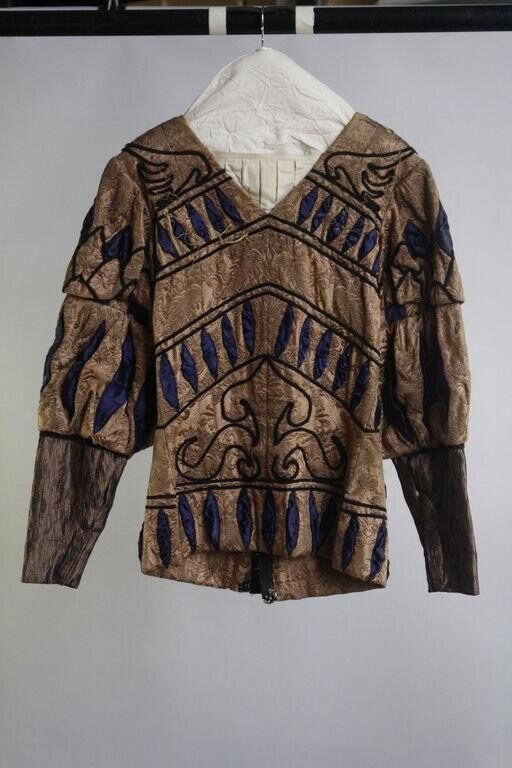
A theatrical costume is displayed on a hanger against a neutral background, shown front-facing with a white collar visible at the neck. The garment is a short jacket or tunic in warm tan and brown tones, constructed from what appears to be textured or patterned fabric. The design features bold geometric patterning in deep blue and dark brown, arranged in symmetrical bands across the chest and torso. Angular, semi-abstract motifs—possibly stylized feathers or architectural elements—are worked into the design, creating a striking Art Deco or modernist aesthetic. The sleeves are constructed from a different fabric, appearing darker and more textured, possibly ribbed or cord-like material in brown-black. The overall silhouette is compact and structured, suggesting a costume designed for visibility and movement on stage rather than everyday wear. The quality of the construction and the sophistication of the patterning indicate this was made for a significant theatrical production.
The dancing
This is not a figure study but a costume object. There are no dancers visible; the garment is presented as a theatrical artifact on a display hanger. The structure of the jacket—its compact proportions, reinforced sleeves, and bold surface patterning—suggests it was designed to read clearly from a distance and to allow full range of movement for a performer.
The dance depicted
Without seeing the costume in use on a dancer, or having access to production records, the specific dance form cannot be definitively identified. The geometric patterning and Art Deco-influenced design suggest a modernist theatrical context, possibly European experimental theatre or ballet of the mid-twentieth century. The bold, symmetrical motifs are consistent with 1960s avant-garde costume design, which often drew on tribal, architectural, and geometric sources. The compact cut and reinforced construction suggest a character role or dramatic movement vocabulary rather than classical ballet.
How it was made
This is a constructed textile garment, hand-sewn and patterned with applied or woven design elements. The catalogue record does not specify the precise materials, but the appearance suggests a combination of woven base fabrics (possibly cotton or linen for the patterned sections, a ribbed knit or cord for the sleeves) with surface decoration or pattern-weaving creating the geometric motifs. The construction is professional and designed for durability under stage use and repeated handling. As a costume rather than a fine art object, it was made for function and visibility in performance rather than for exhibition.
About this work
This is a mid-twentieth-century theatrical costume designed by Nicholas Georgiadis, a significant figure in theatre and ballet design. It exemplifies the modernist approach to stage dress that emerged in European experimental theatre during the 1950s–1960s, combining bold geometric patterning with carefully considered construction for movement and visibility. The costume survives as a material record of a specific production or commission, now held in what appears to be a design or theatre collection. Georgiadis was known for his influential work in bringing visual sophistication and intellectual rigour to costume design across multiple theatrical disciplines, and this piece reflects his commitment to integrating costume into the total design concept of a production.
How to look at it
Observe the careful balance between structure and pattern: the costume is not elaborately decorated but rather architecturally composed, with pattern integral to the garment's planes and proportions. The contrast between the patterned front sections and the plain, textured sleeves suggests a designer thinking about which areas need visual emphasis during performance. The geometric motifs—arranged in bands rather than scattered—create strong vertical and horizontal lines that would read clearly from a distance and that would move dynamically with a performer's motion. The compact cut and defined waist suggest this was a costume for a character with a specific physical presence on stage.
The artist
Nicholas Georgiadis (1923–2001) was a Greek-born, London-based designer who became one of the most influential theatre and ballet designers of the mid-twentieth century. He worked across opera, theatre, and dance, creating costumes and sets for productions at the Royal Opera House, Covent Garden, the Royal Shakespeare Company, and major ballet companies. Georgiadis was known for his intellectually rigorous approach, combining modernist aesthetics with meticulous historical or conceptual research. His designs were characterized by bold colour, architectural geometry, and a deep understanding of how costume functions in performance. He trained in architecture before turning to theatre design, a background evident in his geometric and structural approach to costume.
The period
The 1960s saw a widespread reassessment of theatre design in Europe, driven by directors and designers who rejected literal or decorative costume in favour of approaches that were conceptual, sculptural, or abstract. Modernist design principles—geometric form, bold colour contrast, functional construction—were applied to theatre across the continent. In ballet and dance theatre, this period saw growing experimentation with non-narrative forms and non-classical movement vocabularies, often accompanied by equally experimental costume and visual design. Georgiadis's work was part of this broader shift toward treating costume as an integral part of spatial and kinetic design rather than as decoration.
Where it lives
The costume is held in what the record indicates is a theatre costume collection (catalogue source: 'va', likely the Victoria and Albert Museum's Theatre Collection in London). The record provides no information on the specific production, commission date, dancer, or choreographer, suggesting it may be an unattributed or inadequately catalogued item.
Questions about this work
Who was Nicholas Georgiadis?
Georgiadis (1923–2001) was one of the mid-twentieth century's most important theatre designers. Trained in architecture, he brought modernist visual principles to costume and set design for opera, theatre, and ballet across Europe. He worked regularly with the Royal Opera House, Covent Garden and the Royal Shakespeare Company, and was known for intellectually rigorous, beautifully crafted designs that integrated fully with the choreography or staging.
What production is this costume from?
The catalogue record does not identify the specific production, choreographer, or dancer. This information may be contained in the collection's archival records but is not reflected in the publicly available metadata. The 1965 date is recorded, but without further documentation it is not possible to definitively place this costume within Georgiadis's body of work.
What kind of dance would have used this costume?
The costume's compact, structured form and bold modernist design suggest it was created for a significant theatrical or dance production in the mid-twentieth century, possibly in ballet, opera, or experimental theatre. The geometric patterning and sculptural approach to construction are consistent with 1960s avant-garde practice. Specific identification of the dance form or choreographer would require production records.
How was this costume made?
It is a hand-sewn garment combining multiple fabrics: a patterned woven base (the tan and blue sections with geometric design) and contrasting ribbed or cord-like material for the sleeves. The pattern appears to be either woven directly into the fabric or applied through careful seaming and inlay. The construction is professional, designed to withstand the demands of stage performance and repeated use.
More dance artwork





