49 works in this view — arrow keys or swipe to move between them.
Dance in Art
Theatre costume
Georgiadis, Nicholas
- Collection:
- Theatre costume
- Source:
- Victoria and Albert Museum
- Rights:
- Rights vary by item — check the source record before reusing this image. Source record ↗
- Recorded as:
- V&A — check rights per item
This costume is significant as an artifact of Georgiadis's design practice and as evidence of how mid-twentieth-century theatre designers integrated pattern, color, and construction to signal character and social identity. The patchwork technique—economical, visually distinctive, and rooted in folk textile traditions—reflects both practical constraints and conceptual choices about how bodies and narratives were clothed on the mid-century stage.
What you are looking at
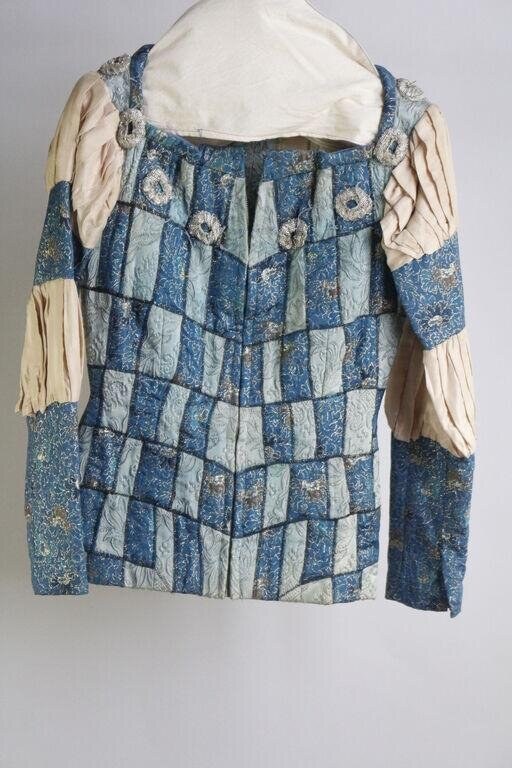
This is a patchwork theatre costume viewed from the back, composed of contrasting fabric squares in a checkerboard arrangement. The dominant pattern alternates between deep indigo blue and cream or natural linen, with small repeated floral or geometric motifs visible within each colored square. The sleeves are constructed from plain cream linen, gathered at the shoulder with visible puffing, and extend to about mid-forearm. The body of the garment shows a more complex piecing: the squares vary in their printed patterns, with some blues appearing lighter or darker, suggesting either age-related fading or intentional variation. A cream linen collar or neck binding is visible at the top. The overall construction appears sturdy and functional rather than decorative—this is working costume, not formal dress. The patchwork effect creates visual texture across the entire back surface, with the geometric squares forming an almost architectural grid.
The dancing
No human figure is present in this image. The costume is displayed flat or mounted on a form with only the back panel visible. Without a wearer, movement, hold, or frame cannot be assessed.
The dance depicted
This costume does not depict a dancer or dance action. It is a physical object—a garment—that was likely worn during theatrical performance. The patchwork construction, the natural and indigo color palette, and the simplified geometric patterning suggest this may be a peasant, folk, or character costume from mid-twentieth-century European theatre, possibly from a production exploring rural or working-class life. The 1965 date and the designer's name (Georgiadis, a prominent mid-century theatre designer) point toward a specific production, but the image alone does not reveal which dance or theatrical work it served.
How it was made
This is a textile object—a sewn garment composed of patchworked fabric squares. The squares appear to be printed cotton or linen in indigo and cream, joined together by hand or machine stitching. The puffed sleeves suggest hand-finishing or period tailoring. The photograph is a documentary image of the object itself, likely taken to record the costume in museum or archive holdings. Photography of this kind serves as both preservation and reference: it allows the object to be studied without handling, but a photograph cannot show the weight, drape, wear, or three-dimensional form that would be apparent in person.
About this work
This is a theatre costume from 1965, designed by Nicholas Georgiadis, a significant figure in mid-century stage design. The patchworked construction—indigo and cream squares, each printed with small motifs—creates a distinctive visual texture while maintaining practical functionality for an actor's movement. The garment appears intended for a character role, likely representing rural, working-class, or folk identity. Georgiadis was known for his work with major ballet and theatre companies, and this costume is part of the material archive of theatrical practice. The object is held in a theatre costume collection and is documented here as a photograph of the back panel.
How to look at it
Look at how the squares are arranged and how the colors alternate to create rhythm and visual weight. Notice that the squares are not uniform in their printed patterns—the designer or maker has used a variety of prints within each color family, adding visual complexity and suggesting either a historical patchwork tradition or a deliberately assembled effect. Observe how the sleeves break from the patchwork grid and return to plain cream linen, creating a visual anchor. The back view tells you about silhouette and construction but not about how the garment moved or how a performer inhabited it.
The artist
Nicholas Georgiadis (1923–2001) was a Greek-born British theatre and ballet designer of international stature. He designed for leading European and American ballet companies, including the Royal Ballet, American Ballet Theatre, and numerous opera houses and theatres. His work was characterized by bold color, architectural form, and careful attention to the relationship between costume, set, and choreography. He was as comfortable with modernist abstraction as with historical reference and frequently drew on folk and vernacular textile traditions in his costume work.
The period
In 1965, mid-century modernism in theatre and dance was at its height. Designers like Georgiadis were reconsidering how to marry contemporary design principles—geometric form, bold color, economy of means—with the specific needs of the stage. There was growing interest in folk traditions and in costume as a carrier of cultural meaning. At the same time, practical considerations—durability, rapid changes, budget constraints—meant that designers had to be inventive with materials and construction. Patchwork offered both visual richness and economic sense.
Where it lives
This costume is held in a theatre costume collection (recorded as 'VA' in the source field, likely referring to a major British or European institution). It is documented here as a single photograph of the back panel, which is the standard archival record for theatrical costume.
Questions about this work
What dance or theatrical work was this costume made for?
The catalogue record does not specify the production, title, or choreographer. The date (1965) and designer (Georgiadis) narrow the field, but this information alone cannot identify the specific work. Further research in Georgiadis's papers, production records, or the holding institution's documentation would be needed.
Is this a ballet costume or a theatre costume?
The record lists it as a theatre costume. Georgiadis worked across both ballet and theatre, so further documentation would be needed to confirm whether this was worn in a theatrical play, an opera, or a dance work.
Why is the costume made of patches?
Patchwork serves multiple purposes: it is economical with fabric, it creates visual texture and pattern, and it can evoke folk traditions or historical garment-making. In Georgiadis's practice, such techniques were typically deliberate design choices, not accidents of budget.
Could this costume have been made from scraps or repurposed fabric?
The uniform sizing of the squares and the careful color coordination suggest intentional design and assembly rather than scrap-piecing, though only examining the object in person could confirm this.
More dance artwork





