49 works in this view — arrow keys or swipe to move between them.
Dance in Art
Theatre costume
Georgiadis, Nicholas
- Collection:
- Theatre costume
- Source:
- Victoria and Albert Museum
- Rights:
- Rights vary by item — check the source record before reusing this image. Source record ↗
- Recorded as:
- V&A — check rights per item
This object preserves evidence of theatrical costume construction and modernist design practice in mid-20th-century dance and theater. For historians of stage design and costume, the garment reveals materials, techniques, and aesthetic priorities specific to the 1960s—the choice of patchwork geometry, the use of contrasting solid fabrics rather than printed or woven patterns, and the emphasis on visual impact over ergonomic fit. For designers, it demonstrates how structured geometric abstraction can be translated into wearable form for performance.
What you are looking at
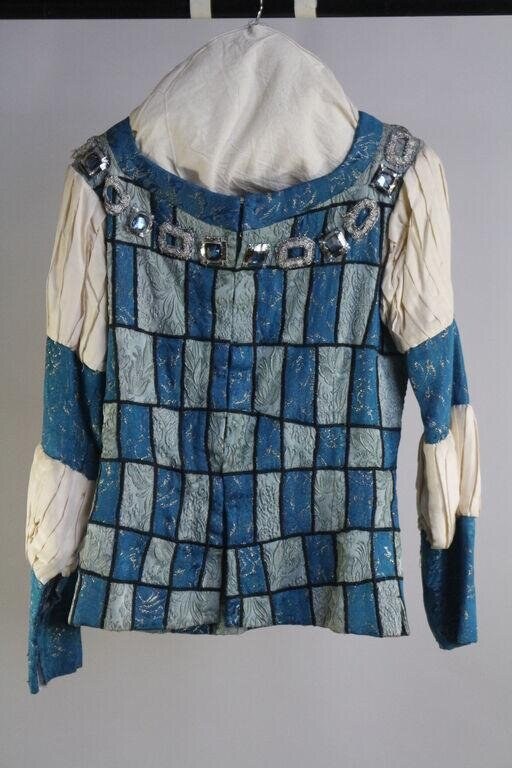
A theatrical costume displayed on a dress form against a neutral background, shown from the back. The garment is a sleeveless tunic or vest-like piece constructed from a patchwork of contrasting fabrics in a regular grid pattern—alternating squares of deep blue and pale grey-green, each square approximately 4–5 inches across. The grid is bounded by dark navy trim that frames the pattern and defines each square with precision. The tunic has a rounded neckline finished with a band of decorative trim featuring a repeating geometric or figural motif in metallic tones. Cream-colored long sleeves with visible wear and patina are attached at the armholes, suggesting they may be constructed separately or made from a different material. The overall silhouette is loose and tunic-like, falling straight from the shoulders with no defined waist, typical of modernist or abstract costume design. The patchwork construction is methodical and bold, creating a visual rhythm across the front and back.
The dancing
This is a costume object, not a depiction of a dancer in motion. The garment is presented statically on a dress form, allowing examination of its construction, proportions, and color relationships. The lack of a moving body prevents assessment of how the costume would drape, move, or frame a dancer's gestures in performance. The tunic's generous cut and lack of fitted seaming suggest it was designed for movement and visibility on stage rather than realistic tailoring.
The dance depicted
Without documentation of the production or performance context, the specific dance style cannot be determined from the costume alone. The bold geometric patchwork and modernist aesthetic suggest a 20th-century theatrical work, likely contemporary dance, experimental theater, or avant-garde ballet rather than classical ballet or historically-based dance. The design's emphasis on pattern and color field over body-conforming construction aligns with mid-century modernist theatrical practice. Nicholas Georgiadis was a prominent stage designer; this costume likely belongs to a specific production designed by him in 1965, but without production records or performance documentation visible in the image, the identity of that production and its dance genre cannot be established.
How it was made
This is a constructed textile object—a three-dimensional garment assembled from pieced fabric. The patchwork technique involved cutting squares of two contrasting fabrics, arranging them in an alternating checkerboard pattern, and joining them with structural seaming bound by dark tape or ribbon. The applied trim at the neckline appears to be a woven or printed ribbon. The sleeves are sewn separately into the armholes. The garment shows signs of age and handling consistent with a working stage costume—visible wear on the sleeves, slight discoloration, and evidence of repair or adjustment. As a constructed artifact, this object preserves information about theatrical costume practice, materials, and construction methods of the 1960s that photography or drawing could not convey.
About this work
This is a stage costume designed by Nicholas Georgiadis in 1965, a prominent mid-20th-century theater designer known for innovative scenic and costume work. The garment is a sleeveless tunic constructed from geometric patchwork—alternating squares of blue and pale green fabric arranged in a strict grid and bound by dark trim, with cream-colored sleeves and a decorative neckline band. The design reflects modernist theatrical aesthetics of the 1960s, prioritizing bold color and geometric form over body-conforming tailoring. The costume belongs to a specific theatrical production, though without production records the exact work and dance style cannot be identified from the object alone. It represents costume design as a sculptural and painterly practice, where color, pattern, and construction become primary visual statements on stage.
How to look at it
Examine the precision and regularity of the patchwork grid and consider how it would appear in motion—the alternating squares would create a rhythm of color and movement across the dancer's body, emphasizing gesture and spatial relationships rather than mimicry of natural form. Notice how the grid pattern is unbroken and treats the entire front surface as a unified field, rather than following anatomical landmarks or tailoring lines. The contrast between the structured tunic and the softer, worn cream sleeves suggests they served different functions in performance—the patchwork front facing the audience as the primary visual element. The neckline trim, though small in the overall design, is richly detailed and suggests the costume was designed for close viewing as well as stage presence.
The artist
Nicholas Georgiadis (1923–2001) was a Greek-born British stage designer and artist who became one of the most influential theater and ballet designers of the post-war period. He collaborated extensively with major choreographers and theater companies, notably the Royal Ballet and the Royal Opera House, and was known for his sophisticated integration of sculptural form, color, and modernist aesthetics into stage design. His work ranged from naturalistic sets to abstract and geometric approaches, often created in close dialogue with the artists directing the production. Georgiadis was also a painter and muralist, and his design practice reflected his visual art training.
The period
In 1965, modernist and avant-garde approaches to theater and dance were in ascendance. The influence of abstract art, particularly color field painting and geometric abstraction, extended into stage design. Designers increasingly treated the stage as a space for visual and spatial experimentation rather than realistic representation. In ballet, the period saw parallel developments: the Royal Ballet under Frederick Ashton was expanding its repertoire to include more abstract and contemporary works, while international companies were exploring new relationships between choreography, design, and music. The geometric patchwork aesthetic of this costume aligns with broader mid-century trends in art and design toward modular systems, primary colors, and mathematical ordering.
Where it lives
The costume is held in a theater costume collection and attributed to Nicholas Georgiadis, 1965. The catalogue identifies it as a theatre costume but provides no production title, dancer name, or performance date beyond the design year. It is presented as a museum object and artifact of theater practice rather than as documentation of a specific performance.
Questions about this work
Who wore this costume and in what production?
The catalogue record does not identify the specific production, dancer, or premiere date. Nicholas Georgiadis designed costumes for numerous productions throughout the 1960s; without additional documentation such as production photographs, programs, or provenance records, the work cannot be pinpointed. The holding collection may have further records not reflected in the visible catalogue entry.
Why is the costume made from patchwork squares rather than a single fabric?
The patchwork construction was likely a deliberate aesthetic choice, creating a geometric visual field on stage. The alternating color pattern and grid structure would emphasize movement and spatial relationships, treating the costume as an abstract sculptural and painterly object rather than a body-conforming garment. This approach aligns with modernist theatrical design of the 1960s.
What dance style is this costume for?
The costume's design suggests a modernist or experimental theatrical work rather than classical ballet or traditional dance. Without production identification, the specific dance genre cannot be determined. The loose, non-tailored cut indicates the designer prioritized stage visibility and aesthetic impact over supporting a particular movement vocabulary.
More dance artwork





