49 works in this view — arrow keys or swipe to move between them.
Dance in Art
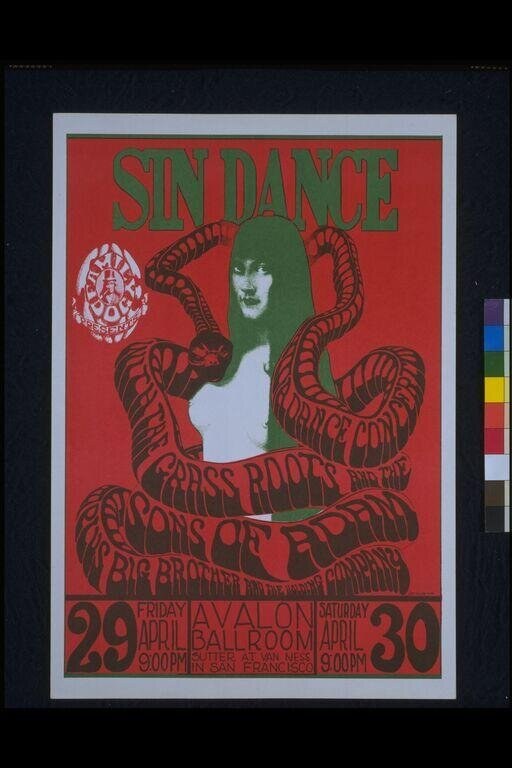
Sin Dance. The Family Dog presents a dance concert with The Grass Roots and the Sons of Adam plus Big Brother and the Holding Company
Wilson, Wes
- Collection:
- Poster
- Source:
- Victoria and Albert Museum
- Rights:
- Rights vary by item — check the source record before reusing this image. Source record ↗
- Recorded as:
- V&A — check rights per item
Wes Wilson is recognized as one of the defining graphic artists of the San Francisco poster movement, and this work exemplifies the style that became synonymous with 1960s concert culture. For dance historians, the poster documents the Avalon Ballroom and the Family Dog as crucial sites where rock concerts and social dancing coexisted, a cultural formation that shaped American dance and music practice. The piece shows how visual design and performance advertising shaped the experience and self-image of a generation.
What you are looking at
A psychedelic concert poster dominated by a woman's face rendered in vivid green and white against a hot red background. Her face emerges from the center, framed by thick, writhing red tentacles or serpentine forms that coil across the entire composition. The woman's expression is stark and confrontational, with dark eye makeup and a direct gaze. The tentacles form organic, almost art-nouveau curves that fill the space, their surfaces detailed with linear patterns suggesting scales or texture. At the bottom, text announces a dance concert at the Avalon Ballroom in San Francisco: "Sin Dance" featuring The Grass Roots, Sons of Adam, and Big Brother and the Holding Company, scheduled for Friday-Saturday, April 29-30. The poster exemplifies the 1960s San Francisco poster aesthetic—bold letterforms, saturated colors, and hallucinogenic imagery that merge figuration with abstraction.
The dancing
A single female figure dominates the composition as a head and torso, rendered flatly with minimal anatomical detail. Her posture is upright and static—she is not dancing but gazing directly outward. The face is highly stylized, almost mask-like, with heavy eye makeup suggesting theatrical or performance presentation. There is no visible body movement, weight shift, or dynamic gesture; the woman functions as a symbolic or decorative element rather than as a dancing figure caught in action.
The dance depicted
This is a concert poster announcing a dance event, but the visual emphasis is on psychedelic graphic design rather than the depiction of actual dancing. The "Sin Dance" was a concert presented by the Family Dog (a San Francisco promotions collective) featuring rock and soul bands of the era—not a theatrical dance performance. The poster advertises the event but does not illustrate the dance itself; the woman's figure is symbolic, part of the poster's hallucinogenic visual language. Any dancing would have occurred at the Avalon Ballroom as audience members moved to live music, but that social context is not represented in the image.
How it was made
This is a lithographic concert poster, printed in multiple colors to achieve the vivid, saturated palette. The medium allowed for bold, flat areas of color and enabled large-scale reproduction for street posting and distribution. The graphic style—with strong outlines, simplified forms, and vibrant hue contrasts—is characteristic of the offset lithography technique favored in 1960s San Francisco poster design. The clarity and graphic directness made the poster effective as street-level advertising while also embedding it in the psychedelic art movement of the period.
About this work
This is a concert poster rather than a representation of dance itself, but it documents an intersection of rock culture, ballroom venues, and the visual identity of the 1960s counterculture. The Family Dog presented dance events that mixed live music with social dancing in historic San Francisco dance halls; the Avalon Ballroom was one of the city's primary venues for rock concerts that doubled as dance events. The poster's hallucinogenic imagery—the serpent-haired woman and lurid color scheme—communicated the transgressive, psychedelic aesthetic associated with San Francisco rock and the broader youth culture of the mid-1960s. Though the poster does not depict actual dance movement, it exists within the ecosystem of venues and events where social dancing and rock music were intertwined.
How to look at it
The poster does not freeze a moment of dance but instead uses figuration symbolically. The woman's confrontational gaze and the coiling tentacles create visual energy and psychological intensity, communicating the poster's invitation to an altered, transgressive experience. A viewer should notice the graphic relationship between the face (order, symmetry, human familiarity) and the tentacles (chaos, animalism, the surreal)—a tension that encodes the era's fascination with the dissolution of rational control and the emergence of the unconscious. The intensity of the color and the flatness of the forms mark this as visual propaganda for a specific moment and place.
The artist
Wes Wilson (1931–2006) was a pioneering graphic designer and one of the most influential poster artists of the 1960s San Francisco psychedelic movement. Working for the Family Dog and other San Francisco promoters from 1965 onward, he developed a distinctive style combining organic, flowing forms with vibrant color and dense letterforms, often incorporating biological or mythological imagery. His work helped define the visual language of the era and influenced graphic design and concert poster aesthetics internationally.
The period
In 1966, San Francisco was the epicenter of rock music and psychedelic culture. The Avalon Ballroom and Fillmore Auditorium were venues where concerts and dances merged—bands performed live while audiences danced socially. The Family Dog was a collective of promoters and organizers who produced these events and commissioned poster artists like Wilson to create advertising that matched the visual and cultural energy of the music. This moment predates the modern separation of concert-going (as seated, listening) from dancing (as a discrete activity), reflecting a time when rock venues were active dance floors.
Where it lives
This poster is held as part of a collection of concert and promotional materials, likely the San Francisco Poster Archive or a similar institutional holding of 1960s rock and psychedelic ephemera. It is an artifact of commercial printing and street distribution, designed for temporary display and wide circulation.
Questions about this work
What is the Avalon Ballroom?
The Avalon Ballroom was a historic dance hall in San Francisco opened in 1913. In the 1960s, it became a key venue for rock concerts and psychedelic music, run by the Family Dog collective. It functioned simultaneously as a concert venue and a dance floor where audiences moved freely to live music.
Who was Wes Wilson?
Wes Wilson was a graphic designer and artist central to the San Francisco psychedelic poster movement of the 1960s. His posters, with their flowing organic forms and saturated colors, became iconic images of the era and defined the visual identity of rock venues and counterculture events.
What is the Family Dog?
The Family Dog was a collective of San Francisco promoters and organizers who produced rock concerts and dance events at venues like the Avalon Ballroom and Fillmore Auditorium. They commissioned poster artists and shaped the cultural life of 1960s San Francisco.
Does this poster show people dancing?
No. The poster depicts a stylized woman's face and uses psychedelic imagery to advertise the event, but it does not show actual dancers or dance movement. The dancing would have taken place at the Avalon Ballroom during the concert itself.
More dance artwork





