49 works in this view — arrow keys or swipe to move between them.
Dance in Art
Reiff, Johann Conrad
- Collection:
- Source:
- Victoria and Albert Museum
- Rights:
- Rights vary by item — check the source record before reusing this image. Source record ↗
- Recorded as:
- V&A — check rights per item
This frame documents the visual and social conventions of early 18th-century courtly spectacle at the moment when Baroque court dance was reaching codification. The composition preserves a historical moment in which dance, theater, architecture, and allegory converged in the service of courtly power and artistic prestige. For historians of dance and patronage, it offers evidence of how dance communities were visually imagined and promoted to audiences.
What you are looking at
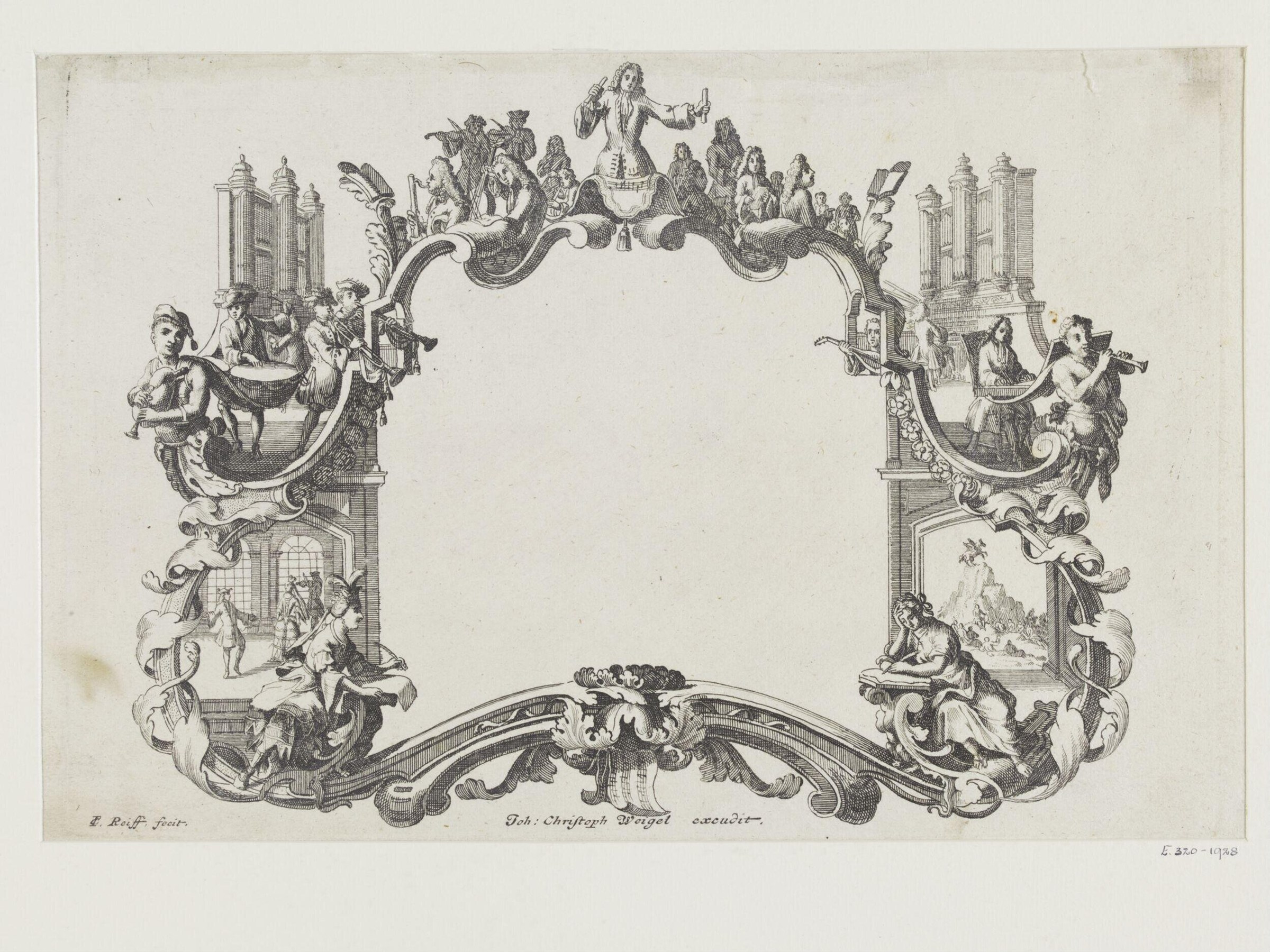
This is an ornamental engraved frame surrounding a blank central space, designed as a title page or frontispiece. The frame is composed of elaborate scrollwork, architectural elements, and densely populated figural scenes. At the top, a central female figure in classical dress stands elevated on a pedestal or platform, surrounded by a crowd of smaller figures—men, women, and children in 18th-century costume. She gestures outward with both arms in a commanding pose. The left and right sides of the frame feature tall classical structures resembling towers or temples with detailed stonework. Between these structures and the central top scene, curved ornamental bands flow downward, creating a sense of movement and supporting the narrative composition. At the bottom, a cartouche with ribbon flourishes contains text (partially legible as "Foh: Christoph Weigel excudit"), framed by two reclining allegorical figures. Throughout the composition, small scenes depict daily life and activity—figures entering buildings, conversing, gesturing—rendered in fine parallel lines characteristic of engraving technique. The whole creates a theatrical, celebratory atmosphere suggesting this frame was designed to announce or honor a significant work or patron.
The dancing
The central elevated female figure displays a clear, authoritative stance: feet planted apart, both arms raised and extended outward in an expansive, welcoming or commanding gesture. The surrounding figures are smaller and more loosely grouped, their bodies oriented toward the central figure or engaged in social interaction with one another. Most are rendered in profile or three-quarter view, in standing or walking poses. The density of figures and their varied orientations create a sense of pageantry and communal gathering rather than formal choreography. No couple work or closed holds are evident; instead, the composition emphasizes individual presence within a crowd.
The dance depicted
This is not a record of a specific dance, but rather an emblematic or allegorical composition using dance-adjacent figuration. The central female figure may represent a personification (Muse, Fame, or similar) presiding over a gathering of mortals. The elevated stage-like setting and the ceremonial gestures suggest theatrical or court spectacle rather than social dance instruction. If any dance is implied, it would be the formal court ceremonial or theatrical performance context of early 18th-century Europe—the kind of grand assembly depicted in festival engravings. The work functions as a frame for honor or announcement rather than as a dance manual or record.
How it was made
This is an engraving, as evidenced by the fine parallel hatching, the controlled linear detail, and the characteristic burin-cut line work visible throughout. The technique allows for precise architectural rendering and intricate figural detail across a large surface. Engraving of this scale and complexity was expensive to produce and suggests a work of some prestige—a title page or frontispiece for a significant printed work, likely commissioned by a patron of means. The colophon credits Christoph Weigel as the engraver and presumably publisher (excudit), placing it in a workshop context in early 18th-century Germany or Central Europe. Such frames were designed to frame the authority and importance of whatever text or image they surrounded.
About this work
This is an emblematic title-page frame engraved by Christoph Weigel in the early 18th century. The composition centers on an allegorical female figure presiding over a diverse assembly of courtly and common figures, rendered with architectural grandeur and ceremonial theatricality. The blank central rectangle originally held text identifying the publication, patron, or subject being honored. The work is a specimen of the ornamental allegorical frame tradition in Early Modern printing, where the visual apparatus of engraving was deployed to confer prestige and legitimacy on the publication it introduced.
For a dance researcher or historian, this frame is valuable as a document of how dance, festivity, and courtly assembly were represented in visual culture at the moment when professional dance was becoming codified and documented. The elevated central figure and the gathered crowd below evoke the courtly spectacle that would have included dance as a primary mode of ceremonial performance—even though no specific dance steps are depicted. It shows how dance inhabited a broader culture of formal gathering, gesture, and public display.
How to look at it
Observe the hierarchy of scale and position: the central elevated female figure commands the composition through size, height, and commanding gesture, while the surrounding figures—smaller and more diffuse—represent the assembly or populace. The architectural framing (temples, columns, towers) creates a stage set effect, transforming a city or court into a theater. Notice how the artist has rendered the moment of formal address or proclamation—the gesture is emblematic and timeless rather than documentary. The fine linear detail and the controlled composition convey prestige and formal authority; this is not a casual sketch but an elaborate performance of visual and textual importance.
The artist
Christoph Weigel (1654–1725) was a prolific German engraver, publisher, and print dealer based in Nuremberg and Augsburg. He was known for ornamental frames, title pages, allegorical compositions, and illustrated practical manuals. His workshop produced hundreds of engravings, many serving as frontispieces for significant publications. Weigel's style exemplified the ornamental and allegorical vocabulary of late Baroque printmaking, and his works circulated widely in German-speaking lands and beyond, establishing conventions for how authority and prestige were visualized in print.
The period
In the early 18th century, dance in European courts was undergoing formalization and documentation. Feuillet notation (published 1700) codified choreography for the first time; Weigel's own engravings include illustrations for dance manuals. At the same time, court ceremonial and spectacle remained central to aristocratic power and public display. Allegory and personification were dominant modes in both visual art and theater. The ornamental frame tradition, exemplified here, was a primary vehicle for conferring prestige on printed works in the age of Baroque splendor and emerging Enlightenment systemization. Courtly dance, though not explicitly taught or shown in this frame, was an assumed component of the ceremonial life being allegorized.
Where it lives
The work is catalogued as a print held in a collection with source designation 'va' (likely Virginia). The colophon credits Christoph Weigel as excudit (publisher/engraver), indicating this is an impression from a published engraving, likely issued as a stock ornamental frame available for commissioning with custom text inserted in the central blank space.
Questions about this work
Is this a depiction of an actual event or a generic allegory?
This is almost certainly a generic or semi-generic allegorical frame, designed to be used as a title page or frontispiece for various publications. The central figure and surrounding assembly represent timeless concepts of authority, festivity, and courtly order rather than a specific historical occasion. The blank central space would have been filled with printed text identifying the actual subject, patron, or work being introduced.
Does this show actual dance steps or choreography?
No specific dance choreography is depicted. The work shows the context and social setting in which dance would have occurred—courtly assembly, formal ceremony, elevated performance—but not the movement of dance itself. It is more valuable as evidence of how dance was imagined as part of broader courtly spectacle than as a record of how to dance.
What is the significance of the elevated central female figure?
She likely represents an allegorical personification—possibly Fame, Patronage, Magnificence, or a similar virtue—presiding over and legitimizing the assembly below her. Her commanding gesture and elevated position confer authority and prestige on whatever text or work the frame was designed to introduce. She embodies the courtly and theatrical power that the publication claims.
Who was Christoph Weigel and why does he matter?
Weigel was one of the most prolific and influential German engravers of the late Baroque period. His workshop produced hundreds of engravings, title pages, and ornamental frames that shaped visual conventions across German-speaking Europe. He also illustrated dance manuals, making him a direct documenter of Feuillet notation and early modern choreography.
More dance artwork





