49 works in this view — arrow keys or swipe to move between them.
Dance in Art
Theatre costume
Georgiadis, Nicholas
- Collection:
- Theatre costume
- Source:
- Victoria and Albert Museum
- Rights:
- Rights vary by item — check the source record before reusing this image. Source record ↗
- Recorded as:
- V&A — check rights per item
Georgiadis's costume design was influential in the transition from narrative ballet spectacle toward modernist abstraction in the 1960s. This piece demonstrates how a designer could flatten the body into pure shape and color relationships, treating the dancer as a moving sculpture rather than an illustrated character. For historians of dance design and modernist theatre practice, this object reveals the material choices and compositional strategies that shaped how dancers were visually perceived on stage.
What you are looking at
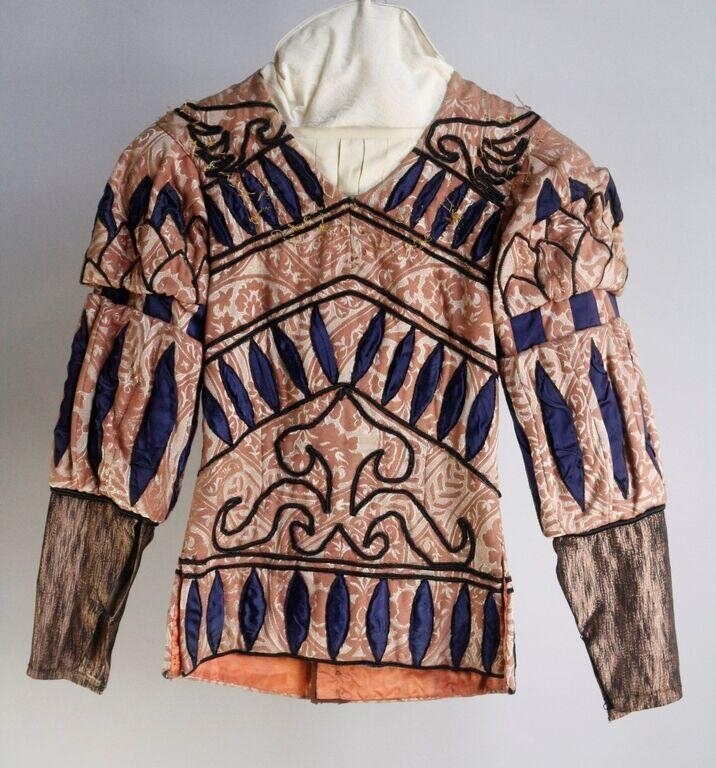
A theatrical costume for a dancer is displayed on a dress form against a neutral background. The garment is a short-sleeved jacket or tunic constructed from patterned fabrics in warm tones—rust, cream, and navy—arranged in geometric sections. The chest and shoulders feature bold vertical striping in navy alternating with rust-colored stripes, framed by bands of ornamental scrollwork in black outline. The sleeves are constructed from a textured grey-brown material, possibly linen or cotton. The lower torso section repeats the striped pattern, while the hem and side panels show orange underpinning peeking through. The overall silhouette is compact and structured, sitting well above the knee, with the sleeve length ending at approximately the forearm. The costume appears designed for movement and visibility on stage, with its bold geometry and contrasting color blocks creating sharp visual definition from a distance.
The dancing
This is a costume object, not a depiction of a dancer in motion, so analysis of body position is limited to what the garment's construction suggests about the wearer. The jacket's narrow cut and short sleeves indicate an articulated torso and freed arms—appropriate for active movement. The weight appears distributed evenly; there is no indication of extreme posture. The geometric patterning and symmetrical layout suggest the costume was designed to be visually striking from all angles during performance.
The dance depicted
The costume's formal structure, theatrical scale of pattern, and geometric abstraction suggest a work created for modernist or avant-garde theatre rather than classical ballet or folk dance. The emphasis on bold graphic design over naturalistic draping points toward early-to-mid twentieth-century experimental theatre or dance such as Constructivist, Cubist, or Expressionist performance art. The simplicity of cut combined with the complexity of patterning is consistent with design principles of theatrical modernism in the 1960s.
How it was made
The costume is constructed from pieced fabrics sewn together: printed cotton or linen for the patterned sections, plain linen or cotton weave for the grey sleeves, and likely cotton for the underlying orange layer visible at the hem. The patterns appear to be printed or woven into the fabric rather than hand-painted. The construction technique—assembling distinct geometric blocks of contrasting materials—reflects a Cubist or Constructivist design philosophy, where the costume itself becomes an abstract composition worn on the body. This approach to costume-making emphasizes line, shape, and color relationships over the body's natural form.
About this work
This is a stage costume designed by the British designer Nicholas Georgiadis in 1965. It represents a particular moment in twentieth-century theatrical design when modernist visual principles—bold geometry, color contrast, and planar abstraction—were being applied to costume and performance. Georgiadis was a prolific designer for ballet and theatre, and this piece exemplifies the sophisticated formal language he brought to the stage. The costume belongs in a dance archive because it is material evidence of how mid-century modernist designers approached the clothed dancer as a visual composition, integrating the body into abstract pictorial schemes rather than decorating it with narrative detail.
How to look at it
Examine how the costume is divided into distinct zones of pattern and material—striped chest, plain grey sleeves, striped lower torso—and notice how these sections would move independently as a dancer moved. The vertical stripes are directional marks that would either align with the body's line or contradict it, depending on the dancer's position. The bold scrollwork outlining the chest piece is a framing device that draws the eye inward toward the torso. The color choices—warm rust against cool grey—create visual separation between the arms and the body, which would be especially legible in stage lighting. The costume was designed to be seen as a coherent abstract composition even as the dancer moved through space.
The artist
Nicholas Georgiadis (1923–2001) was a British set and costume designer best known for his work with major ballet companies, particularly the Royal Ballet and the London Festival Ballet. He trained as a painter and graphic designer before turning to theatre design in the 1950s. Georgiadis developed a distinctive modernist approach that combined bold geometric abstraction with sophisticated color relationships. His designs often reflected contemporary art movements—Constructivism, Cubism, and Expressionism—translating them into wearable and stageable form. He worked extensively with choreographers including Frederick Ashton and John Cranko, and his design language significantly influenced the visual presentation of mid-century ballet.
The period
The 1960s were a period of rapid transformation in theatrical design across Europe and America. The influence of abstract art, geometric formalism, and anti-naturalist aesthetics was reshaping approaches to costume and scenography. Designers like Georgiadis were moving away from the decorative, narrative-driven costumes of earlier ballet toward compositions that treated the dancer's body as one element in a larger abstract visual field. Simultaneously, modern dance pioneers were experimenting with minimal, geometric costumes that prioritized movement over ornamentation. In painting and sculpture, geometric abstraction and Constructivism were dominant forces, and designers like Georgiadis translated these principles into the temporal, embodied medium of performance.
Where it lives
The costume is housed in a theatre costume collection, likely held by a museum or archive with a focus on performance design. The V&A Museum of Childhood or the V&A's Theatre Collection are plausible holding institutions for such material. The object is a museum piece intended to preserve evidence of Georgiadis's design practice and the material culture of mid-century theatrical production.
Questions about this work
What is this costume supposed to represent?
The costume is an abstract geometric composition rather than a representation of a specific character or narrative idea. It is a modernist design where the patterns, colors, and shapes are the primary content. The emphasis is on how the costume functions as a visual element on stage, not on what it depicts.
What kind of dance was this costume used for?
Without documentation linking this specific costume to a particular production, the dance style cannot be definitively identified. However, Georgiadis's practice centered on ballet and contemporary theatrical dance. The formal construction and geometric aesthetic suggest it was designed for a modernist ballet or experimental theatre production rather than classical narrative ballet.
Why is the costume made from so many different pieces?
The pieced construction is both a practical and aesthetic choice. Practically, it allows different fabric types to be used where they serve the design best—printed cotton for bold pattern, plain linen for visual rest, textured weave for tactile variety. Aesthetically, the visible seams and distinct color blocks echo Cubist and Constructivist art, treating the costume as a constructed object rather than a seamless garment.
Who was Nicholas Georgiadis?
Georgiadis (1923–2001) was a British designer trained as a painter who became one of the most influential costume and set designers for ballet and theatre in the mid-twentieth century. He worked with the Royal Ballet and London Festival Ballet, bringing modernist visual principles into dance design. His work reflects the influence of contemporary abstract art movements on theatrical practice.
More dance artwork





