49 works in this view — arrow keys or swipe to move between them.
Dance in Art
Fashion plate
Anaïs Toudouze
- Collection:
- Fashion plate
- Source:
- Victoria and Albert Museum
- Rights:
- Rights vary by item — check the source record before reusing this image. Source record ↗
- Recorded as:
- V&A — check rights per item
Fashion plates are primary sources for understanding how bodies were dressed and constrained during the ballroom era, and thus what movements were possible and desirable. This plate's emphasis on the silhouette, the weight of fabric, and the formal posture directly shaped how women moved in dance. The artist Anaïs Toudouze was a significant figure in fashion illustration whose work set aesthetic standards for the mid-nineteenth-century elite.
What you are looking at
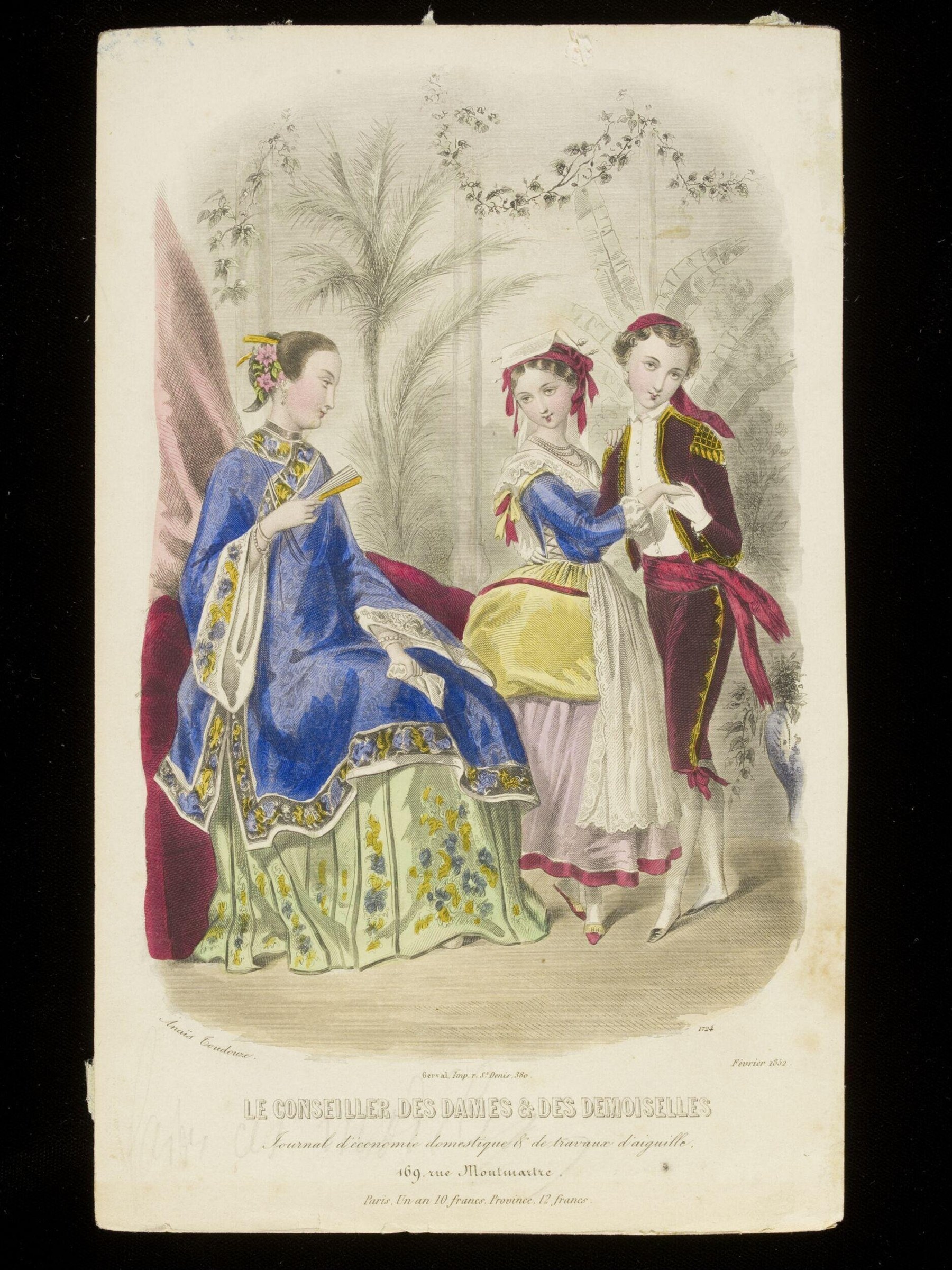
A hand-colored fashion plate depicting three elegantly dressed figures in an interior setting furnished with potted plants and draped fabrics. A seated woman in a striking blue silk dress with gold embroidered trim occupies the center-left, holding a yellow fan. She wears her dark hair adorned with yellow flowers. Two standing figures flank her: a young woman in a white dress with pink trim and red ribbon bows in her hair stands at center, while a man in a burgundy military-style coat with gold epaulettes and white waistcoat stands to the right. The three figures are engaged in what appears to be a moment of social interaction or courtship, with the standing woman gesturing toward the seated woman while the man observes. The composition emphasizes the luxurious textures and fashionable silhouettes of 1850s dress, with careful attention to the fall of fabric and decorative detail.
The dancing
The figures are posed in a static, formal arrangement typical of fashion plate convention rather than active dance. The standing woman's posture is upright and graceful, with her arms gently raised in a gesture of presentation or conversation. The seated woman reclines with composed dignity, one arm extended to hold her fan. The man stands in an attentive but passive pose, his weight distributed evenly, his hand resting casually. There is no weight shift, no spring in the step, no indication of ballroom movement or choreographed action. The arrangement is one of social tableau rather than kinetic engagement.
The dance depicted
This is not a depiction of dance but a fashion plate—a commercial illustration designed to display contemporary dress and social manners. The image shows three figures in a parlor setting engaged in leisurely social interaction, likely representing an idealized scene of courtship or social gathering. Fashion plates of this period sometimes included figures in ballroom settings, but here the poses and framing emphasize sartorial display rather than movement. No dance style is identifiable because none is intended to be depicted.
How it was made
This is a hand-colored engraving or lithograph, a reproductive print medium that was the dominant vehicle for fashion illustration in the nineteenth century. The fine lines and precise detailing characteristic of engraving are visible, particularly in the rendering of the plants, drapery, and ornamental details. Hand coloring was applied after printing, a labor-intensive process that made such plates relatively expensive. The technique allowed rapid distribution of fashion trends to a broad middle-class audience through periodicals and albums.
About this work
This fashion plate from 1852 documents the silhouettes, colors, and accessories of mid-nineteenth-century women's and men's dress through a scene of elegant social gathering. It represents a genre of commercial illustration that shaped taste and consumption during the Second Empire in France. While it depicts figures in a social interior rather than a ballroom, it reflects the aspirations and visual culture of a society in which dance was a central practice of courtship and social performance. The work belongs in a dance archive because fashion plates both documented and influenced the material conditions under which dance occurred—the weight and shape of skirts, the constriction of corsetry, the mobility allowed by tailoring—and because dance imagery and dance settings were frequently deployed in fashion illustration to convey elegance and desirability.
How to look at it
Attend to the silhouette: the bell-shaped skirt, the narrow waist emphasized by the tight bodice, the short puffed sleeves. Notice how the artist has rendered the weight and movement of the fabric—the way the seated woman's skirt falls in precise pleats, the translucency of the standing woman's skirts. Observe the posture demanded by the corsetry: the upright spine, the composed gesture, the constraint of the arms. This is how bodies were dressed for the ballroom, and these constraints shaped what was considered graceful movement. The setting—the potted palms and draped fabrics of an interior space—signals the refined domestic or ballroom context in which such dress was worn.
The artist
Anaïs Toudouze (1822–1899) was a French fashion illustrator and painter who contributed regularly to *Le Conseiller des Dames et des Demoiselles*, a prominent fashion journal of the Second Empire. She was one of the few women whose name appeared on fashion plates of the period, indicating her reputation and professional standing. Her work was known for refined draftsmanship, careful attention to textile detail, and elegant compositional arrangement. She combined illustration with oil painting, maintaining a dual practice in commercial and fine art.
The period
In 1852, the Second Empire had just begun under Napoleon III. Fashion illustration was at its peak as a tool of luxury marketing and social aspiration. The magazine *Le Conseiller des Dames et des Demoiselles* (founded 1848) targeted middle-class and upper-class women eager to follow Parisian trends. The mid-nineteenth century was the era of the full-skirted dress, the tightly laced corset, and the ballroom as the primary site of female public visibility and marriageability. Fashion plates often depicted women in the social settings where dress mattered most: at dances, in drawing rooms, at promenades. The ballroom waltz, polka, and quadrille were the dominant social dances of this moment.
Where it lives
This is a colored engraving from *Le Conseiller des Dames et des Demoiselles*, a Parisian fashion journal that appeared twice monthly from 1848 to the 1890s. Fashion plates were typically issued as loose prints or bound into periodicals, and many were collected and preserved in albums. This work's survival as a separately catalogued art object reflects the growing recognition of fashion illustration as a significant category of nineteenth-century visual culture.
Questions about this work
Is this a dance scene?
No. This is a fashion plate—a commercial illustration designed to display dress, not to depict choreography or movement. The three figures are posed in static, formal positions characteristic of social interaction rather than dance. However, the dress shown here was the standard ballroom costume, and understanding what such garments allowed or prevented is essential to understanding how people danced in this period.
Who were these clothes for?
These are fashions for the Parisian elite and aspiring middle-class women and men of the 1850s. The seated woman's silk dress with elaborate embroidery and the man's military-style coat signal wealth and status. Fashion plates like this were published in journals aimed at women who wanted to keep pace with Parisian luxury—the arbiter of taste for Europe at the time.
Why are there potted plants?
The potted plants, along with the draped fabrics, create the impression of an elegant interior—a drawing room or ballroom. This setting signals that what is being displayed are clothes for social occasions and courtship, the contexts in which such illustration mattered most to readers.
What can fashion plates tell us about dance?
Fashion plates document the silhouettes, fabrics, and accessories that constrained and enabled movement. The full skirts, tight corsets, and formal posture visible here shaped what movements were possible and what was considered graceful. They also frequently depicted women in the ballroom and at dance, making them valuable sources for understanding the visual culture of dance.
More dance artwork





