49 works in this view — arrow keys or swipe to move between them.
Dance in Art
Neptune's Notion
Moscoso, Victor
- Collection:
- Poster
- Source:
- Victoria and Albert Museum
- Rights:
- Rights vary by item — check the source record before reusing this image. Source record ↗
- Recorded as:
- V&A — check rights per item
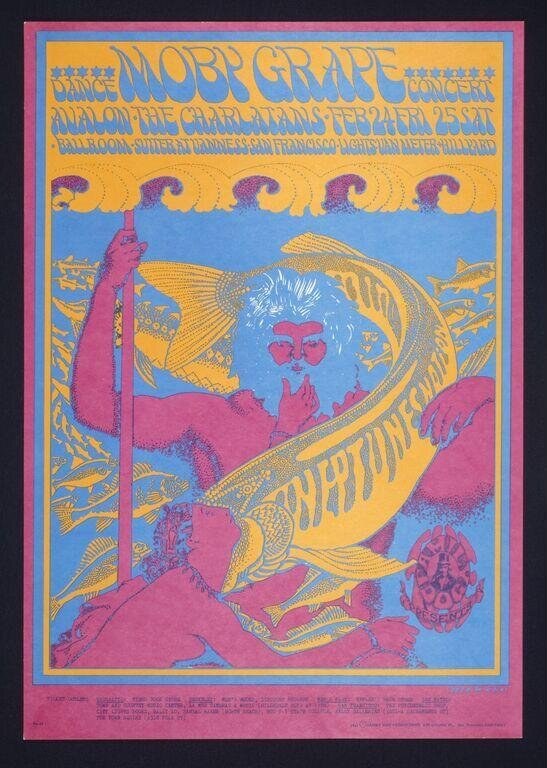
For a gallery of dance, this poster documents the visual codes through which the 1960s counterculture represented the body in motion and at rest—the fusion of music, visual art, and embodied experience that shaped a generation's understanding of movement, freedom, and transcendence. It shows how graphic design itself became a medium for choreographing the viewer's visual and sensory encounter with the image, much as a concert choreographs the listener's temporal and emotional experience.
What you are looking at
A psychedelic concert poster rendered in Victor Moscoso's signature electric color palette of magenta, blue, and gold. A single figure dominates the composition, seated or reclining with their body rendered in vivid magenta against a bright blue background. The figure's face is blue with magenta features; their hair or head covering flows in undulating lines that echo the decorative wave patterns at the top of the poster. An ornate, coiled serpent or sea creature rendered in gold and yellow curves across the body, its scales intricately patterned. The entire background is densely layered with ornamental motifs—stylized fish, decorative scrolls, and baroque-inspired embellishments in gold, creating a sense of underwater or mythological abundance. The color vibrations between the complementary hues create the optical shimmer characteristic of Moscoso's work.
The dancing
A single reclining or semi-seated figure occupies the full composition, their body relaxed and sprawled. The figure's posture suggests languor or repose rather than active movement; the head is tilted back and to the side in a contemplative or surrendered pose. The arms are not clearly articulated as distinct limbs but rather integrated into the surrounding patterning. The body is presented frontally, flattened against the picture plane in the manner of decorative or graphic art rather than representational figuration. There is no indication of a partner, ensemble, or defined dance hold.
The dance depicted
This is not a depiction of dance in the conventional sense. The figure is presented in a static, decorative pose suggestive of music-induced reverie or altered consciousness rather than choreographed movement. The poster advertises a concert (the text reads "Mobe Grape" and names venues including the Fillmore), so the imagery relates to the experience of live music performance and psychedelic culture of the late 1960s rather than to a specific dance style or theatrical tradition. The reclining, languid posture evokes the dreamy, transcendent states sought by concert-goers rather than any recognizable dance vocabulary.
How it was made
This is a concert poster lithograph executed in Moscoso's distinctive psychedelic style, characterized by high-saturation, clashing complementary colors printed in layers. The medium allows for flat, graphic areas of bold color with fine linear detail (visible in the scales and ornamental patterns); lithography permitted the rapid production and mass distribution necessary for concert promotion. The intentional color vibration—achieved by printing magenta, blue, and gold in close proximity—creates an optical effect that mimics or evokes the sensory overwhelm of the concert experience itself. The technique is integral to the content: the visual disorientation produced by the saturated colors parallels the psychedelic music and drug culture the poster addresses.
About this work
This is a concert poster for Moby Grape, created by Victor Moscoso, a prominent designer of psychedelic rock posters in San Francisco during the 1966–1968 period. Rather than depicting choreographed dance, it presents a figure in a state of musical or psychedelic absorption—reclining, languid, merged with ornamental serpentine forms. The work belongs in a gallery about dance not because it shows dancing, but because it captures the embodied, visionary experience of music and movement that defined the counterculture moment; it represents the visual language through which concert-goers understood their own bodies as sites of aesthetic and chemical transformation. The poster is an artifact of a specific historical convergence: the rise of the Fillmore concert halls, the demand for radical visual design, and the emergence of psychedelic art as a vehicle for representing altered consciousness and liberation of the body from conventional constraint.
How to look at it
Attend to the color relationships: the magenta, blue, and gold are chosen to vibrate against one another, creating a sense of visual instability or shimmer that can be uncomfortable to look at directly. This discomfort is intentional and mimics the sensory excess of the concert experience. Notice how the figure's body dissolves into ornamental patterning—the boundary between figure and ground is deliberately ambiguous, reflecting the psychedelic breakdown of ego and self-other boundaries. The symmetrical, decorative composition (the waves at the top, the mirrored ornaments) contrasts with the off-center reclining figure, creating tension between order and dissolution. The viewer is invited to experience the image not as a window onto a scene but as a direct stimulus to optical and imaginative perception.
The artist
Victor Moscoso (1936–) is a foundational figure in psychedelic graphic design and poster art. He emerged as a key designer for San Francisco's Fillmore Auditorium and Avalon Ballroom in the mid-1960s, creating iconic concert posters for bands including Big Brother and the Holding Company, the Grateful Dead, and Moby Grape. Moscoso studied color theory and developed a systematic approach to optical vibration through complementary color combinations; his work was informed by both fine-art traditions and commercial design. He was among the first to recognize that psychedelic visual effects could be achieved through graphic technique rather than merely illustrating psychedelic subject matter. His posters became foundational documents of the era and remain among the most recognizable images of the 1960s counterculture.
The period
The late 1960s in San Francisco saw the emergence of the Fillmore Auditorium and Avalon Ballroom as venues for rock concerts, and with them a new demand for visually radical poster design that would appeal to countercultural audiences and convey the transgressive energy of psychedelic music. Concurrently, psychedelic art—rooted in optical art theory, drug culture, and avant-garde design—was reaching its aesthetic and commercial peak. In the dance world, these years saw the rise of participatory, non-narrative dance in concert settings (the postmodern dance movement) and the blurring of boundaries between concert dance, rock performance, and audience participation. The poster's languid, merged figure reflects broader countercultural critique of the body as a site of individual expression and liberation from social constraint.
Where it lives
The work is catalogued as a poster and attributed to the collection at va (likely a digital archive or institutional collection). Concert posters of this era were ephemeral objects, produced in runs of hundreds to thousands for single or short-run events; many were discarded, and surviving examples are now valuable historical documents.
Questions about this work
Is this actually depicting dance?
Not in the sense of choreographed movement or recognizable dance vocabulary. The figure is reclining, not dancing. However, the poster captures the embodied, visionary experience that live music and psychedelic culture created—what might be called the phenomenology of counterculture movement and consciousness. For a dance archive, it represents how the visual culture of the era understood and represented the body as a site of aesthetic experience and liberation.
Who is Moby Grape and why does this poster matter?
Moby Grape was a San Francisco psychedelic rock band active in the late 1960s. The poster matters because it is a canonical example of psychedelic graphic design and concert poster art, created during a moment when visual design became inseparable from the music and cultural experience. Victor Moscoso's work defined the aesthetic of the San Francisco concert scene and influenced generations of graphic designers.
What is the creature in the image?
The coiled gold form appears to be a stylized serpent or sea creature, rendered in ornamental, almost baroque patterning. The title 'Neptune's Notion' suggests marine or mythological associations, and the creature may evoke both classical decoration and the hallucinogenic visions reported by users of psychedelic drugs. The ornamental style emphasizes pattern and surface over naturalistic representation.
Why are the colors so intense and clashing?
Moscoso deliberately chose complementary colors (magenta and blue, gold and blue) that vibrate against one another, creating optical shimmer and visual instability. This technique mimics the sensory overwhelm and perceptual distortion associated with both psychedelic drugs and the concert experience itself. The discomfort of looking at the image is part of its meaning.
More dance artwork





