49 works in this view — arrow keys or swipe to move between them.
Dance in Art
During the Ball
J. W. Debenham
- Collection:
- Photograph
- Source:
- Victoria and Albert Museum
- Rights:
- Rights vary by item — check the source record before reusing this image. Source record ↗
- Recorded as:
- V&A — check rights per item
The work is valuable as evidence of theatrical spectacle and amateur aesthetic performance in the 1930s, and as a window into educated, upper-middle-class entertainment culture of the interwar period. It demonstrates the currency of classical revivalism and pictorialist aesthetics in amateur theatrical practice, and the role of photography in preserving and elevating such ephemeral events to the status of fine art. For dance history specifically, it illustrates how 'dance' in aristocratic and educated circles often meant pageantry, pose, and visual spectacle rather than formalized technique or social partner dancing.
What you are looking at
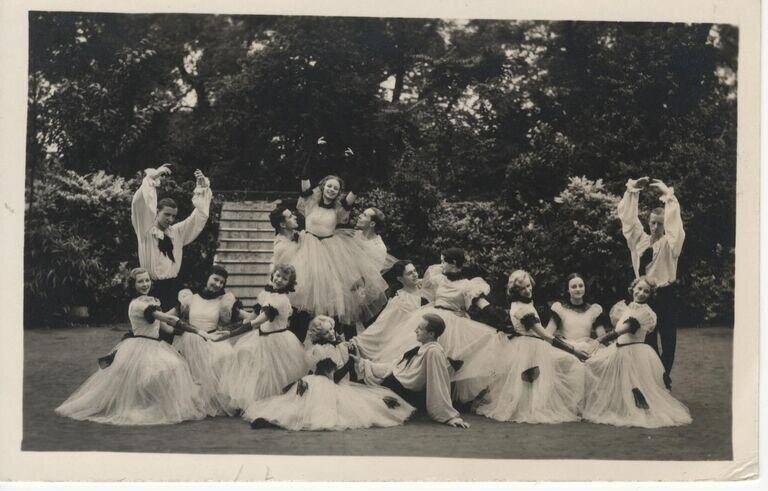
A formal outdoor garden scene, photographed in black and white, showing approximately fifteen young women arranged in a theatrical tableau vivant. The setting is a manicured lawn backed by dense foliage and evergreen trees, with a wooden staircase visible at center rear. The women wear diaphanous, floor-length white dresses—some pale and gauzy, others with more substantial layering—that create a unified ethereal effect. They are arranged in loose clusters across the lawn, some seated on the grass with skirts spread in full circles, others standing or reclining, posed with their arms raised, extended, or arranged decoratively. The composition suggests a prepared performance or pageant frozen in time rather than a moment of spontaneous movement. The photograph's soft focus and the sculptural quality of the draped fabrics give the scene a dreamlike, allegorical quality typical of Edwardian pictorial aesthetics.
The dancing
The bodies are arranged without clear hierarchical focus; the composition is deliberately dispersed across the frame. Most figures adopt soft, extended arm positions with little sense of ballroom frame or partnered hold. Several women recline or sit with limbs arranged for visual effect rather than functional dancing—the emphasis is on pictorial composition and the fall of fabric rather than on technique or momentum. The poses suggest classical or neo-classical referents: one figure at upper right lifts both arms as if in invocation or supplication, another at left appears to support or tend to a seated companion. There is no visible footwork, no sense of weight transfer, and no evidence of rhythmic unison. The arrangement reads as tableau rather than as captured dance.
The dance depicted
This appears not to be a documentation of actual dance performance but rather a staged pictorial composition evoking ideas of classical movement, spectacle, and feminine grace. The title 'During the Ball' suggests a social context—perhaps the supper interval at a debutante ball or a garden party entertainment—but the poses and the absence of musicians, male partners, or any apparatus for actual dancing suggest this is a pose de danse or arranged tableau, possibly from an amateur dramatic or aesthetic movement performance. The style and sensibility—the white dresses, the garden setting, the emphasis on elongated line and pictorial arrangement—align more closely with fin-de-siècle revivalist or symbolic theatrical practice than with ballroom dancing. The work may document a private performance or a photographic fantasy rather than a social dance event.
How it was made
This is a black and white photograph, likely gelatin silver print from its tonal range and grain. The soft focus and subtle lighting are consistent with pictorialist photographic practice of the 1920s–1930s, a mode that foregrounded artistic intent and emotional effect over documentary precision. The photographer has chosen a relatively long exposure and possibly diffusion to soften edges and emphasize the sculptural quality of the drapery and the ethereal, almost allegorical mood of the scene. The photographic medium allowed such a large group to be arranged and composed without the constraints of a painted canvas, while the archival properties of the print ensured the scene's preservation. This approach to photography—treating it as a fine art medium rather than a mere record—suggests an educated, aesthetically conscious audience.
About this work
This photograph documents a staged tableau vivant or posed dramatic scene from a garden party or ball in the 1930s, featuring approximately fifteen women in white drapery arranged in a deliberate pictorial composition. The work is fundamentally theatrical rather than documentary: it captures a constructed moment of aesthetic spectacle—possibly part of an amateur theatrical performance, a debutante entertainment, or an artist's imagined scene—rather than an actual social dance. The image sits at the intersection of photography, theatre, and the applied arts, reflecting early twentieth-century taste for neoclassical revival, aesthetic dress, and pictorialist visual culture. It belongs in a dance archive not because it documents dance technique or social practice, but because it depicts the body, spectacle, and the staging of movement as theatrical art.
How to look at it
Observe the deliberate arrangement of the figures across the frame and the emphasis on the fall and movement of fabric rather than on bodily technique. Note the absence of visible footwork, the soft and extended quality of the arm positions, and the way the composition reads as a unified aesthetic design rather than as a captured moment of actual social dancing. Pay attention to the photographic technique—the soft focus, the tonal subtlety, the way light models the drapery—which elevates the scene to the status of fine art and suggests that the photographer's intention was pictorial and allegorical rather than documentary. The work invites a reading as tableau, pageant, or theatrical fantasy rather than as evidence of how people actually danced.
The artist
J. W. Debenham is not widely documented in standard photographic histories. The name and practice suggest a photographer working in the upper-middle-class amateur and theatrical circles of interwar Britain, with access to estates and educated patrons interested in aesthetic and theatrical documentation. The pictorialist technique and the subject matter—private theatrical performance rather than commercial portraiture—suggest a photographer working in the tradition of pictorialist fine art photography, possibly as an amateur or semi-professional serving a limited, cultivated clientele.
The period
The 1930s saw a widespread revival of classical and neoclassical aesthetics in European and British culture, partly as a reaction against modernism and partly as an expression of nostalgia during economic uncertainty. Amateur dramatic societies, pageants, and garden theatricals were popular entertainments for educated and wealthy households; they frequently drew on classical or medieval themes and emphasized visual spectacle, costume, and arranged tableaux over plot or dialogue. Pictorialist photography—which had emerged in the 1890s but remained current in artistic circles through the 1930s—was the natural medium for documenting such events, as it elevated them to the status of fine art and aligned photographic practice with the aesthetic values of symbolism and the applied arts. The photograph reflects the persistence of Edwardian aesthetic ideals well into the twentieth century.
Where it lives
The work is held in the V&A (Victoria and Albert Museum), the British national repository for decorative and applied arts, design, and theatrical and photographic heritage. Its presence in this collection reflects its status as evidence of theatrical practice and aesthetic culture rather than as a fine art photograph acquired for purely artistic merit.
Dance in this work
Questions about this work
Is this a real dance or a posed scene?
It appears to be a posed tableau or staged theatrical scene rather than a document of actual social dancing. The absence of visible footwork, the careful arrangement of figures for visual effect, and the emphasis on drapery and pictorial composition suggest an arranged performance—possibly a garden pageant or amateur theatrical entertainment—photographed as if it were a work of fine art.
What kind of ball or dance is this?
The title and setting suggest a garden party or society entertainment, possibly the supper interval of a debutante ball or a private theatrical performance. The absence of musicians, male partners, and actual ballroom dancing implies that 'the ball' is a social context or a theatrical frame rather than the subject of direct representation.
Why does the photograph look so soft and dreamlike?
The photographer has used pictorialist techniques—soft focus, possibly diffusion or diffusion filters, and careful lighting—to create an artistic rather than a documentary effect. This was a deliberate aesthetic choice aligned with fine art photography of the period, intended to elevate the subject to the status of allegorical or symbolic art.
Who were these women and what was the occasion?
The catalogue record does not provide this information, and the photograph alone does not reveal specific identities or occasion. The formal dress, garden setting, and theatrical arrangement suggest educated and affluent young women participating in an amateur theatrical performance or pageant, likely in Britain in the 1930s, but the precise event and participants remain unknown.
More dance artwork





