49 works in this view — arrow keys or swipe to move between them.
Dance in Art
Theatre costume
Unknown
- Collection:
- Theatre costume
- Source:
- Victoria and Albert Museum
- Rights:
- Rights vary by item — check the source record before reusing this image. Source record ↗
- Recorded as:
- V&A — check rights per item
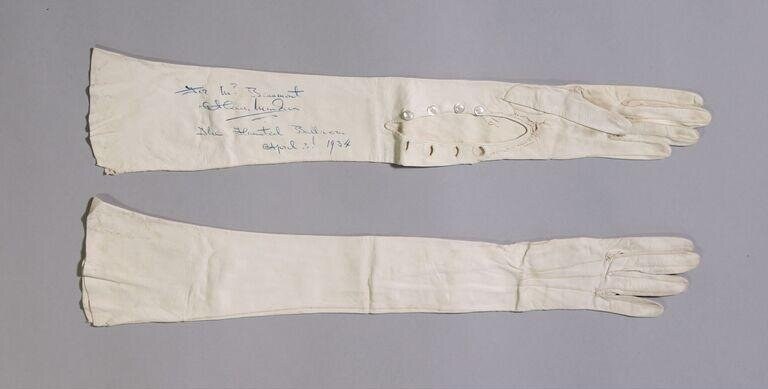
Costume pieces like these are rare documentary evidence of how dancers actually dressed and performed. The handwritten inscription is crucial: it directly connects the object to a specific performer and moment in 1934, making this a dated artifact of individual dance history rather than a generic garment.
What you are looking at
Two long white gloves or arm-length sleeves, photographed flat against a neutral gray background. The upper garment bears handwritten annotations in blue ink, including what appears to be a signature and a date of 1934. The lower garment is plain, unmarked cream or off-white fabric. Both are constructed from a lightweight material—likely cotton, linen, or silk—and show the creasing and wear of age. The upper piece is stained in places and exhibits the handling marks of a century-old textile. These are working costume pieces, not display garments: the stitching is functional, the fit is cut for movement, and the fabric shows the daily use of performance wear.
The dancing
There are no human figures depicted. This is a flat photograph of two separate costume pieces with no movement or gesture to analyze. The gloves or sleeves are arranged to show their full length and construction, laid out for museum documentation.
The dance depicted
These are costume pieces dated to 1934, but the image alone cannot identify the specific dance form they supported. The length suggests either ballroom or theatrical dance of the period—long gloves were worn in both contexts. The handwritten annotation and date inscribed on the upper piece indicate this was a documented costume, likely retained for archival or sentimental reasons. Without additional provenance or context about the performer or production, the dance form remains unidentifiable.
How it was made
This is a photograph of a two-dimensional object arrangement—a museum documentation shot, not an artwork. The photograph is color and shows the textiles in raking light that emphasizes texture and aging. It serves as a record of the object's condition and appearance. The original objects are textiles: constructed from woven or knitted fiber, hand-stitched with functional seams, and bearing the stains and creases of performance use and storage over ninety years.
About this work
This is a catalogue photograph of theatrical or ballroom costume gloves from 1934, documented as part of a performance archive. The upper piece bears a handwritten inscription—likely a dancer's name or production information and the date—suggesting it was kept as a memento. The pair illustrates the practical costume components of early-twentieth-century theatrical dance: long gloves were standard evening wear for ballroom, and they were also worn in many theatrical styles of the period. The photograph documents both the physical object and the information inscribed upon it, preserving evidence of performance history that would otherwise be lost.
How to look at it
Look at the handwritten inscription on the upper glove—it contains information the photographer deemed important enough to preserve. Note the wear and staining on both pieces: the creasing of the seams, the yellowing of the fabric, the marks of use. These signs of aging are evidence of actual performance, not display. The length and cut tell you something about the performer's arm span and the era's aesthetic: long, elegant lines were the goal. The fact that both pieces survived together suggests they were kept as a matched pair, possibly by the dancer who wore them.
The period
In 1934, evening gloves were ubiquitous in ballroom dance, where they were worn as part of formal dress. They were also standard in many theatrical styles—musical theater, vaudeville, and some forms of theatrical jazz. The long white or cream glove was a marker of formal elegance and professionalism. This was the era of the Hollywood musical and Broadway's golden age, both of which required dancers to wear costume pieces that extended the line of the arm and maintained formality under stage lights. The archive photograph itself reflects museum conservation practice: by 1934 or shortly after, dance companies and theaters were beginning to preserve costumes as historical documents.
Where it lives
These pieces are held in a collection catalogued as 'Theatre costume' with a source marked 'va' (possibly Virginia or a collection abbreviation). The handwritten annotation on the upper piece is the only documentation currently recorded; it may contain the performer's name or the production name, but the catalogue record does not transcribe it.
Questions about this work
Are these gloves or sleeves?
Likely gloves, given the length and the way they are constructed with openings at both ends. Ballroom and theatrical dancers of the 1930s wore long gloves that extended partway up the arm, providing elegance and extending the line of the limb. These could have extended above the elbow.
What does the handwriting say?
The catalogue record does not provide a transcription. The inscription appears to include a name or production information and the date 1934, but it is not legible in this photograph. Examination of the original object would be needed to read it precisely.
What dance style used these?
Without more information, it is impossible to say definitively. Long gloves were worn in ballroom dance, musical theater, vaudeville, and theatrical jazz in the 1930s. The inscription on the piece might identify the specific production or performer, which would resolve the question.
More dance artwork





