49 works in this view — arrow keys or swipe to move between them.
Dance in Art
Illustration
Beaton, Cecil (Sir)
- Collection:
- Illustration
- Source:
- Victoria and Albert Museum
- Rights:
- Rights vary by item — check the source record before reusing this image. Source record ↗
- Recorded as:
- V&A — check rights per item
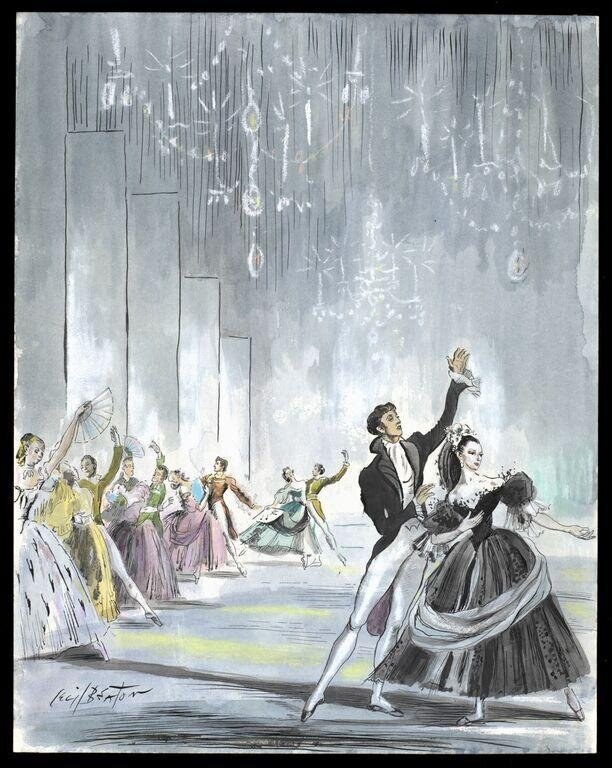
This illustration documents the aesthetics and movement vocabulary of Gilded Age ballroom dance at a moment when Beaton was at the height of his influence as a designer and visual chronicler of elite culture. The dramatic central pose—the woman's supported arch—reveals how theatrical and physically demanding even ostensibly 'social' ballroom dance could be in performance contexts. The work offers direct evidence of how the ballroom was imagined and represented in mid-century visual culture, especially the ideal of effortless elegance and the feminized spectacle of the extended female body in partnership.
What you are looking at
A grand ballroom scene rendered in watercolor and ink, dominated by a soaring architectural space with a coffered ceiling from which crystal chandeliers descend like icicles. The floor is polished and spacious. In the foreground, a couple in formal evening dress commands attention: the man in black tailcoat with arm raised gestures expansively, while the woman in a full skirt of pale gray or lavender executes a dramatic pose, her body arched and supported by her partner. To the left, a woman in golden yellow watches with raised parasol; behind and throughout the composition, other couples and individual figures in pastel gowns of pink, blue, and cream populate the ballroom in various attitudes of dance and socializing. The lighting is ethereal, with cool tones and white highlights suggesting either gaslight or the illustrator's deliberate choice of a luminous, theatrical quality. The scene captures a moment of high formality and aristocratic leisure.
The dancing
The central couple is posed in a dramatic, supported position characteristic of late 19th-century ballroom spectacle: the woman's body is extended nearly horizontal, held by the man's strong frame, her arm extended upward. The hold suggests partner support rather than the closed ballroom frame of standard waltz or foxtrot. Other dancers visible in the background appear to be in more conventional partnered positions, though the distance and composition do not allow precise reading of their frame or footwork. The figures are uniformly elegant and composed, suggesting trained dancers or at least practiced social partners performing for an audience.
The dance depicted
This appears to depict a formal ballroom dance of the Romantic era or Gilded Age, most likely a waltz or a waltz-based showcase piece, given the evening dress, the grand architectural setting, and the theatrical pose of the central couple. The dramatic supported arch at center suggests a climactic moment or a specially choreographed figure designed to display elegance and physical control. The ballroom setting and the presence of multiple couples in the background indicate this is social ballroom dance at the highest level—either a ball or a theatrical representation of one. The woman's nearly horizontal extension and the man's raised arm position are consistent with late 19th-century waltz performance, where such dramatic figures were part of the vocabulary of display.
How it was made
This is a watercolor and ink illustration on paper, employing a loose, gestural technique typical of fashion and society illustration of the 1930s. The artist uses transparent washes of cool gray-blue and lavender to establish the grand interior, with white gouache or reserve to create the chandelier drops and highlights on fabric. The ink provides crisp definition of the figures' silhouettes and the architectural geometry. The technique allows rapid, expressive rendering suited to publication in magazines or journals covering high society and the arts. The sketchy, elegant line work and the soft color palette are characteristic of mid-century illustration practice.
About this work
This is a society illustration depicting an elegant ballroom dance scene, most likely a waltz at a formal Gilded Age ball or a theatrical representation thereof. The work is signed by Cecil Beaton, the influential British photographer, designer, and illustrator, dated 1936. It captures the glamour and formality of high society dance in the period between the wars, when ballroom dancing remained central to aristocratic social life and theatrical spectacle. The dramatic central pose, the careful rendering of evening dress, and the grand architectural setting all speak to Beaton's well-known interest in fashion, theater, and the aesthetics of luxury and refinement.
As an illustration, this work participates in a tradition of documenting and idealizing ballroom culture. Its presence in a major collection (the V&A) reflects the status of dance illustration as a legitimate art form and historical document. The work is typical of Beaton's practice of rendering theatrical and social events with a keen eye for composition and fashion detail.
How to look at it
Attend to the central couple's pose: the woman's nearly horizontal extension and the man's supporting frame create a moment of maximum visual drama and physical vulnerability—a far cry from the upright, contained frame of standard ballroom technique. This is a climax or a showcase moment, designed to arrest the eye. Notice also the asymmetry in the composition: the central figures are offset to the right, with the watching crowd and the woman in yellow distributed to the left and background, creating depth and a sense of theatrical staging. The chandelier above, rendered as icicle-like drops, frames and elevates the moment, suggesting both the physical grandeur of the ballroom and a dreamlike, almost balletic quality. The cool color palette and the ethereal lighting reinforce the sense of spectacle and refinement.
The artist
Cecil Beaton (1904–1980) was a British photographer, illustrator, stage and costume designer, and diarist whose career spanned the mid-20th century. He was celebrated for his fashion photography and his designs for theatre and film, including major Shakespearean productions and the costumes for My Fair Lady. Beaton had a keen eye for the aesthetics of movement, fabric, and social display, and his illustrations of society events and theatrical moments are marked by elegance, attention to detail, and a somewhat idealized rendering of his subjects. He moved easily between documentary and fantasy, between the social world and the theatrical. This illustration reflects his practice of capturing moments of high elegance and physical display.
The period
In 1936, ballroom dancing was undergoing a transition. The waltz remained a cornerstone of formal social dance and remained popular in both aristocratic and middle-class contexts. However, the 1930s also saw the rise of newer social dances—the foxtrot, the tango, and various swing styles—which offered different aesthetic and kinetic possibilities. Ballroom dancing in the 1930s was increasingly professionalized and theatricalized, with exhibition dancers and competition dances shaping social practice. Beaton's illustration, with its dramatic pose and theatrical lighting, reflects this theatricalization: the scene is not merely a record of an actual ball, but an idealization of ballroom dance as a form of aesthetic and social performance. The illustration also reflects the 1930s fascination with glamour, luxury, and the visual spectacle of evening dress and refined manners.
Where it lives
Held by the Victoria and Albert Museum (V&A), London. The work is catalogued as an illustration and comes from the Museum's collection of theatrical and fashion design materials, which includes extensive holdings of Beaton's work. It is one of many illustrations and designs by Beaton in the Museum's care.
Dance in this work
Questions about this work
What dance is this?
This appears to be a waltz or waltz-based showcase piece, given the formal ballroom setting, the evening dress, and the style of the central couple's dramatic pose. The supported arch position is consistent with late 19th- and early 20th-century waltz performance, where such figures were part of the vocabulary of display and spectacle. However, the illustration is idealized rather than documentary, so it may not represent any single historical dance event.
Is this a record of an actual ball?
It is unlikely to be a precise record of a specific event. Beaton's illustration style is idealized and theatrical—he captures the aesthetic and mood of high society ballroom culture rather than documenting a particular moment. The dramatic central pose and the carefully composed scene suggest this is a representation of the ideal of ballroom elegance rather than reportage.
What does the woman's pose tell us about the dance?
The nearly horizontal extension of the woman's body, supported by her partner, demonstrates that ballroom dance in this period could include very dramatic and physically demanding moments. This is not the upright, contained posture of modern standard ballroom technique, but rather a more theatrical, visually spectacular pose designed to display elegance, control, and the feminine form. Such figures were part of the performance vocabulary of exhibition and social dancing.
Why is Cecil Beaton illustrating a ballroom scene?
Beaton was fascinated by fashion, theatre, and the visual aesthetics of refined society. Ballroom culture was central to his world and to the world of his wealthy, aristocratic clients and subjects. Illustrating such scenes allowed him to explore his interests in movement, dress, and social spectacle, and to contribute to the visual documentation and idealization of high society culture that was part of his larger artistic practice.
More dance artwork





