49 works in this view — arrow keys or swipe to move between them.
Dance in Art
Harry Beard Collection
unknown
- Collection:
- Sheet music
- Source:
- Victoria and Albert Museum
- Rights:
- Rights vary by item — check the source record before reusing this image. Source record ↗
- Recorded as:
- V&A — check rights per item
This object documents the polka craze of the 1840s—a genuine social phenomenon that swept across Europe and America—at the moment of its peak popularity. Sheet music covers are primary evidence for which dances mattered to which audiences in a given period, and this piece connects the dance to a specific historical figure and to contemporary fashion and gender politics. The visual representation of social dance in its commercial context shows how dance was packaged and sold to middle-class consumers.
What you are looking at
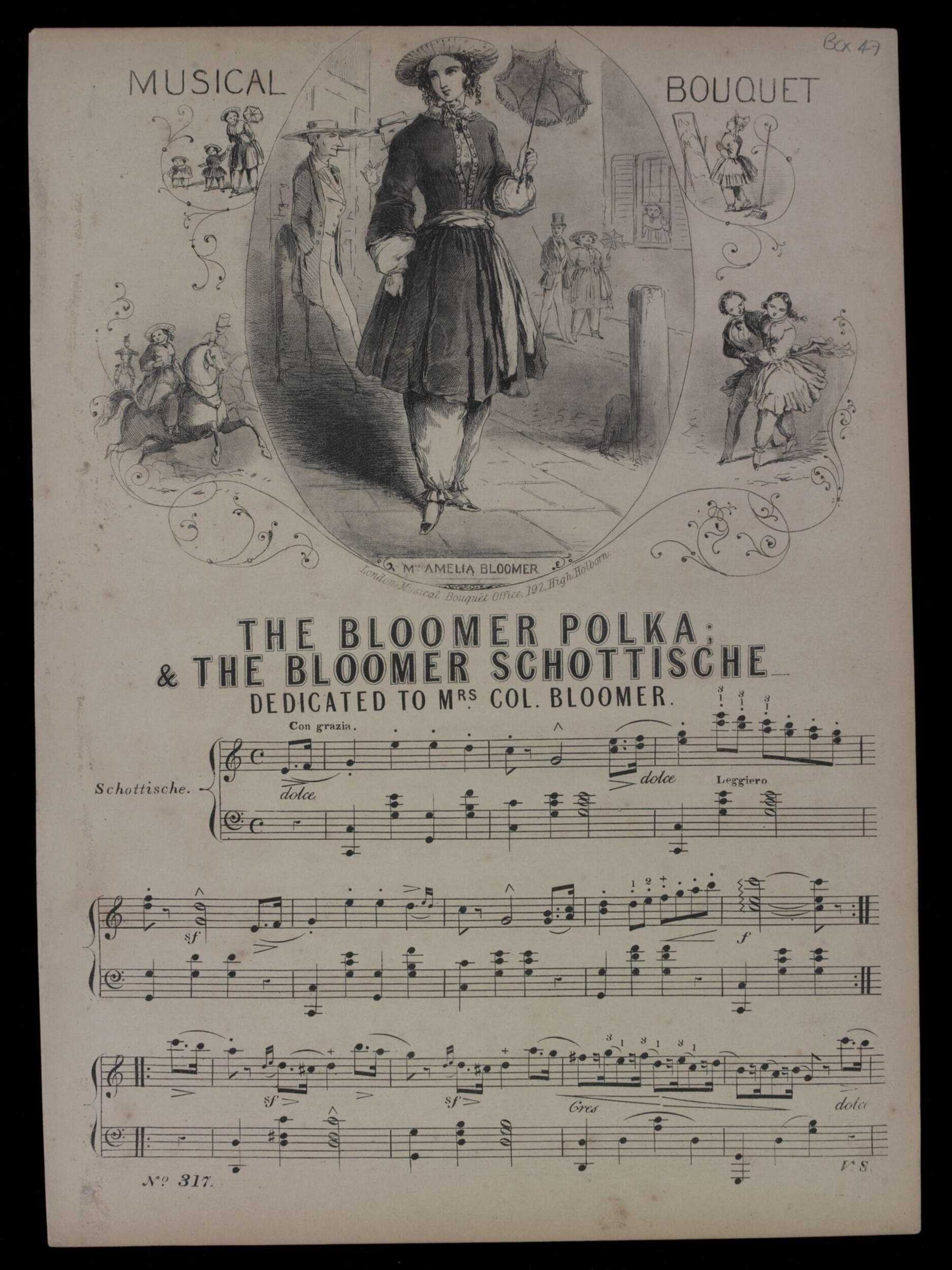
Sheet music cover for a mid-19th-century polka and schottische composed for Mme Amelia Bloomer. The central figure is a fashionable woman in dark dress with full skirts, holding a parasol, walking down a street. She wears a wide-brimmed hat trimmed with feathers and demonstrates the silhouette of the 1840s. Surrounding her in decorative vignettes are miniature scenes: on the left, musicians performing and small figures in social settings; on the right, dancers in various poses including what appear to be children or young performers in theatrical dress, one holding a fan. The entire composition is framed by ornamental scrollwork typical of Victorian commercial printing. The title identifies this as music dedicated to Mrs. Col. Bloomer, likely referencing the prominent women's rights advocate Amelia Bloomer.
The dancing
The central figure stands in an upright, promenade position characteristic of mid-Victorian posture—shoulders back, parasol held at an angle, body composed and formal. The smaller figures in the surrounding vignettes show varied poses: some appear to be in social dance positions, others in theatrical or performance attitudes with arms raised or extended. The scale difference between the central figure and the peripheral dancers emphasizes the hierarchy of the composition, with the named woman as the focus and the dance scenes as decorative framing elements rather than the primary subject.
The dance depicted
The work depicts two closely related social dances of the 1840s: the polka and the schottische. Both were fashionable couples' dances of the period, performed in ballroom settings. The polka, which originated in Bohemia in the 1830s, spread rapidly through European dance society in the 1840s and became a craze in London and America. The schottische, a slower variant with German origins, often appeared in paired repertoire with the polka. The vignettes suggest both theatrical and social contexts—the central figure embodies the fashionable consumer of dance music, while the surrounding scenes imply both ballroom performance and theatrical spectacle.
How it was made
This is a wood or steel engraving, printed as sheet music cover stock. The technique allowed for fine linear detail in both the figurative scenes and the ornamental scrollwork, typical of mid-Victorian commercial publishing. The engraving medium enabled mass reproduction, which was essential for sheet music distribution; as a printed cover, this object circulated in middle-class homes via piano teachers and music shops. The refinement of the line work and the complexity of the composition indicate skilled commercial engraving practice of the period.
About this work
This is a commercial sheet music cover from approximately 1849, depicting the social dances—polka and schottische—that dominated fashionable ballrooms in the 1840s. The cover functions as both musical document and cultural artifact, advertising the music by associating it with a notable woman while visualizing the dance contexts in which it would be performed. The work sits at the intersection of dance history, women's social history (given the Bloomer connection), and the commercial visual culture of Victorian sheet music, revealing how dance was marketed and consumed in mid-19th-century households.
How to look at it
Observe the contrast between the static, formally composed central figure and the energetic, varied poses in the surrounding vignettes. The central woman embodies the fashionable consumer of dance music—she is not herself dancing but displaying the dress and posture of someone who attends dances. The peripheral scenes suggest the actual social context: musicians, couples, performers. Notice the theatrical framing and the ornamental excess, which tell you this is a commercial product designed to appeal through visual richness and cultural authority, not documentary accuracy. The printed title and dedication are essential: they situate this music within a specific social moment and market.
The artist
The artist is not identified in the record, which is typical for commercial engravers of this period. The work is attributed only to the Harry Beard Collection. The quality of execution suggests a professional commercial engraver working for a London music publisher, likely during the 1840s when this style of ornate, figure-rich sheet music cover was standard.
The period
The polka craze of the 1840s was one of the first genuinely international popular dance phenomena. Originating in Prague around 1830, the polka reached London in 1842 and became an immediate sensation, leading to polka-themed fashions, decorative arts, and popular culture across Europe and America. The 1840s were also a period of democratization in dance: the polka and schottische were within reach of middle-class dancers and were performed in commercial dance halls as well as aristocratic ballrooms. This accessibility, combined with rapid music printing and distribution, created the first modern dance craze. The appearance of this music in association with Amelia Bloomer—famous for her advocacy of rational dress reform—is intriguing, as it positions fashionable dancing within contemporary debates about women's bodies, movement, and public presence.
Where it lives
The work is held in the Harry Beard Collection and catalogued as sheet music. It is a commercial printed object, one of thousands of polka covers produced in London during the 1840s, suggesting it had wide circulation among middle-class households with pianos.
Dance in this work
Questions about this work
Who was Amelia Bloomer?
Amelia Bloomer (1818–1894) was an American social reformer and advocate for women's rights, temperance, and dress reform. She is remembered for promoting 'rational dress' and for lending her name to the bloomers, the baggy trousers worn under a shorter skirt. The dedication of this dance music to her suggests a deliberate connection between fashionable dancing and contemporary debates about women's bodies and public participation.
What is the difference between a polka and a schottische?
Both are couples' dances in 2/4 time popular in the mid-19th century. The polka is faster and more energetic, with a characteristic 'hop' on the third beat. The schottische is slower and more controlled, resembling a slow polka. They were often performed in sequence at balls, and composers frequently paired them, as here. Both originated in Central Europe and spread rapidly through social dance culture in the 1840s.
How do we know this is from around 1849?
The record dates it to 1849. The stylistic markers—the women's fashion (the dress silhouette, hat style, parasol), the ornamental frame design, and the printing technique—are consistent with mid-1840s London sheet music production. The polka itself was at peak popularity in London in this period, making a dedicated polka cover unsurprising.
Was this music actually danced to?
Yes. This is not a commemorative or artistic representation of dance but a functional musical score intended for pianists to play at home or in dance halls and ballrooms. The cover design sells the product by visually representing the contexts in which it would be performed—fashionable drawing rooms, theatrical spaces, social gatherings. Thousands of such pieces were printed and distributed.
More dance artwork





