49 works in this view — arrow keys or swipe to move between them.
Dance in Art
Parisiana
Campbell & Gray
- Collection:
- Photograph
- Source:
- Victoria and Albert Museum
- Rights:
- Rights vary by item — check the source record before reusing this image. Source record ↗
- Recorded as:
- V&A — check rights per item
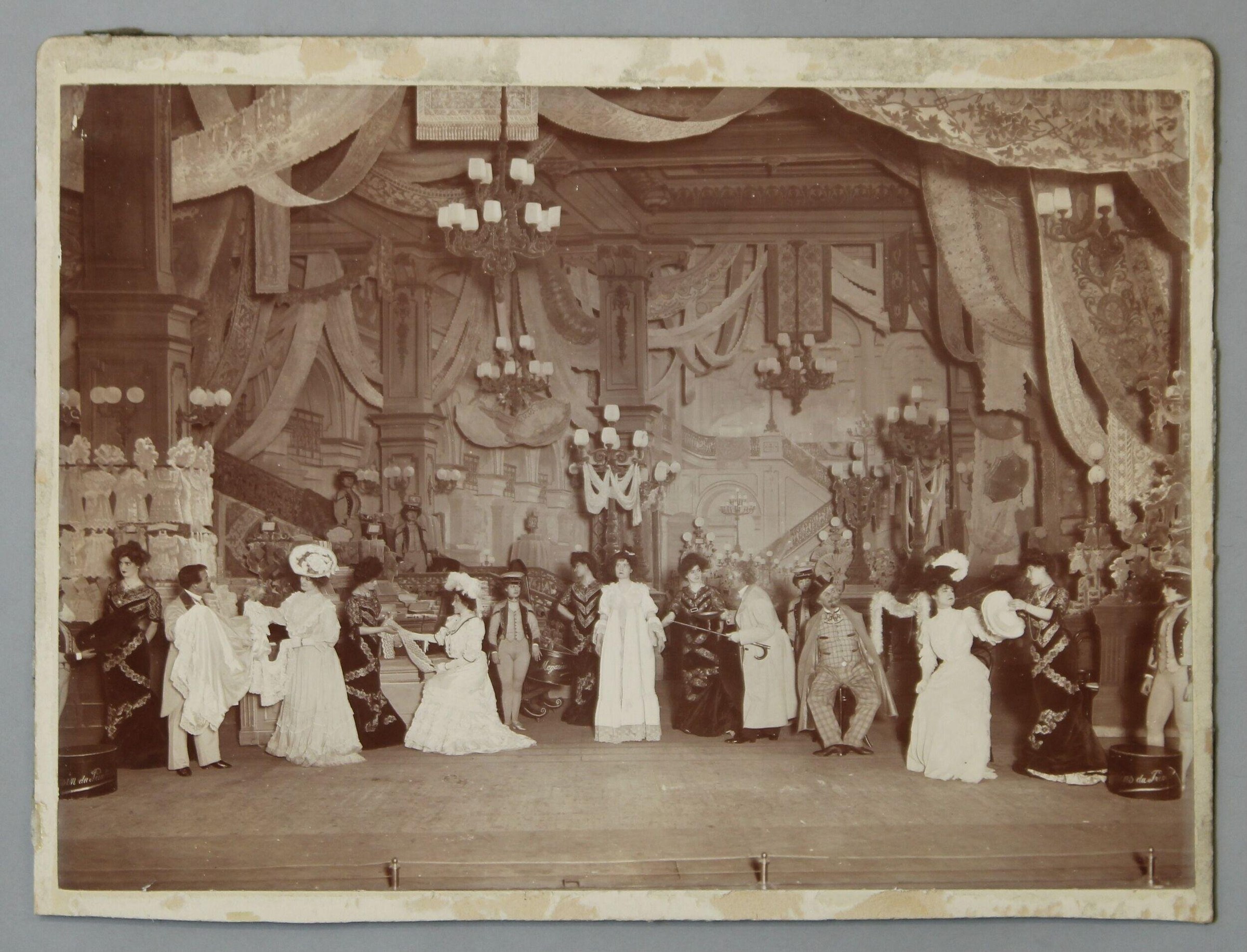
This photograph documents the aesthetic presentation of formal ballroom dance and ceremony in Parisian theater, showing how stage designers and choreographers translated upper-class social life into theatrical spectacle. The work is valuable for understanding the visual conventions of early 20th-century theatrical dance and the cultural fascination with Paris as a site of glamour and social performance.
What you are looking at
A grand theatrical interior frames an elaborate ball or formal reception. The space is defined by classical architecture—fluted columns supporting a richly decorated ceiling hung with ornate chandeliers and swags of drapery. The floor is a polished stage. In the middle distance, roughly twelve figures in formal dress are arranged in a loose processional or social grouping, with several women in white gowns (some with trains), men in military uniforms or tailcoats, and at least one figure in white robes or ecclesiastical dress. The figures are not actively dancing but are positioned as if at a formal ceremonial moment: some face forward, others turn toward their neighbors, suggesting conversation or the transition between events. The lighting is theatrical, falling from above to create a sense of stage space. Elaborate decorative elements—swags, festoons, and architectural ornament rendered in light tones—dominate the upper half of the composition, emphasizing the grandeur of the venue. The overall effect is of a moment of stasis in a formal evening, a tableau vivant or choreographed processional rather than dynamic movement.
The dancing
The figures maintain upright, formal posture throughout. Most stand at rest or in conversation poses rather than in dancing frame; arms hang naturally or are held at the sides, with occasional gestures suggesting acknowledgment or greeting. A woman in white at center-left holds what appears to be a fan. The grouping is linear and processional rather than coupled, suggesting either a formal promenade or a ceremonial gathering. The weight distribution is stable and grounded—no figure leans, reaches, or extends into the dynamic, off-balance positions characteristic of active ballroom dance. The arrangement reads as theatrical staging for a formal occasion rather than a moment of dancing itself.
The dance depicted
The image depicts a formal reception, ball, or theatrical tableau of a type common in early 20th-century Paris and associated with the 'Parisiana' genre—glamorous scenes of upper-class entertainment, often performed as pantomime or spectacle in music halls and theaters. The work shows a moment of ceremony or promenade rather than active social dance. If dance occurs in this scene, it is likely to be a waltz, quadrille, or cotillion—the standard ballroom forms of the era—but the frozen moment is one of formal gathering rather than dancing movement. The setting, costume, and grouping all suggest theatrical representation of Parisian high society, possibly for a revue or operetta. Without evidence of partnered frame, footwork, or dynamic movement, the identification remains at the level of genre (formal ballroom occasion) rather than a specific dance style.
How it was made
This is a photograph of a theatrical stage set or production, printed as a sepia-toned photograph on cream stock. The technique captures the set design, lighting, and figure arrangement as they appeared under stage lighting. The soft-focus quality and warm tone suggest hand-tinted or albumen printing, common in theatrical documentation of the period. The photograph functioned as a production record and promotional material, allowing the image to circulate beyond the theater—such images were collected as postcards, in programs, or in press archives. The sepia tone and mounting style suggest this is a studio or archival print rather than a contemporary ephemeral theater card, indicating it was considered a document worth preserving.
About this work
This is a photograph of a staged scene from a Parisian theatrical production titled 'Parisiana,' captured by the photographer Campbell & Gray in 1905. The image shows a formal ball or reception scene in classical architectural setting, with actors and dancers arranged in an elaborate tableaux. The work is a record of Edwardian theatrical spectacle, documenting the visual and choreographic conventions of high-society entertainment as performed and consumed in Paris in the early 20th century. It belongs in a dance history collection as evidence of how ballroom forms, formal social arrangements, and theatrical pageantry intersected in the entertainment culture of the period.
How to look at it
The photograph emphasizes architectural grandeur and formal arrangement over dynamic dance movement. The viewer should attend to the symmetry and processional ordering of the figures, the relationship between the elaborate decorative setting and the human-scale groupings within it, and the quality of stage lighting that creates volume and presence. The artist has chosen a moment of assembly and ceremony rather than movement; the 'dance' of this scene lies in the choreography of formal gathering and social hierarchy made visible through position and dress.
The artist
Campbell & Gray were photographers active in the early 20th century, known for theatrical and commercial photography, likely operating a studio in Paris or with connections to the Parisian theater world. The firm's work appears in records as documentary photographers of theatrical productions, capturing stage sets, costumes, and actors for promotional and archival purposes. Their practice was typical of the period's theatrical photography industry, which served both as a record for the theater company and as marketing material for audiences and critics.
The period
In 1905, Paris was the acknowledged center of entertainment culture in Europe. The Belle Époque and early Edwardian era saw the rise of large-scale theatrical revues and music-hall spectacles that celebrated modern luxury, fashion, and social life. The 'Parisiana' genre specifically capitalized on the glamorous image of Paris itself—theaters produced elaborate productions with lavish sets, choreographed processions, and ballroom scenes designed to evoke the social world of the wealthy. Ballroom dancing remained a central form of both social practice and theatrical representation, and formal quadrilles, waltzes, and processional choreography were common elements of such spectacles. Photography had become the dominant medium for theatrical documentation by this date, replacing lithography for most production records.
Where it lives
The work is held as a photograph by the Victoria and Albert Museum (indicated by source 'va' in the record). It is catalogued as a theatrical photograph, part of the museum's collection of stage design and theatrical practice documentation.
Dance in this work
Questions about this work
Is this a photograph of an actual dance performance?
It is a photograph of a theatrical stage set and scene, showing actors and possibly dancers in costume at a formal moment. The frozen image captures a tableau or processional arrangement rather than active dancing. The work documents the visual and theatrical framing of ballroom spectacle rather than dance in motion.
What does 'Parisiana' refer to?
Parisiana is a genre of early 20th-century theatrical production that celebrated Paris and Parisian high society through elaborate revues, ball scenes, and costume spectacles. These productions were popular in music halls and theaters across Europe and capitalized on the glamorous international image of Paris. Themes included fashion, luxury, courtship, and social ceremony.
Why is the architectural setting so elaborate?
The grand classical interior is essential to the Parisiana fantasy—it establishes the wealth, refinement, and European cultural prestige of the scene. The setting anchors the theatrical narrative in a specific social world (upper-class leisure and ceremony) and provides the visual vocabulary through which the audience understood Paris as a capital of civilization and taste.
Who were Campbell & Gray?
Campbell & Gray were theatrical photographers active in the early 1900s, specializing in documentation of stage productions. They produced archive and promotional photographs of sets, costumes, and actors for theater companies, particularly those producing large-scale revues and spectacles. Their work is an important record of early 20th-century theatrical design and practice.
More dance artwork





