49 works in this view — arrow keys or swipe to move between them.
Dance in Art
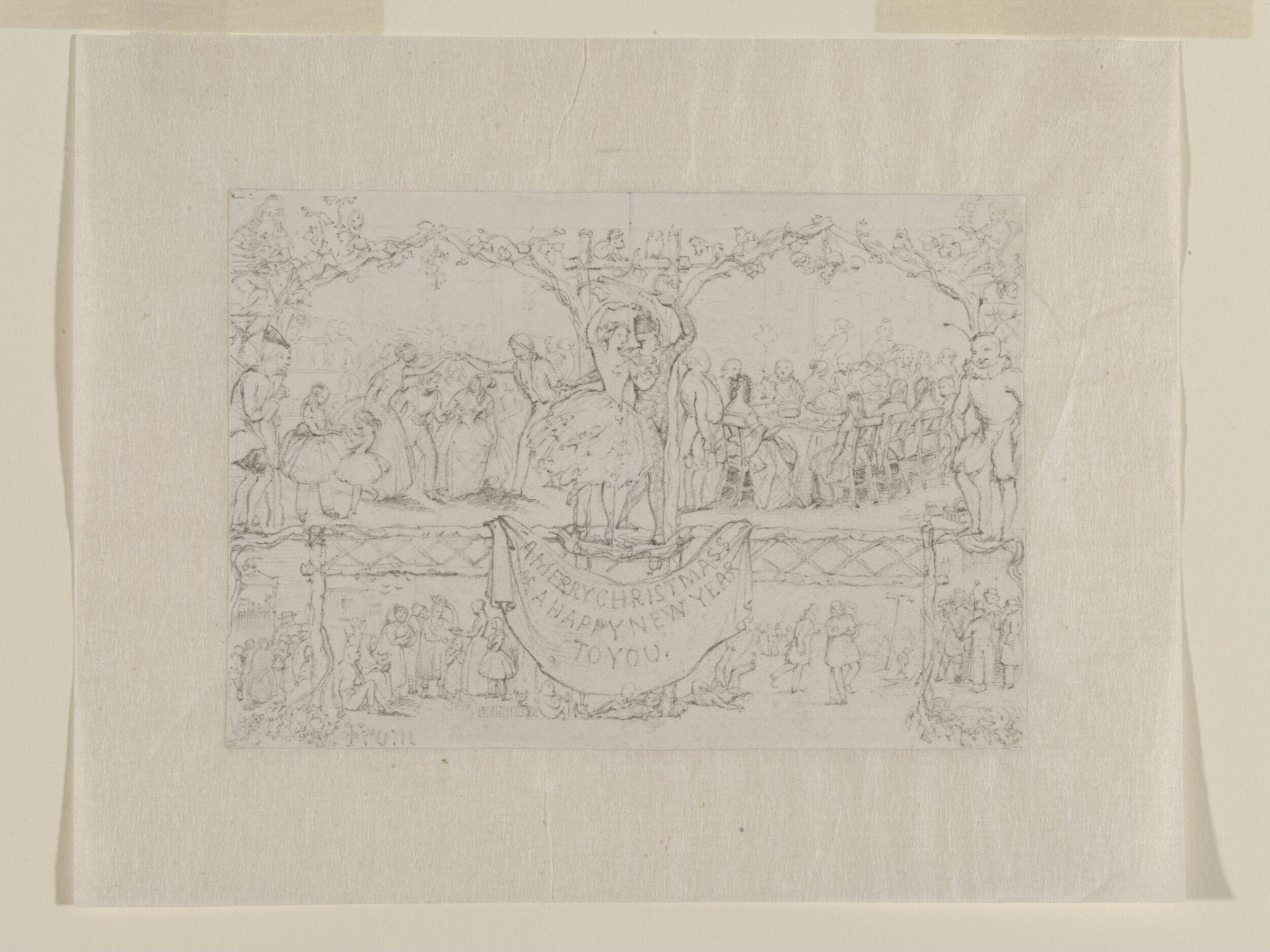
Finished design for a Christmas card
Egley, William Maw
- Collection:
- Drawing
- Source:
- Victoria and Albert Museum
- Rights:
- Rights vary by item — check the source record before reusing this image. Source record ↗
- Recorded as:
- V&A — check rights per item
This work is valuable for understanding the visual culture of mid-Victorian Christmas celebration and the role of the decorated tree as a focal point for family and social gathering—a tradition only recently imported to England and still becoming established in 1848. It also demonstrates the sophisticated commercial print culture of the Victorian period, where skilled artists like Egley produced designs for mass-market reproduction, making seasonal imagery accessible to a broad public.
What you are looking at
A dense, festive composition crowded with figures arranged in multiple zones across the sheet. In the center stands a large evergreen tree hung with garlands and topped with a star, positioned within an ornamental fenced enclosure. The tree is surrounded by an excited throng of people—men, women, and children—in Victorian dress, many gesturing upward or outward in gestures of joy and celebration. The composition extends laterally across the sheet to include crowds on either side of the central tree, with figures visible at multiple depths, some in the immediate foreground and others receding into the background. A banner or scroll unfurls below the tree bearing the inscription "A Merry Christmas & A Happy New Year To You" (or similar festive greeting). The entire scene is rendered as a preparatory pen-and-ink line drawing, with figures sketched in rapid, energetic strokes that capture movement and animation throughout the composition. The density of the crowd and the upward orientation of many figures suggest a moment of collective celebration and gathering.
The dancing
Bodies throughout are rendered in varied poses suggesting animated conversation, celebration, and upward gazing. Many figures raise their arms or gesture toward the tree; children cluster around its base while adults stand or lean in conversation. The poses are informal and social rather than formally aligned—this is a crowd, not a formation. Clothing visible on multiple figures suggests the full dress of mid-Victorian England: women in bonnets and full skirts, men in tailcoats and top hats. The variety and overlapping of poses conveys spontaneity rather than choreographed movement.
The dance depicted
This is not a depiction of dance proper, but rather a Christmas celebration scene in the Victorian tradition of the Christmas tree gathering. The figures do not appear to be dancing; rather, they are assembled around a decorated tree in what was becoming a fashionable domestic or semi-public celebration ritual by mid-century. Any movement suggested is social movement—circulation, clustering, gesturing—rather than rhythmic or patterned dance movement.
How it was made
A finished preparatory design rendered in pen and ink on paper. The technique employs fine linear hatching and cross-hatching to suggest depth, shadow, and texture; the line work is varied in weight and density to create emphasis and atmosphere. The drawing shows the care and finish of a design intended for translation to print or reproduction—likely prepared for engraving or lithographic transfer for mass production as a Christmas card, as the title indicates. This level of finish is typical of commercial card design of the period, where the preliminary artwork would guide the engraver or lithographer in creating the final published version.
About this work
This is a finished pen-and-ink design for a Christmas greeting card, created by William Maw Egley in 1848. The work captures a moment of Victorian festive culture—the gathering around a decorated Christmas tree—rendered in a crowded, celebratory composition filled with energetic figural detail. The drawing demonstrates Egley's skill in managing a complex multi-figure scene and his understanding of the commercial print tradition; the work was designed for reproduction and circulation as a mass-produced seasonal greeting. While not a dance image per se, it documents a crucial moment in the social history of Victorian recreation and domestic celebration, and the animated, gestural quality of the crowd speaks to period conventions for depicting collective joy.
How to look at it
Attend first to the tree itself, centered and clearly the compositional anchor, then trace outward to the clustered figures. Notice how Egley uses the density of line work and the overlapping of figures to create a sense of throng and excitement—the drawing technique itself conveys the press of a crowd. Look at the variety of gesture and posture: the raised arms, the bowed heads in conversation, the children at the base. The inscription on the banner below grounds this as a greeting, a commercial work designed to carry a message of goodwill into Victorian homes.
The artist
William Maw Egley (1826–1916) was a prolific Victorian painter and illustrator known for genre scenes and historical subjects. He was active as both an easel painter and a commercial designer, producing work for the expanding Victorian market in prints and illustrated publications. His facility with complex figural compositions and his ability to convey narrative and emotion through dense, detailed scenes made him well suited to both fine art and commercial work.
The period
In 1848, the Christmas tree was still a relatively novel and fashionable ornament in England, imported from German tradition and championed by the Royal Family (whose adoption of the tree had been publicized a few years earlier, in 1846). The period saw an explosion in Christmas imagery and greeting cards as both the holiday became increasingly commercialized and sentimentalized, and printing technology made mass reproduction faster and cheaper. The mid-Victorian period witnessed the codification of many Christmas traditions we recognize today—the tree, carols, cards, and family gatherings—and artists and printers worked to capitalize on and shape these emerging customs. Egley's design sits at this intersection of artistic skill, commercial opportunity, and the invention of modern Christmas.
Where it lives
Held in the Victoria and Albert Museum collection as a drawing. The catalogue identifies it as a finished design for a Christmas card, reflecting its status as a work of commercial art rather than a unique fine art object.
Questions about this work
Was the Christmas tree common in England in 1848?
No. The tree was still fashionable and novel, having been recently popularized by the Royal Family. Egley's design documents the early enthusiasm for what was becoming a defining symbol of Victorian Christmas. The density of the crowd around the tree suggests the novelty and appeal of the spectacle.
Is this a painting or a print?
It is a preparatory drawing—a finished pen-and-ink design intended to be reproduced as a printed card. The work shown here is the original design; multiple printed copies would have been made from it for sale.
Who would have bought this card?
Middle and upper-class Victorians purchasing seasonal greetings to send to family and acquaintances. The skill and finish of the design suggests a premium product aimed at a literate, affluent market.
More dance artwork





