49 works in this view — arrow keys or swipe to move between them.
Dance in Art
Romeo and Juliet
Miller, W
- Collection:
- Source:
- Victoria and Albert Museum
- Rights:
- Rights vary by item — check the source record before reusing this image. Source record ↗
- Recorded as:
- V&A — check rights per item
This print documents the visual and gestural conventions of high theatrical production in the late 18th century—the poses, groupings, and emotional registers that defined dramatic action of the period. Understanding how bodies were arranged and displayed in theatre helps contextualize the dance forms that shared the same stages and audiences. It also shows the power of the engraved image to fix and circulate a canonical version of a famous scene.
What you are looking at
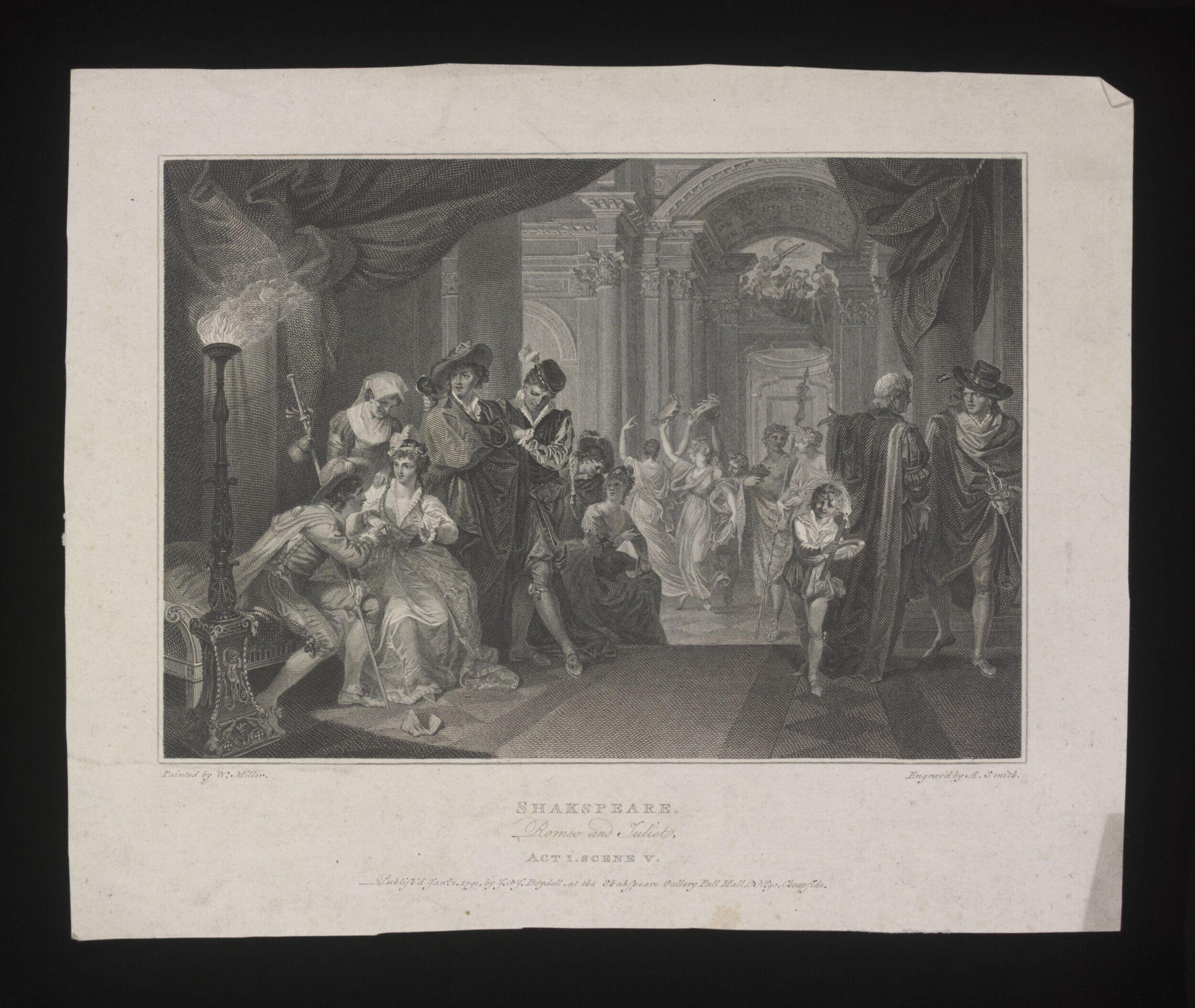
An opulent palace interior with classical columns and arched ceilings provides the setting for a dramatic theatrical moment. A woman sits at the center-left, attended by figures in dark robes; she wears a pale, flowing gown and appears to be the focus of the assembly. Around her stand numerous courtiers and attendants in period dress—cloaks, hats, and formal garments typical of Renaissance or early modern staging. Several figures gesture toward the seated woman or toward a doorway in the background, where additional figures are visible. The composition uses strong light from an ornamental brazier or torch on the left to model the figures and create theatrical depth. This is a moment of high drama, possibly the scene of Juliet's awakening or a formal court gathering, rendered in the manner of history painting or theatrical illustration.
The dancing
The poses are predominantly static and posed rather than actively dancing. The seated woman is the geometric center, with standing figures arranged around her in attitudes of attention, gesture, and conversation. Arms are extended in rhetorical gestures—pointing, reaching, expressing emotion—rather than holding dance positions. The composition is pyramidal and hierarchical; no two figures share a closed embrace or partner hold. Weight appears grounded and formal. This is a scene of dramatic action, not choreographed movement.
The dance depicted
This print does not depict dance in the technical sense. It illustrates a dramatic scene from *Romeo and Juliet*, almost certainly the tomb scene or Juliet's awakening in Act V. The theatrical staging of the period sometimes incorporated stylized movement and gesture—what might be called pantomime or theatrical action—but the poses and grouping here are those of dramatic tableau rather than social or theatrical dance. The image documents the visual conventions of dramatic representation in late 18th-century theatre.
How it was made
This is an engraving, executed with fine cross-hatching and line work to model form and create tonal gradation. The technique allows precise rendering of architectural detail, fabric texture, and facial expression, and supports the work's function as a distributable theatrical print. The composition and finish suggest it was created for a published edition of Shakespeare or a collection of theatrical scenes—a common and popular format in the late 18th century. Engravings circulated widely among the literate public and served as records of celebrated theatrical productions.
About this work
This is a late 18th-century engraved illustration of a scene from Shakespeare's *Romeo and Juliet*, likely the tomb scene, rendered in the theatrical pictorial tradition of the period. It captures a moment of high dramatic action within a grand architectural setting, with multiple figures arranged to guide the viewer's attention to a central female figure. The print belongs to the category of theatrical history painting—visual records of drama that shaped how audiences understood classical plays and how actors posed and moved on stage.
While this work does not depict dance itself, it is historically significant as a document of theatrical practice and visual culture in the 1790s. It shows how classical drama was staged, how bodies were arranged for maximum emotional and compositional effect, and how prints circulated and standardized images of famous scenes. For a dance historian, it offers evidence of the broader theatrical and gestural vocabulary within which dance existed.
How to look at it
Trace the arrangement of figures from the periphery inward to the seated woman—this hierarchical composition guides the eye and emotion. Notice the variety of gesture and pose: some figures reach or point, others stand in formal attendance, still others are caught in motion toward or away from the center. The strong lighting from the left creates a sense of theatrical spotlighting. The architectural frame—the columns, arches, and distant archway—creates a stage-within-the-print, making clear that this is a theatrical space and moment, not a historical one. The style and detail of dress (hats, cloaks, shoes) would have been recognizable to contemporary viewers as 'historical' costume, not contemporary clothing.
The artist
W. Miller was a reproductive engraver active in England in the late 18th century. He specialized in translating paintings and drawings into prints for publication, working in the tradition of narrative and theatrical illustration. This work is characteristic of the engraving trade of the period: a skilled craftsperson rendering a scene, likely after a painting or drawing by another artist, for distribution to a broad educated public.
The period
The 1790s saw intense theatrical revival of Shakespeare, particularly in London. Companies competed to stage his plays with increasing visual spectacle and archaeological costume detail. At the same time, refined reproductive engraving made theatrical scenes widely available as prints. David Garrick's long management of Drury Lane (until 1776) had established Shakespeare as the centerpiece of English theatre, and his influence persisted through the 1790s. This was the era when theatre became a subject of serious visual art, and theatrical prints became a major category of popular visual culture.
Where it lives
This engraving is held in the Virginia collections (likely the University of Virginia or colonial Virginia records). It is catalogued as a print and belongs to a series or collection of theatrical illustrations. The publication details visible at the foot of the print (partially legible in the image) would indicate the engraver, the original artist if different, and the publisher.
Questions about this work
Is this an engraving or an etching?
This is an engraving, recognizable by the fine parallel lines (hatching and cross-hatching) used to create shadow and model form. The precision and evenness of the line work are characteristic of the engraving technique, which uses a burin (a sharp steel tool) to cut lines into a metal plate. Etchings, by contrast, use acid to bite lines into the plate and tend to have a more irregular, fluid quality.
Why is this print in a dance gallery if it does not show dancing?
This print documents theatrical practice and visual culture in an era when dance and theatre were deeply connected. Understanding how bodies were posed, grouped, and lit on stage illuminates the performance conventions within which dance existed. It also shows how canonical literary scenes were translated into visual spectacle—a process that shaped theatrical dance itself.
Who was W. Miller?
W. Miller was a reproductive engraver working in late 18th-century England. Reproductive engravers were skilled craftspeople who translated paintings, drawings, and other designs into prints for publication. They formed the backbone of the print industry and were often the most widely distributed artists of their time, though frequently less celebrated than the painters whose work they reproduced.
More dance artwork





