49 works in this view — arrow keys or swipe to move between them.
Dance in Art
The Original Polka
Brandard, John
- Collection:
- Source:
- Victoria and Albert Museum
- Rights:
- Rights vary by item — check the source record before reusing this image. Source record ↗
- Recorded as:
- V&A — check rights per item
The polka was one of the first European social dances to be documented photographically and through mass-produced prints, making it a crucial test case for how we understand 19th-century ballroom technique and pedagogy. This series by Jullien represents the moment when choreography became a commercial commodity marketed to aspiring middle-class dancers—a transformation that shaped dance publishing for the next century and a half.
What you are looking at
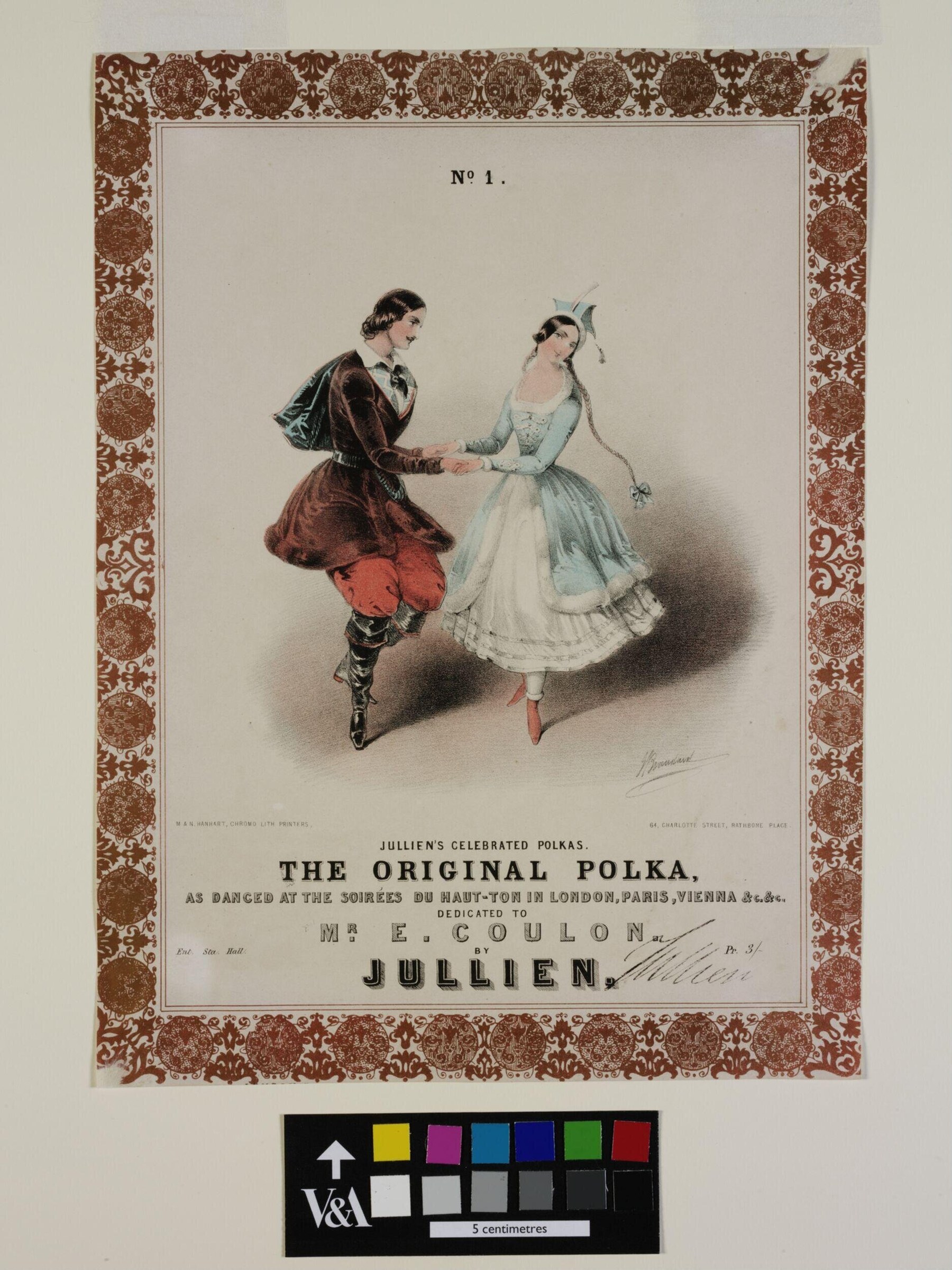
A hand-colored lithograph presenting two figures in a moment of social dance. On the left, a man in dark brown velvet jacket and striking coral-red breeches with black boots executes a sprightly step, his body angled in profile and his left leg extended. On the right, a woman in a pale blue dress with white underskirt and lace trim stands in a complementary pose, her body turned toward her partner, her right arm extended toward him while her left holds a delicate fan. Both figures are poised mid-movement against a plain ground with soft shadow work suggesting volume. The ornate brown damask border, printed in the style of 1840s fashion plates, frames the composition with formality; a dedication reads "JULLIEN'S CELEBRATED POLKAS" in large capitals beneath the scene. The print is numbered No. 1, suggesting it is part of a published series.
The dancing
The two dancers are positioned in a ballroom hold typical of mid-nineteenth-century couple dances, though not in a closed frame—they face one another with open posture and extended arms, ready to turn or step. The man's weight is clearly on his back leg; his front leg is lifted or extended in a sprightly movement suggesting a hop or light jump. The woman's frame is upright and poised, her torso leaning slightly back in a counterbalance to his forward energy. Both figures are executed with anatomical clarity and a sense of buoyant lightness in the lower body—the hallmark of polka style.
The dance depicted
This is unmistakably a polka, the Central European couple dance that swept through European ballrooms in the 1840s-1860s and became the subject of enormous commercial choreography and music publishing. The print documents 'the original polka, as danced at the soirées du haut-ton in London, Paris, Vienna & c.', crediting the famous French quadrille choreographer Joseph Jullien, who popularized polka variations for ballroom use. The energetic hop-step visible in the male figure's posture, the upright closed couple frame, and the outdoor-setting-free stance all confirm this is polka, not waltz or quadrille. Jullien's series of polka prints was among the most widely circulated dance instruction imagery of the era.
How it was made
This is a hand-colored lithograph, a technique that allowed rapid, economical reproduction of images with soft color and continuous tone. The image is printed in brown key-stone with watercolor or chromolithographic color laid over: the blue dress, coral breeches, and green accents of the fan are delicately applied, while the damask border is printed in brown throughout. Lithography's ability to capture line with painterly softness made it ideal for fashion and dance instruction prints; this work would have been circulated as a single sheet or bound into a folio of choreography. The artist's signature—likely 'Brandard' in the bottom right—was a mark of commercial print production.
About this work
This is one of a series of dance prints published in the mid-1840s documenting the polka as it was being codified for European ballrooms. The polka, which emerged in Prague in the 1830s, became a vehicle for fashion, courtship, and urban modernity across Europe and North America in the 1840s-50s. Jullien, a dominant figure in French ballroom choreography, adapted and systematized polka variations for fashionable salons, and this print served both as advertisement for his choreography and as a portable instruction guide for middle-class dancers. The print's survival and circulation—it is held by the V&A, the preeminent museum of design and decorative arts in Britain—confirms its importance as a cultural document of the ballroom at a moment of rapid change.
How to look at it
Attend to the lightness and spring in the male dancer's posture—the lifted leg and forward lean convey the characteristic hop-step or *pas de polka* that distinguishes this from the smooth, gliding waltz. Notice how both figures are shown not in the moment of travel across the floor, but in a moment of weight transfer and rotation, the axis of their bodies not quite aligned, which suggests the rapid turning and re-centering that polka required. The print captures a moment of *engagement*—they are looking toward one another, their frames open and ready to turn—rather than the swoon or abandonment of Romantic waltz imagery. This reflects polka's social character: it was a dance of partnership and conversation, not rapture.
The artist
John Brandard (fl. 1840s-60s) was a commercial lithographer specializing in fashion, theatrical, and dance imagery for the London market. He was one of several artists working in the employ of print publishers catering to aspirational middle-class audiences interested in ballroom etiquette and choreography. His style—precise draftsmanship combined with soft lithographic line—was well suited to fashion plate and dance instruction work, and his name appears on numerous polka, quadrille, and waltz prints of the 1840s-50s.
The period
The polka's arrival in Western Europe (particularly Paris and London) in 1840-43 sparked an unprecedented craze. It represented modernity, accessibility, and national exoticism (being of Czech origin) simultaneously. Unlike the waltz, which required training and was associated with aristocratic balls, the polka was marketed as lively, teachable, and suitable for middle-class assemblies. The 1840s saw an explosion of polka-related prints, music, and choreographic instruction—Jullien was the dominant figure in this market. By the 1850s, polka had been absorbed into the standard ballroom vocabulary alongside quadrille and waltz, but the novelty prints of the 1840s capture the moment of cultural excitement. Lithography, as a rapid and affordable reproductive technology, was essential to this mass circulation.
Where it lives
This print is held by the V&A Museum in London (accession unknown from catalogue record). It is part of the museum's collection of decorative arts and design, which includes extensive 19th-century dance and fashion ephemera. The print is one of a numbered series and was likely sold as a single sheet or in a folio during its period of publication.
Dance in this work
Questions about this work
What is the polka and why was everyone dancing it in the 1840s?
The polka is a lively Czech couple dance in 2/4 time, based on a repeated hop-step and quarter-turn. It arrived in Western Europe around 1840 and became a sensation because it was simpler to learn than the waltz, faster-paced, and felt modern and continental. It was danced in ballrooms, at public balls, and in fashionable salons across Europe and America within a decade of its arrival, and it remained a staple of ballroom dancing into the 20th century.
Who was Jullien and why is his name on this print?
Joseph Jullien (1814-60) was a French choreographer and ballroom master famous for adapting and systematizing variations of fashionable dances for the middle-class ballroom market. He published numerous prints and music showing how to dance quadrilles, polkas, and waltzes, and his name became synonymous with correct, fashionable ballroom technique. This print is one of a commercial series documenting his polka choreography, used both as instruction and as marketing for his authority.
How do you identify a polka from a picture?
Look for the characteristic hopping step visible in the dancer's legs and the upright, energetic carriage of the body (not the smooth glide of waltz). Polka dancers typically stand more upright and move with quicker, more articulate steps. The frame is usually an open or semi-open couple position (as shown here), allowing for the rapid turning and traveling that polka requires. The costume—fashionable 1840s-60s ballroom dress—and the numbered or titled inscription confirm this is ballroom rather than folk or theatrical polka.
Why were prints like this important?
These prints served as portable dance manuals for a rapidly growing middle-class market eager to learn fashionable ballroom steps without hiring a master. Lithography made them affordable and reproducible in large numbers. They also functioned as aspirational images—showing the correct posture, dress, and decorum for fashionable dancing. Many people owned a collection of such prints, using them as reference guides and status symbols.
More dance artwork





