49 works in this view — arrow keys or swipe to move between them.
Dance in Art
Tango
Elena Samperi
- Collection:
- Painting
- Source:
- Victoria and Albert Museum
- Rights:
- Rights vary by item — check the source record before reusing this image. Source record ↗
- Recorded as:
- V&A — check rights per item
For dancers and historians, this work demonstrates how tango transcended its origins as a specific choreographic practice to become a cultural metaphor for desire and connection. The painting shows tango functioning not primarily as technique but as myth—a form whose power lies in what it expresses about human relationship rather than in its steps. Understanding tango requires reckoning with this duality: it is both a learnable dance form and a symbol of something larger, and Samperi's painting captures that symbolic register with visual economy.
What you are looking at
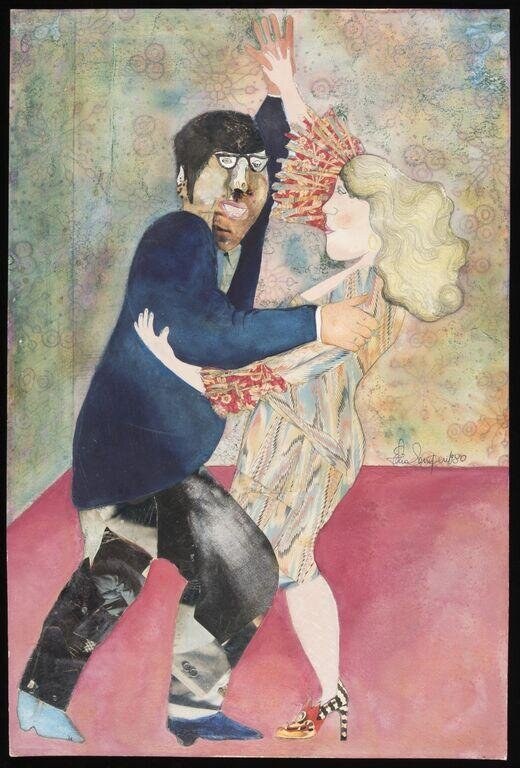
A man and woman locked in an intimate embrace dominate the composition, set against a pale, patterned background of soft circles in muted tones. The man, wearing dark blue-black clothing and glasses, grips the woman tightly around the waist and shoulders; his posture is urgent, almost frantic, with one arm raised. The woman, blonde and dressed in a pale striped garment with what appears to be a corsage or decorative element at her chest, is caught in mid-movement, her body pressed against his. The floor beneath them is a striking deep red-pink, creating a dramatic contrast that isolates the couple from the neutral background. Their bodies are intertwined in a moment of theatrical intensity—this is not a ballroom display but a charged, dramatic encounter. The artist's loose watercolor handling and the pale palette give the work an expressionist quality, with the background dissolving into atmospheric wash.
The dancing
The man's frame is aggressive and controlling, his body angled forward with his right arm raised emphatically—not in a ballroom frame but in a gesture of possessive intensity. The woman's posture is reactive rather than partnered; her body is pulled and leaning, her right arm raised defensively or in surrender. Their holds are close and off-vertical, suggesting momentum and passion rather than the upright, aligned posture of formal ballroom technique. The composition reads as a moment of crisis or seduction rather than technical execution.
The dance depicted
This work is titled Tango, and the close hold, intimate positioning, and dramatic intensity of the embrace align with tango's core aesthetic—a dance born from working-class Buenos Aires culture and mythologized as a vehicle for romantic passion, jealousy, and desire. The woman's reactive posture and the man's controlling frame echo the gender dynamics and charged eroticism central to tango's cultural narrative. However, the painting captures not the technical execution of the dance (footwork, promenade position, or structured movement) but the emotional and physical relationship it dramatizes. The work treats tango as a vehicle for expressing human connection—desire, possession, struggle—rather than documenting dance technique.
How it was made
The work appears to be executed in watercolor or mixed media on paper, with visible brushwork and color modulation suggesting the transparency and spontaneity of watercolor technique. The artist has used broad washes to establish the background and more controlled, detailed rendering for the figures—a distinction that keeps the focus on the dancers while loosening the space around them. The signature visible in the lower right indicates this is a finished work intended for exhibition, not a sketch. The medium's inherent qualities—its fluidity and capacity for both precision and dissolution—are well-suited to capturing the emotional rather than technical dimensions of the dance.
About this work
Elena Samperi's Tango is a 1980 work that uses the iconic dance form as a vehicle for exploring human intimacy, power, and desire. Rather than documenting tango as a technical practice, the painting distills the dance to its emotional essence: the embrace, the struggle, the theatrical union of two bodies in heightened relationship. The work sits at the intersection of dance documentation and emotional expressionism, belonging in a dance gallery not because it teaches us how tango is executed but because it captures why tango has mattered culturally—as a form through which vulnerability, control, and passion are negotiated and performed.
The painting reflects 1980s artistic interest in dance as subject matter, a period when artists across media were drawn to dance's combination of formal beauty and emotional intensity. Samperi treats the dancing couple not as specimens of technique but as protagonists in an intimate drama, using the formal language of tango—the hold, the close connection—to explore larger themes of human relationship.
How to look at it
Attend to the choice of moment: Samperi has frozen an instant of maximum intimacy and tension, not a step or technical position. Notice how the artist uses the red floor to isolate the couple, keeping the viewer focused on the relationship between the bodies rather than the space they inhabit. The raised arm of the man and the reactive posture of the woman create narrative tension—this is a dance of power as much as partnership. The loose brushwork in the background contrasts with the more defined rendering of the figures, a compositional choice that emphasizes emotional and psychological proximity over spatial recession.
The artist
Elena Samperi was an Italian artist active in the late 20th century. Her practice engaged with figurative subjects drawn from social life, music, and dance. The Tango work exemplifies her interest in capturing movement and emotion through expressive brushwork and dramatic composition. Her approach to the figure was neither strictly realist nor purely abstract, but rather a form of expressionism that prioritized emotional content and psychological intensity over anatomical or technical accuracy.
The period
By 1980, tango had become a global cultural form, exported from Argentina and appropriated across Western art, music, and dance. The 1970s and 1980s saw renewed interest in tango among contemporary artists and choreographers, partly through the influence of Argentinian choreography and partly through tango's enduring association with adult sexuality and passionate encounter. In the visual arts, the period saw persistent interest in dance as subject—from ballet's dominance in earlier decades to an expanding engagement with popular and social dance forms. Samperi's work emerges in a moment when tango was being revisited as both technical form and cultural symbol.
Where it lives
The work is held in a collection identified as 'va' in the catalogue record, which does not provide sufficient detail to establish specific provenance. The painting's exhibition history and prior ownership are not documented in the available record.
Dance in this work
Questions about this work
Is this painting accurate to how tango is actually danced?
No—it documents the emotional and cultural meaning of tango rather than its technical execution. You would not learn tango steps from this painting. Instead, Samperi uses the iconic embrace and close hold of tango to explore themes of power, desire, and intimacy. The painting is interested in tango as metaphor and social form, not as choreography.
Why is the floor such a vivid red-pink?
The color choice isolates the couple from the neutral background, intensifying the focus on their bodies and relationship. Red is also culturally coded as passion and desire, reinforcing the emotional content of the work. The warm floor contrasts dramatically with the cool, pale background, a compositional choice that makes the dancing figures the undeniable center of attention.
Who were Elena Samperi and what was her practice?
Samperi was an Italian artist whose work engaged with figuration, movement, and emotional expression. Limited biographical information is available, but her practice suggests an interest in capturing the psychological and emotional dimensions of human experience through expressive painting, often drawing on music and dance as subject matter.
More dance artwork





