49 works in this view — arrow keys or swipe to move between them.
Dance in Art
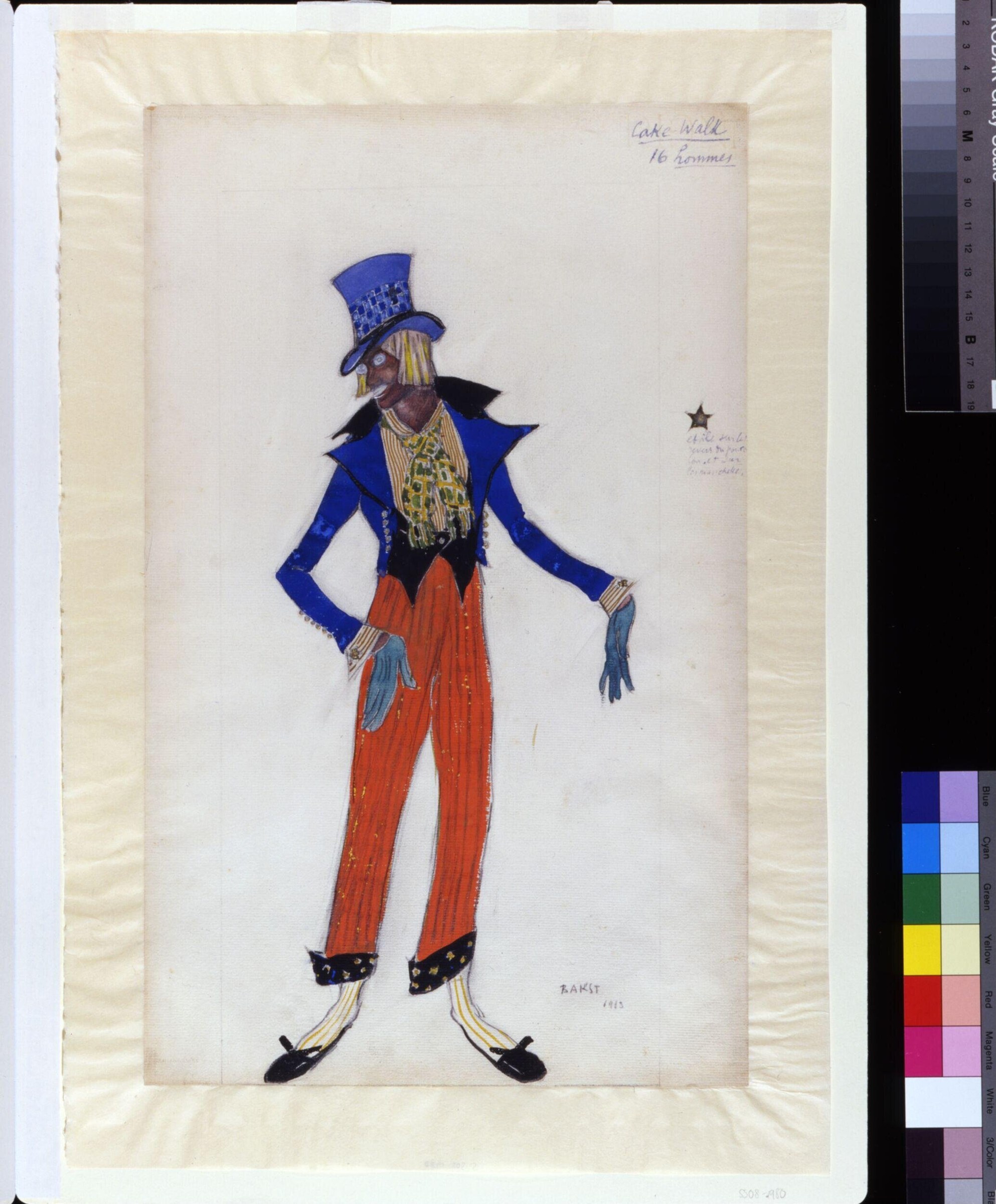
Costume design by Léon Bakst for an American Minstrel in Hullo Tango!
Bakst, Léon
- Collection:
- Costume design
- Source:
- Victoria and Albert Museum
- Rights:
- Rights vary by item — check the source record before reusing this image. Source record ↗
- Recorded as:
- V&A — check rights per item
Bakst's designs shaped how an entire generation understood movement and spectacle on stage; they influenced not only dance but also musical theater, fashion, and visual art. This work documents both the breadth of his practice and the historical moment when minstrelsy conventions were still considered acceptable material for theatrical costume design in the capitals of European culture.
What you are looking at
A tall, elegantly attired figure dominates the composition, posed in a self-assured stance with one hand resting on the hip and the other extended downward. The figure wears a striking ensemble: a tall cylindrical blue hat with a patterned band, a blue tailcoat with sharp black lapels, a yellow jabot or ruffled shirt front, and vivid orange-red trousers that taper dramatically. Black boots with gold or cream-colored cuffs complete the outfit. The figure's face is rendered in brown tones with blonde or light-colored hair visible beneath the hat. The composition is isolated against a plain background, with annotations visible in the upper right corner and artist signature at the lower right. The costume is rendered with careful attention to texture and pattern—the stripes on the trousers are finely detailed, and the materials appear richly colored with watercolor or similar medium.
The dancing
A single male figure stands in an exaggerated, almost mannered pose suggesting theatrical performance. The body is elongated and stylized; the weight appears equally distributed, with the torso twisted slightly to present the figure frontally. The extended arm gestures broadly downward in a manner suggesting showmanship rather than functional dance movement. The stance is proudly vertical, with no indication of the bend, extension, or shifting weight that characterizes most ballroom or social dance. The posture is better described as a presentation or display pose—the vocabulary of a theatrical performer or dandy.
The dance depicted
This appears to be a costume design for a character in theatrical performance, likely drawing from minstrelsy traditions. The figure's costume—particularly the tall hat, elaborate jacket, bold color contrasts, and exaggerated styling—references blackface minstrelsy performance conventions, though the execution here is rendered as a fashionable stage costume. The pose is not a documented dance position and suggests theatrical display or character introduction rather than an active dance technique. The work is titled as a costume for an 'American Minstrel' in a theatrical production, which places it in the history of early-20th-century theatrical spectacle, but the image does not show ballroom technique, step sequences, or the body mechanics of a recognizable social or theatrical dance form.
How it was made
This is a costume design rendered in what appears to be watercolor and ink on paper. The technique is characteristic of theatrical design from the early 20th century: the figure is outlined in bold black line work, with watercolor washes applied to render fabric texture, pattern, and volume. The precision of the line work and the careful attention to costume detail—the pattern of the hat band, the stripe of the trousers, the ruffles of the shirt—suggest this was a working design document for production, not a finished artwork for exhibition. The flatness of the figure and its presentation in strict front view is typical of costume design practice, intended to show the complete appearance of a costume from the audience perspective.
About this work
This is a costume design by Léon Bakst for a character role in a theatrical production titled *Hullo Tango!*, dated 1913. The design depicts an exaggerated male figure in performance attire drawing from minstrelsy traditions—a blue tailcoat, striped orange trousers, and a distinctive tall hat—rendered in watercolor and ink. The work sits at a crucial intersection of theatrical design, fashion, and the visual culture of early-20th-century revue and musical theater.
Bakst was the pre-eminent theatrical designer of the period, celebrated for his work with the Ballets Russes and his influential approach to color, pattern, and historical reference in stage design. This design reveals the cosmopolitan reach of his practice beyond avant-garde dance into commercial theatrical production, and documents the aesthetic conventions—including problematic minstrelsy references—that shaped popular entertainment design in this era.
How to look at it
Examine the pose first: it is not a moment of dance but a presentation stance, a "look at me" moment of theatrical display. The figure is frozen in a performed attitude, not caught mid-step. Notice how Bakst uses costume color and pattern to create visual energy—the orange trousers with their bold stripes read powerfully against the blue tailcoat, and the hat anchors the composition vertically. The handwriting annotations in the upper corners and the signature indicate this is a working design document, a communication between the designer and the production team about what should be made and how. The careful rendering of detail—the texture of each fabric, the geometry of the hat—shows this is a professional document intended to guide costume makers, not a finished exhibition piece.
The artist
Léon Bakst (1866–1924) was a Russian painter, stage designer, and impresario whose work defined theatrical aesthetics of the early 20th century. He was artistic director of the Ballets Russes (1909–1924) and designed costumes and sets for celebrated productions including *Scheherazade*, *The Firebird*, and *Afternoon of a Faun*. Beyond avant-garde ballet, Bakst also designed for opera, musical theater, and commercial revue, as this work demonstrates. His approach combined historical research, bold color theory, and a synthesis of Eastern and Western visual traditions. He was influential among visual artists and fashion designers of the period and maintained a design practice that spanned multiple theatrical contexts.
The period
In 1913, theatrical spectacle in Europe was dominated by the Ballets Russes aesthetic, while musical theater and revue remained hugely popular entertainment forms. *Hullo Tango!* titles itself to the tango craze that had swept European capitals in the 1910s, making tango the contemporary dance reference for audiences. Costume design was considered a serious visual art form, and major artists (including painters) undertook theatrical work. However, minstrelsy traditions persisted in popular theater alongside modernist innovation in ballet and contemporary dance—the two systems coexisted. This design document captures that moment before the visual codes of minstrelsy began to be critically questioned in mainstream theatrical production.
Where it lives
This design is held in a costume design collection (notation "va" in the source field suggests a museum or archive collection in the visual arts). The work is catalogued as a costume design document from the theatrical production *Hullo Tango!*, marking it as a functional artifact of theatrical production rather than a fine art object.
Questions about this work
What is Bakst known for besides the Ballets Russes?
While Bakst is most celebrated for his work with the Ballets Russes, he was a prolific designer across theatrical media. He designed for opera productions, musical theater, and commercial revue productions like *Hullo Tango!*. His design practice also extended to book illustration and private commissions for wealthy patrons. He was influential as a theorist of color and design and wrote extensively on theatrical aesthetics.
What is a costume design in theatrical practice?
A costume design is a working document created before construction of the garment. It serves as a communication between the designer and the costume makers, showing the complete visual appearance, colors, patterns, and details of what should be made. Bakst's designs were typically rendered in watercolor and ink and were often kept by theaters as production records.
Why does this design reference minstrelsy?
In 1913, minstrelsy traditions and imagery were still commonly used in popular theatrical productions, musical theater, and revue, even as they were becoming contested. *Hullo Tango!* appears to be a commercial theatrical revue that drew on multiple popular entertainment traditions for its visual spectacle. The costume reflects the accepted visual vocabulary of the period, though this aesthetic is now understood as deeply problematic.
Is this a dance design?
This is a costume design for a theatrical character role rather than a dance-specific design. The pose does not indicate ballroom technique or a recognizable dance form. However, it documents the visual culture and theatrical spectacle that shaped how audiences understood movement and performance in the early 20th century.
More dance artwork





