49 works in this view — arrow keys or swipe to move between them.
Dance in Art
Dernier Tango
Worth, Jean-Charles
- Collection:
- Fashion design
- Source:
- Victoria and Albert Museum
- Rights:
- Rights vary by item — check the source record before reusing this image. Source record ↗
- Recorded as:
- V&A — check rights per item
Tango revolutionized both dance and fashion simultaneously in the early 20th century, and this sketch captures the moment when the two were inseparable. A historian of dance or fashion should see this work to understand how deeply costume and movement were entangled—the dress was not decoration added after the dance was invented, but part of the dance's social and bodily meaning from the start.
What you are looking at
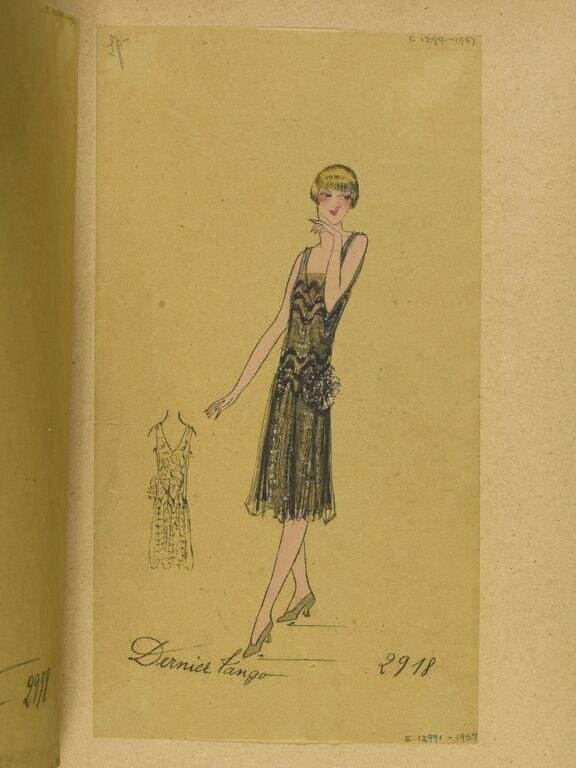
A fashion design sketch of a woman in elegant evening wear, shown in a three-quarter pose against a plain cream background. The figure wears a sleeveless, low-backed dress with ornate beading or embroidery concentrated at the bodice and upper torso, with the skirt falling in pleated or draped folds to knee length. The woman's posture is upright and composed, with one arm extended gracefully downward; her head is tilted slightly, her hair styled in a short, fashionable 1920s bob. To the left of the main figure is a small, roughly sketched detail of the dress front, showing the decorative pattern more clearly. The drawing is executed in ink with delicate linework, using minimal shading; the inscription "Dernier Tango" appears at the lower left in cursive script, with the notation "2918" (likely a design number or archive code) at lower right.
The dancing
The figure is a single standing woman in a formal, static pose rather than a dynamic dance position. Her weight is evenly distributed on both legs; her body is elongated and graceful, with an elegant s-curve in the torso typical of 1920s fashion silhouette. The extended arm is soft and relaxed, held without tension, creating a line of movement that flows from shoulder to fingertips. The pose suggests presentation or display rather than the active engagement of a dancer in motion.
The dance depicted
This is not a depiction of dance in action, but rather a fashion design for evening wear associated with the tango craze of the 1920s. The title 'Dernier Tango' (Last Tango) connects the dress to the Argentine tango, which was at the height of its fashionable popularity in Paris during this period. The design is intended for a woman who would *wear* the dress to tango in a ballroom or nightclub setting, not for a dancer actively performing the steps. The garment itself—sleeveless, low-backed, unstructured—would have allowed the mobility required for tango dancing, while the beading and elegant draping served as evening-wear luxury.
How it was made
This is a fashion design sketch, executed in ink on cream or light tan paper. The technique is rapid and economical: the figure is drawn in continuous line with minimal shading, while the dress detail is rendered with careful attention to the beadwork or embroidery pattern. The small preliminary sketch at left suggests this was a working design, possibly for a couture house or designer. The paper has aged to a warm cream tone, consistent with archival fashion drawings from the 1920s–1930s. The notation and catalogue number suggest institutional preservation, likely in a fashion history or decorative arts collection.
About this work
This is a haute couture design sketch for an evening gown created during the height of the 1920s tango fashion. It belongs to the intersection of fashion, social dance, and design history: the dress was made to enable and display the tango, the era's most transgressive and fashionable social dance. The work documents not the dance itself but the material culture that framed it—the clothing that made tango performance possible for women in ballrooms across Europe and America. Jean-Charles Worth, descendant of the famous Worth fashion house, was working in Paris during the interwar boom in tango-inspired evening wear. The sketch is a primary source for understanding how fashion designers responded to dance culture and how a single garment could embody both the mechanical requirements of a particular dance and the aspirational glamour of modernity.
How to look at it
Observe the care the designer took with the beading at the bodice and the elegance of the back—these details serve both fashion and function. The beadwork would have caught light as the wearer moved, enhancing the visual spectacle of the tango, while the low back was essential to the tango pose, which often involved a pronounced arch and backward lean. The sketch's economy of line—the figure is not laboriously shaded but suggested through confident outline—reflects the speed and directness of design practice. Notice how the dress hangs: it is not a rigid garment but one that would have moved fluidly with the body, a requirement for any dance wear.
The artist
Jean-Charles Worth (1881–1960) was a member of the renowned Worth fashion house founded by his grandfather Charles Frederick Worth. Based in Paris, Jean-Charles inherited and expanded the family business during the 1920s and 1930s, a period when Worth couture was at its zenith. The house was known for innovation in cut, draping, and ornamentation, and for rapid response to fashionable trends. Jean-Charles designed for wealthy American and European clientele, and the house's archives—which include numerous sketches like this one—document the relationship between Parisian high fashion and the dance culture of the interwar period. The sketch style is typical of the house's working designs: quick, assured linework with minimal detail, intended for in-house use rather than client presentation.
The period
The tango arrived in Paris from Buenos Aires around 1910 and became a sensation among the fashionable wealthy by the 1920s. By the time this design was created, tango was no longer transgressive but rather synonymous with sophisticated nightlife and modernity. The 1920s were also the moment of the flapper silhouette and the liberation of women's bodies from Edwardian corsetry—a context in which a sleeveless, low-backed evening dress was itself a statement of contemporary femininity. Fashion designers of the period responded directly to dance culture: the dropped waistlines, abbreviated skirts, and unstructured lines of 1920s fashion were partly driven by the demands of social dance, particularly the tango and Charleston. Worth, as a major couture house, would have been designing evening wear specifically for the ballroom market.
Where it lives
This sketch is held in a fashion design collection (catalogued as 'Fashion design' in the record) and comes from the VA (Victoria and Albert Museum, London), a major repository of fashion archives and design drawings. The work is part of the institutional memory of haute couture practice and the Worth house legacy. The archival notation suggests it has been formally preserved and catalogued.
Questions about this work
Is this a picture of someone dancing?
No. This is a fashion designer's sketch for an evening dress, not a representation of a dancer in action. The figure is posed statically to show the cut and draping of the garment. However, the dress was designed to be worn while tango dancing, and the design reflects the requirements of that dance—freedom of movement, elegant line, and visual drama.
What does 'Dernier Tango' mean?
'Dernier Tango' is French for 'Last Tango.' The title may refer to the final moments of an evening's dancing, or it may be a poetic reference to the tango itself as a culminating or defining social experience. By 1926, tango was no longer new but was the established language of fashionable nightlife.
Why is the back of the dress so bare?
The low, open back was both fashionable and functional in the 1920s. Fashion had moved away from the high necklines and full coverage of the Edwardian era. For tango, the open back allowed the pronounced arch and backward lean that characterize the dance's posture, giving the dancer freedom of movement and allowing the partner to guide the movement more directly.
Who was Jean-Charles Worth?
Jean-Charles Worth was the third-generation head of the Worth fashion house, the most prestigious couture house in Paris. He inherited the business in the 1920s and continued the family tradition of designing for royalty and wealthy clients across Europe and America. His designs reflected the modernism and luxury of interwar high fashion.
More dance artwork





