49 works in this view — arrow keys or swipe to move between them.
Dance in Art
Tango
Worth, Jean-Charles
- Collection:
- Fashion design
- Source:
- Victoria and Albert Museum
- Rights:
- Rights vary by item — check the source record before reusing this image. Source record ↗
- Recorded as:
- V&A — check rights per item
This work sits at the intersection of dance history and fashion history, showing how tango—still a controversial and fashionable dance in the 1920s—shaped the aesthetics of women's dress and how designers marketed modernity through reference to dance. For historians of 1920s culture, it is evidence of how completely tango had penetrated Western social life and commercial imagination by this date.
What you are looking at
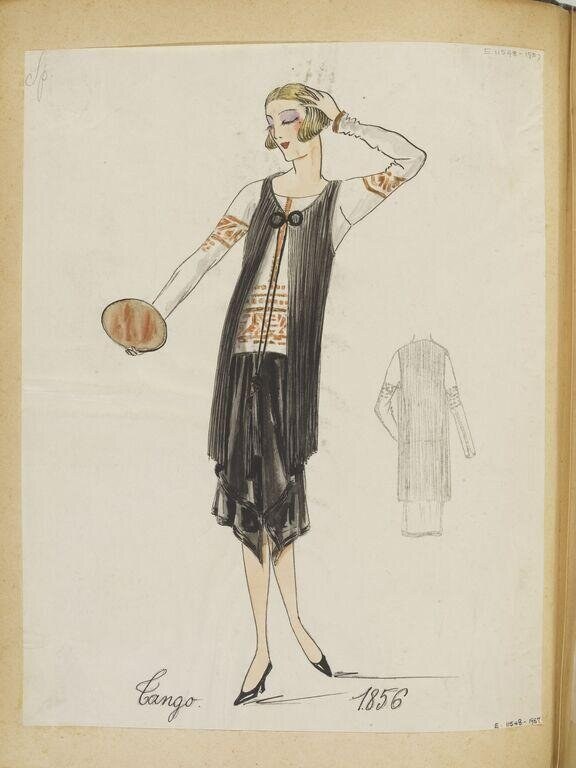
A fashion design drawing in the modernist style of the 1920s shows a woman in a sleeveless day dress with a long cardigan or coat thrown open over it. The outer layer is dark (charcoal or navy) with prominent vertical pleating; beneath it, a lighter patterned dress with geometric or abstract decoration. Her posture is relaxed and elegant: weight on one leg, the other slightly flexed, one arm raised to adjust her styled blonde hair, the other hanging at her side holding what appears to be a small handbag or clutch in a tan or rust tone. Her shoes are dark with a defined heel. The figure is rendered in profile against a plain cream ground, with a small technical sketch of the garment from behind shown to the right. The drawing style is crisp and economical—ink outline with selective watercolour or gouache for flesh tones, the pleated coat, and accessories—typical of haute couture design documentation of the period.
The dancing
The woman's weight is firmly grounded through her standing leg, with a gentle curve of contrapposto creating ease rather than tension. Her raised arm is soft at the elbow, fingers touching her hair in a gesture of casual self-awareness. There is no sense of balletic elongation or formal frame; the pose is intimate and domestic, the gesture of grooming rather than performance. The body reads as contemporary and modern—a living woman choosing her clothes and moment—rather than a dancer in any formal sense.
The dance depicted
This is not a depiction of dance. The title 'Tango' appears to reference the garment itself—likely indicating that this ensemble was designed for tango dancing or evening wear in the era when tango was fashionable—rather than documenting a moment of dance. The figure's posture is too neutral, the setting too interior and private, and the gesture too quotidian for any specific dance movement to be readable. The work belongs to fashion design rather than dance imagery, though tango's cultural dominance in 1920s Paris and London almost certainly informed the style and mood the designer intended to convey.
How it was made
This is a fashion design drawing, executed in ink line with watercolour or gouache for selective colouring and tonal modelling. The technique is characteristic of haute couture house documentation: economical, exact, and designed for reproduction and reference by seamstresses and tailors. The standing figure and back-view technical sketch are standard conventions of fashion design practice. The medium and style indicate this was a working document in a design studio rather than a finished artwork for sale or exhibition, though it has survived in an archive (likely the Victoria & Albert Museum's collection) as a record of a designer's practice.
About this work
This is a fashion design by Jean-Charles Worth, one of the leading couture houses of the 1920s. The drawing documents a day ensemble styled for the modern woman of the Jazz Age—a cardigan dress combining vertical pleating with geometric patterning, presented in the economical but elegant language of haute couture design. Though titled 'Tango,' the work is not dance documentation but rather a garment intended for social occasions when tango was a dominant cultural reference. It represents the intersection of dance culture and fashion in the interwar period: tango's popularity and mystique informed not only what women wore to dance, but how designers and illustrators imagined modernity, movement, and femininity. The drawing's modernist line and selective colour are typical of 1920s design practice, capturing both the structure of the garment and the ease and confidence of its imagined wearer.
How to look at it
Look at the posture and where the weight falls: the figure is at rest, not caught mid-movement, and the raised arm is a gesture of casual self-regard, not a dancing frame. Notice how the pleating of the cardigan is rendered to suggest both structure and flow. The small back-view sketch tells you this is a working design document, not a finished picture; the artist's concern was clarity and technical accuracy for reproduction, not narrative or drama. The title 'Tango' is aspirational—it suggests the mood and market for the dress—rather than descriptive of what the figure is actually doing.
The artist
Jean-Charles Worth (1881–1960) was the son of Charles Frederick Worth, founder of the House of Worth, one of the most prestigious couture houses in Paris. Jean-Charles took over much of the design direction of the house in the early 20th century and was known for his skill in blending structure with an easy, modern silhouette. The house was celebrated for dressing wealthy and fashionable women, including clients from aristocracy, stage, and high society. Worth's designs of the 1920s reflect the post-war appetite for simpler, more mobile forms of dress while maintaining luxury and refinement.
The period
The 1920s saw tango's transformation from a transgressive dance associated with the demi-monde into a fashionable social pastime for the wealthy across Europe and America. By this date, tango was no longer shocking but rather chic and cosmopolitan—a marker of sophistication and continental taste. The same period saw radical change in women's fashion: the abandonment of corsetry, the rise of the flapper silhouette, shorter hemlines, and an emphasis on ease of movement and practicality. A garment designed for tango dancing would need to allow the close frame and articulate hip movement the dance required, while the 1920s ideal of dress sought to suggest movement, youth, and modernity even in stillness. Worth's design captures this moment: the vertical pleating suggests fluidity and the possibility of motion, while the modern geometric patterning roots the garment in contemporary style rather than historical reference.
Where it lives
This drawing is held in the Victoria & Albert Museum's fashion design collection, catalogued as a design document from the House of Worth. It is one of hundreds of similar working drawings that survive from the house archives, preserving the design practice of one of the 20th century's most influential couture studios.
Questions about this work
Is this a picture of someone dancing the tango?
No. This is a fashion design drawing, not a dance documentation. The figure is standing at rest in a pose of casual elegance. The title 'Tango' refers to the intended use and market for the garment—it is a dress designed for tango dancing or evening wear in an era when tango was fashionable—rather than depicting a moment of dance.
Why is a fashion design in a dance gallery?
Because tango was so culturally dominant in the 1920s that it shaped how designers imagined women's bodies, movement, and modernity. Looking at what people wore to dance, and how designers marketed dress through reference to dance, tells us as much about a dance's cultural life as looking at images of the dance itself. This drawing is evidence of tango's prestige and influence.
Who was Jean-Charles Worth?
He was a couture designer and the son of Charles Frederick Worth, founder of the House of Worth in Paris, one of the most prestigious and influential fashion houses of the 19th and 20th centuries. Jean-Charles took over much of the design direction in the early 1900s and was known for blending structure with modern, wearable elegance.
More dance artwork





