49 works in this view — arrow keys or swipe to move between them.
Dance in Art
Pair of shoes
Peter Robinson Ltd.
- Collection:
- Pair of shoes
- Source:
- Victoria and Albert Museum
- Rights:
- Rights vary by item — check the source record before reusing this image. Source record ↗
- Recorded as:
- V&A — check rights per item
For dance historians and teachers, these shoes are primary evidence of the physical reality of early 20th-century ballroom dancing: the extremely narrow toe box, the moderate heel, and the lack of any reinforcement for rapid weight changes all tell us something about the speed, style, and postural control of the dances of the era. They are also material evidence of class and gender: only wealthy women wore shoes of such elaboration, and the decorative embroidery emphasizes display and stillness rather than labour or active movement, reflecting the social position of women dancing in formal settings.
What you are looking at
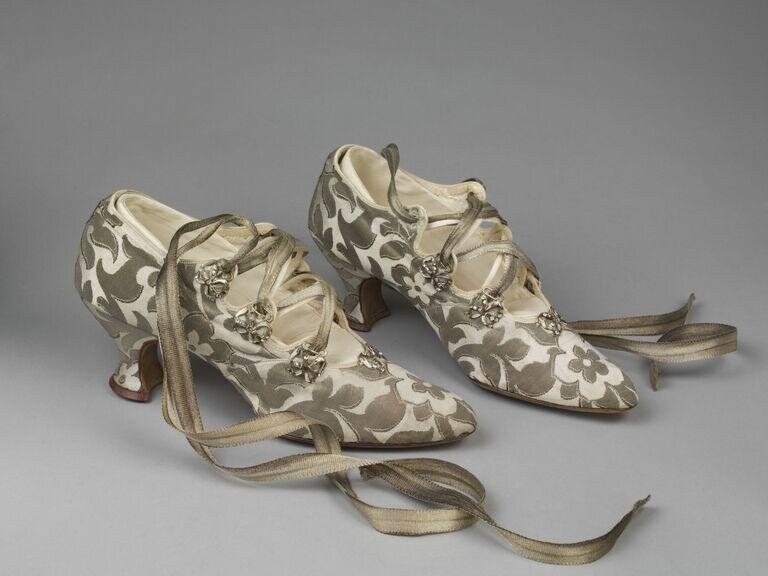
A pair of women's heeled shoes photographed against a neutral ground, displayed from a three-quarter angle that shows both the sole profile and the decorated upper. Each shoe is a pointed-toe slipper with a curved heel of moderate height, the vamp and quarters densely embroidered or woven in a contrasting cream or ivory pattern against a taupe or grey-brown ground. The pattern consists of stylized floral or foliate motifs—scrolling vines, quatrefoil blooms, possibly pomegranates—arranged symmetrically across the visible surfaces. Both shoes feature ribbon ties or laces in a pale neutral tone, long enough to trail across the neutral mounting surface. The construction is clearly structured: a defined toe, a shaped instep, and what appears to be a lined or reinforced upper edge that stands away from the foot slightly, giving the shoes a sculptural presence. The heel is wooden, darkened with age or polish, and shows wear consistent with use. The overall effect is of an ornamental, costly object made for display and formal social occasions—not daily wear.
The dancing
No human figures are present. These are garments—specifically footwear—displayed as objects. However, the shoes reveal the physical demands and dimensions of the wearer: the extremely narrow, pointed toe indicates a very small foot held in a fashionable silhouette; the moderate heel height (approximately 1.5–2 inches) and the structured upper suggest a shoe made for standing and walking in social settings rather than dancing, or at least for a highly controlled, upright posture. The ribbon ties suggest an adjustable, wrapped fit, typical of a slipper designed to secure a foot without a hard structural shank.
The dance depicted
These are not dance shoes, though they are from a period (1914) when ballroom and social dancing was prominent. The shoe style—a delicate, embroidered slipper with ribbon closure—is consistent with Edwardian and early 1910s women's formal and indoor footwear. The pointed toe and the decorative treatment (clearly too ornate and fragile for vigorous movement) suggest these were made for ballroom promenading, receiving guests, or theatrical performance rather than for the sustained weight shifts and footwork of modern ballroom dance. If worn for dance, they would have been for slow, processional styles like the waltz or minuet—dances requiring gliding, controlled steps rather than pivots or rapid changes of weight. The embellishment and material suggest they may have been costume pieces or commissioned for a wealthy client's formal occasions.
How it was made
The shoes are constructed textile and leather work: the upper is embroidered or possibly needle-woven (likely silk or linen threads on a linen or wool base), the sole appears to be leather, and the heel is turned wood. The surviving example—preserved in a museum collection—has been photographed in studio light against a neutral ground, a standard archival documentation method that reveals the three-dimensional form and surface detail without distraction. The photograph itself is a modern professional image, likely taken for conservation or collection record purposes. The shoes themselves are hand-made: the precision of the embroidery pattern and the careful shaping of the upper indicate workshop production, possibly bespoke, and certainly labour-intensive. The Peter Robinson Ltd. attribution suggests these were either made by or sold through that London department store, which was known for high-end ladies' fashion and footwear in the Edwardian era.
About this work
This is a pair of women's formal slippers from 1914, attributed to Peter Robinson Ltd., a prestigious London retailer. They are display objects rather than action images: the shoes themselves are the artwork, preserved in a collection dedicated to dress and dance material culture. The embroidery, ribbon closure, and delicate heel mark them as objects for formal social life—ballrooms, drawing rooms, theatres—in the 1910s, when women's fashion footwear was highly ornamental and when ballroom dancing (waltz, foxtrot, tango) was at its height. The shoes document the material conditions of dance: the shapes that fashionable feet were expected to occupy, the balance and posture they enforced, and the aesthetic ideals of the period. They are not evidence of a dance style, but evidence of the body that danced and the constraints and possibilities that body inhabited.
How to look at it
Examine the structure and its implications. The pointed toe is so narrow that it offers no platform for weight distribution—the wearer's weight would be concentrated on the ball of the foot and the heel, enforcing an upright, high-arched posture. The moderate heel is a dressy heel, not a working heel: it is present enough to elevate and arch the foot, but not so high as to permit active movement. Look at the heel wear (visible on the darker wood)—it shows use, but not the grinding, heel-heavy wear of a walking shoe or a shoe worn for energetic dancing. The embroidery is too delicate and time-consuming to be accidental: it is a sign of status, of a foot that was not expected to labour. The ribbon ties are functional and adjustable, which means the shoe was made to fit a range of widths or to be wrapped more or less tightly around an ankle, a common solution before modern shoe-size standardization. These details together paint a picture of a shoe made for a woman of means, dancing slowly and decorously in a formal setting.
The artist
Peter Robinson Ltd. was a London department store founded in 1833, located on Regent Street. It became one of the leading retailers of high-fashion clothing and accessories for women in the late 19th and early 20th centuries, known for stocking and commissioning exclusive designs. By 1914, Peter Robinson was a house name for quality, fashionable ready-to-wear and bespoke clothing. The store was patronised by middle-class and aristocratic women, and it cultivated a reputation for contemporary styling and craftsmanship. These shoes are likely either made in-house, commissioned from a specialist bootmaker, or selected for stock from a high-end London manufacturer. The attribution to the retailer rather than a maker's name is typical of department store merchandise of the period.
The period
In 1914, Europe and North America were in the final year of peace before World War I. Women's fashion was in a moment of transition: the Edwardian era of extreme ornamentation and the S-bend corset was giving way to a straighter, more columnar silhouette under the influence of designer Paul Poiret and other modernist aesthetics. Simultaneously, ballroom dancing was at its peak of social importance and innovation—the foxtrot had been introduced in 1912, the tango was scandalising society, and the waltz remained dominant. Footwear followed fashion: the extremely narrow, pointed toe was still fashionable, though the height and flexibility of heels were beginning to evolve in response to the demands of new dances. These shoes, with their ornamental embroidery, represent the persistence of Edwardian luxury and display even as the fashion world was beginning to modernize. They are also products of the last moment of European haute couture before the war disrupted manufacturing and shifted cultural priorities.
Where it lives
The shoes are held in the V&A (Victoria and Albert Museum) collection, as indicated by the catalogue source "va". They are part of the museum's extensive collection of historical dress and personal adornment, which documents the material culture of daily life and social ritual. The museum's acquisition and preservation practices ensure that such objects are available for study and display in context with other material from the same period.
Dance in this work
Questions about this work
Are these dance shoes?
Not in the modern sense. They are formal slippers made for social occasions—ballrooms, receptions, and theatre—in the 1910s. The extremely narrow toe and delicate embroidery indicate they were made for controlled, formal movement (like the waltz) rather than vigorous dancing or modern ballroom footwork. They would have been impractical for the pivots, swivels, and rapid weight changes required by the tango or foxtrot, though those dances were being performed by 1914.
How do we know these were worn for dancing?
We can infer it from the context: they are formal slippers from a period when ballroom dancing was a central social practice for wealthy women, and the moderate heel and flexible upper are consistent with dancing shoes of the era. However, they may equally have been worn for formal dinners, receptions, or theatre. The embroidery suggests they were primarily display objects, worn in settings where the foot itself was visible and on display.
Why is the toe so narrow?
Fashion. The pointed toe was a fashionable silhouette throughout the Edwardian era and into the 1910s. It was also a mark of status: a foot so narrow and so useless for actual labour was a sign of wealth and leisure. The shape was achieved partly by the shoe design and partly by the wearer's posture and training—upper-class girls were taught to walk with turned-out feet and an upright carriage from childhood.
What does the embroidery tell us?
The embroidery is time-consuming, skilled, and beautiful—and therefore expensive. It marks these shoes as luxury objects, likely commissioned or selected from a high-end maker. The motifs (likely floral or foliate) are ornamental rather than functional, emphasizing that these shoes were made for display in a formal setting where the foot would be visible and admired, not hidden under a long skirt.
More dance artwork





