49 works in this view — arrow keys or swipe to move between them.
Dance in Art
Set design
Stevenson, Hugh
- Collection:
- Set design
- Source:
- Victoria and Albert Museum
- Rights:
- Rights vary by item — check the source record before reusing this image. Source record ↗
- Recorded as:
- V&A — check rights per item
As a set design for theatrical dance, this work documents how mid-twentieth-century designers conceived the relationship between dancer, architecture, and audience sight line—the physical and visual grammar of theatrical space itself. Stevenson's composition demonstrates the classical vocabulary available to designers in the 1940s and the balance between formal architectural framing and the flexibility required to accommodate choreographic movement.
What you are looking at
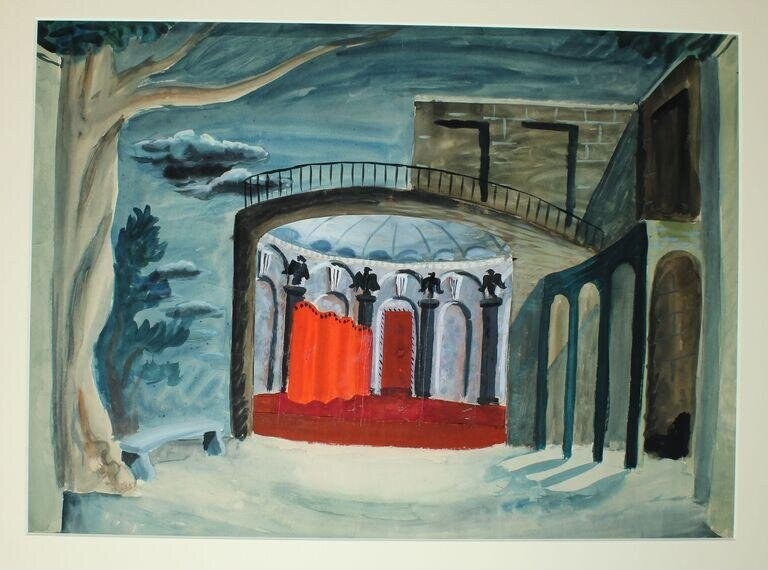
A watercolor or gouache design for a theatrical stage set, painted in muted blues, greens, and ochres. The composition shows a domed pavilion or rotunda at center stage, its interior flooded with brilliant red drapery hung from a semicircular frame. The pavilion is framed by classical colonnade—tall rounded arches visible in the immediate foreground on the right, receding into shadow. A curved bridge or walkway with railings spans above the pavilion, connecting two stone structures. To the left, a stylized tree with blue-green foliage suggests landscape. The sky is pale blue with a single wisp of cloud. The design is rendered in loose, economical brushwork typical of theatrical working drawings, with careful attention to spatial recession and the play of interior light against exterior architecture. The red drapery dominates the composition and suggests a focal performance space or ceremonial enclosure.
The dancing
No human figures or dancers are visible in this work. This is a set design without performers—a visualization of the stage environment rather than a scene of dance in action.
The dance depicted
This is a stage set design, not a depiction of dance itself. However, the theatrical character of the design—the ceremonial pavilion, the prominent drapery, the formal architectural frame—suggests the space was created for a formal or classical theatrical performance. The design's emphasis on a central enclosed performance area, visible from a distance through a portico, is consistent with mid-twentieth-century modern ballet or theatrical dance production. The domed pavilion and classical vocabulary could serve works with mythological or neoclassical subject matter, but without documentation of which production this served, the specific dance context cannot be confirmed.
How it was made
The work is executed in watercolor or gouache on paper. The technique is characteristic of scenic design working drawings: economical but precise brushwork establishing spatial relationships, architectural forms rendered in outline and flat color washes, and careful notation of interior and exterior lighting zones through color temperature. The medium allowed rapid visualization and revision, making it suited to the collaborative process of theatrical production design. The apparent age and condition of the paper suggest original archival material from the production process rather than a finished artwork for exhibition.
About this work
This is a stage set design by Hugh Stevenson, dated 1944, created for a theatrical production of unspecified dance or dramatic work. The design proposes a formal classical setting: a domed pavilion as the central playing space, framed by a colonnade and connected by a curved bridge to flanking structures. The interior is defined by bold red drapery, drawing focus to the performance area while the surrounding architecture establishes scale and ceremony. The watercolor technique and economical draftsmanship are typical of mid-twentieth-century theatrical design practice, when such drawings served as blueprints for construction and guided the director, choreographer, and lighting designer. The work exemplifies the designer's role in shaping the spatial and visual context of performance.
How to look at it
Study the spatial recession: how the colonnade pulls the eye inward toward the pavilion, and how the red interior draws focus while remaining framed and controlled by architecture. Notice the balance between solids (stone, structure) and voids (the red curtain acts as both solid visual barrier and permeable interior space). The design assumes a frontal viewpoint from the audience; the curved bridge above creates a second playing level. The color choices—the dominant red against cool blues and greens—suggest not naturalism but heightened theatrical artifice, where color becomes a tool of emotional and spatial emphasis rather than mimesis.
The artist
Hugh Stevenson (1910–1992) was a British stage designer who worked extensively in theatre and ballet during the mid-twentieth century. He was particularly associated with ballet productions and created designs for major companies including those of Frederick Ashton and other leading choreographers of the period. His practice was rooted in modernist principles applied to classical theatrical vocabulary—economical, functional design that prioritized spatial clarity and the relationship between performer and viewer.
The period
In 1944, British theatre and ballet were in the midst of wartime austerity but emerging as centers of cultural innovation. The Romantic and Neoclassical ballets of the previous centuries were being reimagined through modernist eyes. Set design was shifting toward greater abstraction and economy of means, influenced by Bauhaus principles and modernist aesthetics, while still engaging with classical architectural vocabulary. Stevenson's formal, symmetrical composition reflects this moment—the pavilion and colonnade evoke historical authority and ceremony, but the simplified forms and restrained color palette are distinctly modern.
Where it lives
The work is held as a set design in a holding collection, likely a theatre archive, indicating it is part of the documentary record of production rather than a fine art collection. It was catalogued as having source 'va' (likely an institutional archive), suggesting it comes from an institutional rather than private collector.
Questions about this work
Is this a painting or a design drawing?
It is a design drawing—a working visualization created to guide the construction and execution of a stage set. Theatrical designers use such drawings to communicate their vision to builders, directors, and other production staff. It is functional rather than fine art, though it employs watercolor and compositional skill.
Which ballet or play was this designed for?
The catalogue record does not specify the production. The formal classical vocabulary—the pavilion, colonnade, and ceremonial space—suggests a classical or neoclassical work, but without additional documentation, the specific piece cannot be identified.
Why is the pavilion interior filled with red drapery?
Red drapery would focus the audience's attention on the central performance space and would likely transform under theatrical lighting. The drapery may also have served practical functions—masking the backstage area, creating entrances and exits, or defining a ceremonial or enclosed space within the broader stage. In 1940s theatre, such drapery was also economical and easy to rig and adjust.
What is the architectural style?
The design employs simplified neoclassical or Palladian vocabulary—the colonnade, the domed pavilion, the symmetry—but rendered in a modernist idiom with flattened forms and muted color. It suggests neither strict historicism nor pure abstraction, but a theatrical language that borrows from architecture while remaining clearly artificial and stage-bound.
More dance artwork





