49 works in this view — arrow keys or swipe to move between them.
Dance in Art
Corset
Debenham & Freebody
- Collection:
- Corset
- Source:
- Victoria and Albert Museum
- Rights:
- Rights vary by item — check the source record before reusing this image. Source record ↗
- Recorded as:
- V&A — check rights per item
To dancers and historians, this corset is a crucial document of the physical norms against which early modern dance defined itself. Viewing the actual construction—the rigid boning, the limiting lacing, the engineered posture it enforced—makes visceral why the uncorseted, barefoot dancer became such a radical figure. It reveals that the freedom of movement we now take for granted in dance was not the default, but had to be fought for through the rejection of precisely this kind of garment.
What you are looking at
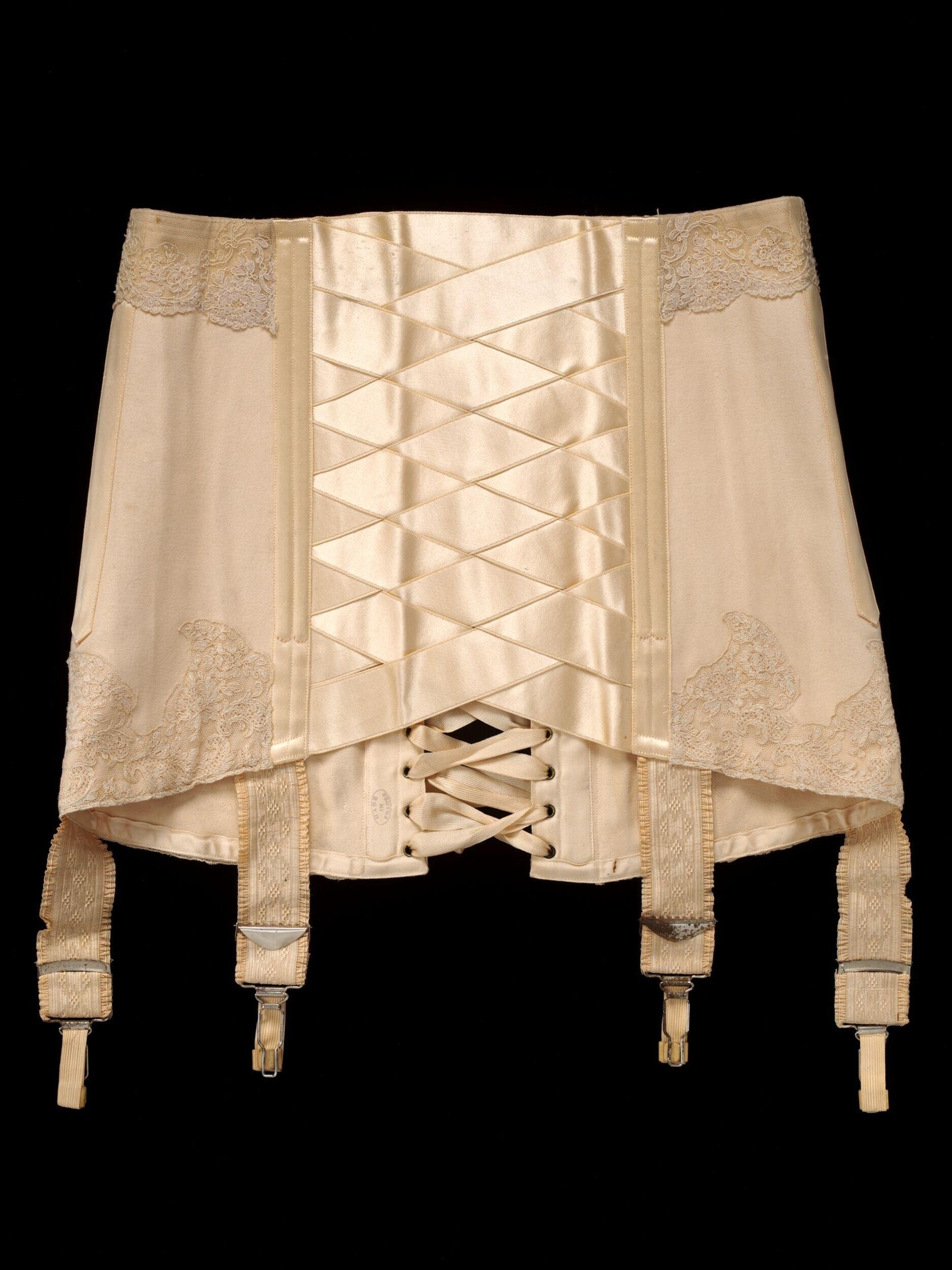
This is a women's corset of the Edwardian era, displayed flat against a black background in a museum documentation photograph. The garment is constructed in pale cream or champagne silk with lace panels at the upper chest and hips. The defining feature is the elaborate lacing system at center front: vertical rows of satin ribbon interlaced in a complex crosshatch pattern create a geometric grid effect down the torso. Four substantial fabric tabs extend downward from the base of the corset, each fitted with metal grommets at the hem to allow connection to separate garters for holding up stockings. The overall silhouette, when worn, would have created the S-bend figure characteristic of 1910s fashion—a rigid hourglass shape with the bust thrust forward and the hips and backside exaggerated. The construction demonstrates the engineering involved in fashionable dress of the period, where the corset was not merely decorative but a structural undergarment that dictated posture, movement, and the silhouette of all clothing worn over it.
The dancing
No figures are present. This is an object photograph, not a depiction of dancers or movement. The corset itself, when worn, would have severely restricted the wearer's mobility and movement range, enforcing an upright, corseted posture with limited spinal flexibility and a characteristic thrust-forward chest position.
The dance depicted
This corset does not depict dance, though it is intimately connected to the history of dance and bodily movement. The garment represents the structural constraints that shaped how women moved during the Edwardian period. Corsets of this design would have made participation in vigorous social dances difficult or impossible—the rigid front lacing and restrictive silhouette were fundamentally at odds with the free movement required by athletic or acrobatic dance. This object is valuable to dance history as material evidence of the physical norms that professional and social dancers worked within, and against, during this era.
How it was made
This is a surviving garment—a three-dimensional textile object preserved in a museum collection. The photograph is a museum documentation image, likely created for cataloguing purposes, using studio lighting to render the construction details legible. The corset itself is handmade using silk damask or a similar heavy fabric, with applied lace panels, hand-stitched seams, and metal grommets mechanically set into the garter tabs. The elaborate front lacing system required precision placement of eyelet holes through multiple layers of fabric.
About this work
This Edwardian corset from Debenham & Freebody, a prestigious London department store, documents the material culture of early 20th-century fashion and its relationship to bodily constraint. It belongs in a dance gallery not because it was worn while dancing, but because it represents the opposite: the rigid, controlled silhouette that defined women's posture and mobility during the years when modern dance was beginning to rebel against such restriction. It is evidence of what dancers like Isadora Duncan and the early modern movement were reacting against—the corseted, constrained female body as the norm. Understanding this garment is essential to understanding the revolutionary impact of dancers who rejected such garments and claimed freedom of movement for women's bodies.
How to look at it
Examine the engineering of the front lacing carefully: the precise grid pattern required mathematical planning and hand-work to execute. Note how much of the garment's surface area is devoted to structural elements—boning channels, lacing channels, reinforced seams—rather than decoration, revealing that this was primarily a functional device despite its aesthetic finish. The garter tabs at the base are indicators of how the corset extended down the thigh when worn, controlling the silhouette all the way down the leg. This is not a comfortable garment; it is an instrument of fashion discipline.
The artist
Debenham & Freebody was a major London department store and fashion house founded in the 19th century. They were manufacturers of high-end women's fashion and undergarments for the middle and upper classes. Like other luxury retailers of the period, they employed skilled seamstresses and produced garments to exacting standards. The store catered to fashionable London society and was a significant player in establishing and reinforcing Edwardian aesthetic ideals of the feminine silhouette.
The period
In 1914, the S-bend corset represented the established norm of fashionable femininity, though it was already being contested. The decade saw the rise of the suffragette movement, which critiqued not only women's political disenfranchisement but also the physical constraints imposed by fashion. Simultaneously, pioneering modern dancers were abandoning such garments entirely. Isadora Duncan had already been performing barefoot and uncorseted for over a decade by 1914, and Russian Ballet and other avant-garde dance forms were challenging the rigid ballet silhouette. By the time this corset was made, it was already becoming an emblem of an older order that some women and artists were beginning to reject. The First World War, beginning in the year of this corset's manufacture, would accelerate changes in women's dress as women entered the workforce in greater numbers.
Where it lives
The object is held in the Corset collection (notation: VA, likely Victoria and Albert Museum, London). It is a surviving example of commercial fashion manufacture from one of London's most important department stores of the period.
Questions about this work
What would it have felt like to dance in a corset like this?
Nearly impossible. The rigid front lacing and engineered S-bend shape would have restricted spinal flexion, prevented the torso from twisting, and forced the wearer into a narrow stance with the weight shifted forward onto the balls of the feet. Vigorous movement like waltzing or polka would have been uncomfortable; athletic movement would have been unthinkable. This is precisely why early modern dancers abandoned corsets.
Who wore corsets like this?
Respectable middle- and upper-class women in Britain and Europe. A corset from Debenham & Freebody would have been expensive and represented fashionable status. Working-class women, who needed mobility for their labor, wore simpler corsets or none at all. The corset was a marker of class and a technology of enforced femininity for women with the leisure to wear one.
How does this relate to dance history?
It documents the physical norm that modern dance pioneers rejected. Dancers like Isadora Duncan, the Denishawn company, and others were radical partly because they refused to wear these garments and instead danced in simple tunics or barefoot. Understanding what the corseted body looked like and felt like is essential to understanding why uncorseted dance was so shocking and so liberating.
More dance artwork





