49 works in this view — arrow keys or swipe to move between them.
Dance in Art
Costume design
Sonnabend, Yolanda
- Collection:
- Costume design
- Source:
- Victoria and Albert Museum
- Rights:
- Rights vary by item — check the source record before reusing this image. Source record ↗
- Recorded as:
- V&A — check rights per item
Costume designs are primary sources for understanding how dance bodies were dressed, framed, and presented on mid-20th-century stages. This sketch reveals both the technical knowledge required to construct garments that move with dancers and the aesthetic choices—the restraint, the emphasis on line and drape—that shaped how audiences saw dance in the 1950s. Sonnabend's work documents a transitional moment in theatrical design practice.
What you are looking at
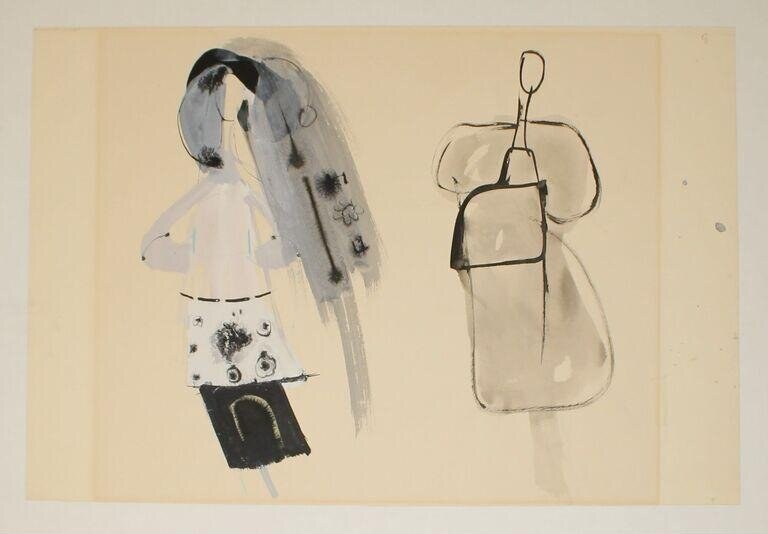
Two costume designs are presented side by side on cream paper in an economical, sketch-like technique. On the left is a figure in profile, head bowed, wearing a white bell-shaped skirt with decorative spotted details and a white upper garment with a pronounced collar. A substantial gray cloak or shawl drapes heavily over the shoulders and back, rendered in loose, gestural brushstrokes. A black rectangular panel or underskirt forms the base. On the right stands a figure shown from behind, rendered more schematically in pale washes and line. This figure wears a box-like tunic or dress with a belt at the waist and has prominent looped or padded shoulders. A small loop protrudes from the top, perhaps indicating a headdress attachment point or decorative element. Both figures are studies in simplified form, prioritizing silhouette and essential costume structure over anatomical detail.
The dancing
Neither figure assumes a dynamic dance pose. Both are relatively still and frontal in presentation—the left figure in profile with head lowered in a meditative or introspective attitude; the right figure in back view, arms at rest. The bodies function as costume armatures rather than as agents in motion. The left figure's posture suggests a moment of repose or contemplation rather than active movement, while the right figure's geometric, almost abstract rendering emphasizes the architectural quality of the garment over bodily articulation.
The dance depicted
These are costume designs rather than depictions of dance in progress. The garments—the bell skirt, the heavy cloak, the structured tunic—belong to theatrical dress, likely for a mid-20th-century ballet or theatrical work. The simplified, almost modernist rendering suggests design studies rather than documentation of an actual performance. Without further context, the specific dance cannot be identified, but the formality and theatre-oriented silhouettes indicate a classical or neoclassical theatrical tradition rather than vernacular or social dance.
How it was made
The work is executed in what appears to be watercolor and ink or gouache on paper, using rapid, gestural brushwork combined with deliberate line drawing. The technique is economical and conceptual—broad washes establish volume and drape, while pen or ink outlines define structure and detail. This approach is characteristic of costume design practice, where quick studies communicate essential silhouettes and fabric behavior to makers and performers without photorealistic rendering. The lightness of touch and minimal color suggest a preliminary or working study rather than a finished presentation drawing.
About this work
This is a paired costume design study from 1957 by Yolanda Sonnabend, presenting two theatrical garments in profile and back view. The left costume, with its bell skirt and draped cloak, and the right, with its structured tunic and padded shoulders, exemplify mid-century theatrical tailoring. The designs are rendered in a modernist idiom—simplified, gestural, and focused on silhouette rather than surface decoration. Together they form part of the working practice of theatrical costume design, a discipline that sits at the intersection of fashion, sculpture, and dance.
How to look at it
Attend to the two different approaches to silhouette and drapery. The left costume demonstrates how heavy fabric (the cloak) can be suggested through gestural brushwork and how a bell skirt creates a particular spatial presence. The right costume, by contrast, uses geometric outline and the suggestion of structure (the belt, the padded shoulders) without illusionistic rendering. Notice too the economy of means: no color beyond the necessary whites, grays, and blacks, and no extraneous ornament. This restraint is itself a design choice, reflecting 1950s modernist aesthetics.
The artist
Yolanda Sonnabend was a costume and fashion designer working in the mid-20th century, practicing in a modernist idiom that emphasized clean lines and functional elegance. Her sketch technique—economical, assured, and conceptually rather than decoratively oriented—places her within the European and American design traditions of the 1950s, where costume design was understood as a discipline allied to architecture and sculpture as much as to fashion.
The period
In 1957, theatrical costume design was in transition. The ornamental, heavily constructed costumes of earlier decades were giving way to cleaner, more abstracted forms influenced by modernism and, in ballet, by the Ballets Russes legacy and its emphasis on bold visual statement over historical accuracy. Neoclassical ballet was in its ascendancy, and the costumes shown here—particularly the right figure's geometric, almost constructivist tunic—reflect that aesthetic. In fine art, the sketch as autonomous artwork was gaining legitimacy; costume designs were increasingly recognized and collected as serious artistic documents rather than merely functional blueprints.
Where it lives
The work is held in a collection designated as 'Costume design' and comes from a source marked 'va' (likely an archive or institution code). It remains a working document within a design practice rather than a completed artwork for independent display.
Questions about this work
Is this a drawing of an actual costume, or a design before it was made?
It is a design study, part of the conceptual and planning stage of costume creation. Such sketches communicate the designer's vision to the costume maker, director, and eventually the performer. It shows what the designer imagined, not necessarily what was ultimately constructed or worn.
What dance was this costume for?
The catalogue does not specify which dance or theatrical work these designs were intended for. The formal, theatrical nature of the garments suggests a ballet or high theatrical production of the 1950s, but without additional documentation, the specific work cannot be identified.
Why are the two figures shown in different ways—one detailed, one abstract?
This reflects the designer's working process. The left figure may be a more resolved or studied proposal, showing how fabric actually falls; the right may be a schematic exploration of structure and proportion. Designers often work through multiple approaches simultaneously to test ideas.
What can this design tell us about how dancers moved in the 1950s?
The bell skirt on the left would have moved in a specific way—creating volume with momentum, constraining leg articulation, and creating a visual silhouette at odds with the body's actual shape. The tunic on the right, with its structured shoulders and belt, would have framed the torso and created a more geometric, architectural line. Both designs prioritize visual form and theatrical presence over freedom of movement.
More dance artwork





