49 works in this view — arrow keys or swipe to move between them.
Dance in Art
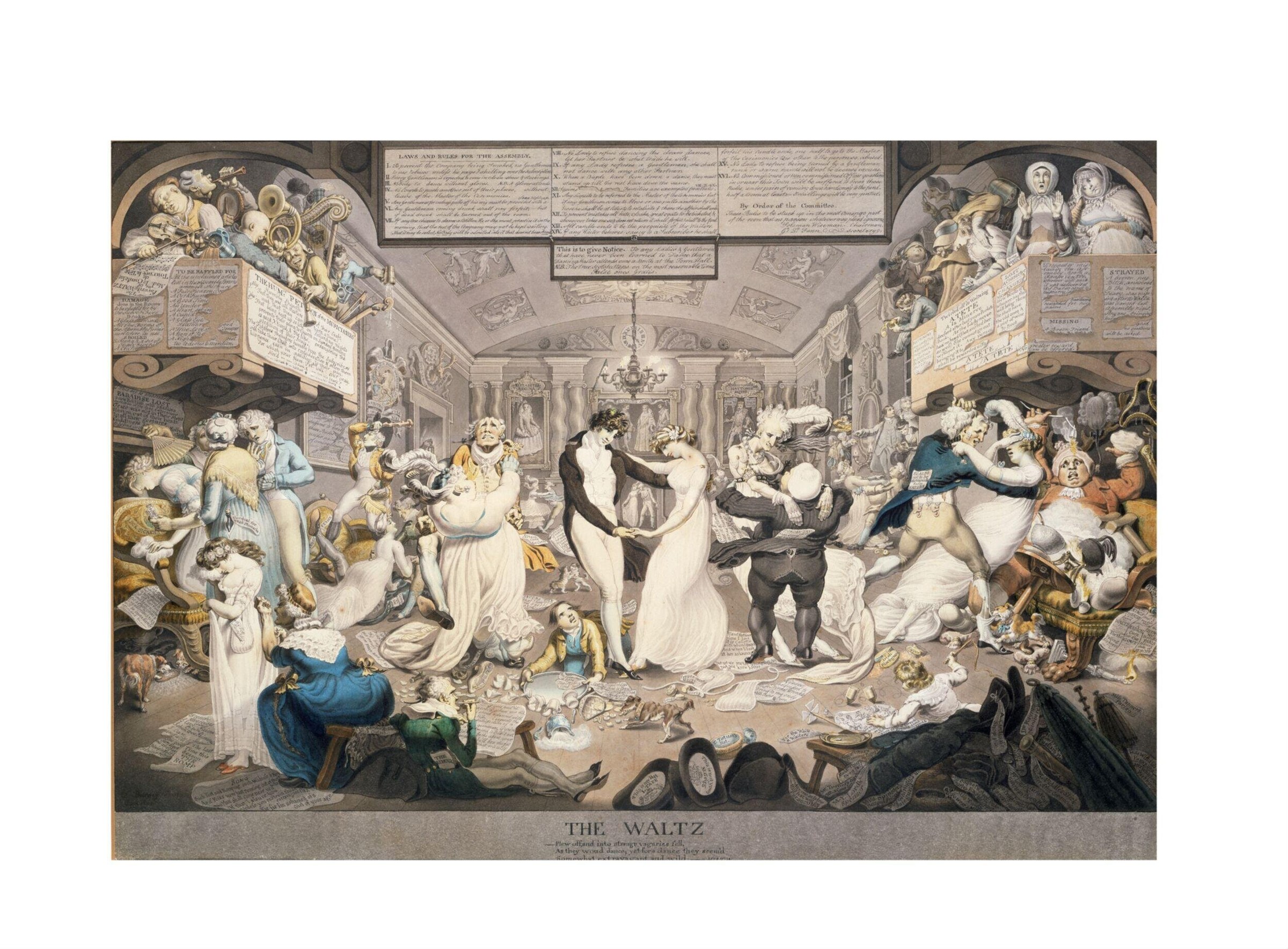
The Waltz
Burney
- Collection:
- Watercolour
- Source:
- Victoria and Albert Museum
- Rights:
- Rights vary by item — check the source record before reusing this image. Source record ↗
- Recorded as:
- V&A — check rights per item
This print is crucial evidence for understanding the waltz as a contested dance—not a neutral technique but a marker of continental decadence and sexual impropriety that alarmed British society. For historians of dance and manners, it shows the waltz's actual impact on the ballroom and the body's new freedom to move in close contact. For art historians, it exemplifies the satirical print tradition at the moment when social critique became visual spectacle.
What you are looking at
A crowded ballroom scene alive with satirical energy and social chaos. The space is a grand interior with a barrel-vaulted ceiling, ornate wall panels, and a chandelier overhead; architectural elements recede toward a distant vanishing point. The floor is scattered with overturned chairs, shoes, hats, and musical instruments—visual markers of disorder. Couples waltz and embrace in the foreground and middle ground, their bodies intertwined with varying degrees of control. The figures are rendered in a mixed palette of flesh tones, pale gowns, and darker coats; women wear high-waisted classical dresses with flowing trains, men wear tailcoats and breeches. Clustered throughout are onlookers, servants, cherubs, and marginal figures: some laugh, some gesture wildly, some recline exhausted on the periphery. The composition builds from careful architectural perspective to increasingly chaotic human activity, suggesting the waltz itself as a transgressive, destabilizing force. Text panels frame the composition at top and sides, indicating this is a documented satirical narrative. The tone is one of moral critique wrapped in visual exuberance—excess and impropriety rendered with formal precision.
The dancing
Couples occupy the center in what appears to be a closed ballroom hold, their bodies pressed close and often at dramatic angles. The dancers' arms are raised and extended; torsos lean into turns or pivots. Some figures are rigidly upright, others melt or collapse into their partners' embrace, suggesting fatigue or abandon. The artist has rendered weight distribution inconsistently—some dancers appear weightless, others heavily grounded—which reads as deliberate caricature rather than anatomical error. Foot positions are largely obscured by dress, but the rotational movement of the torso is emphatic. A notable asymmetry: women's bodies are depicted as passive or surrendered, while men often appear to steer or support. Children and cherubs cluster above and around the dancers, adding surreal dimensionality to the scene.
The dance depicted
This is unmistakably a waltz, and a satirical representation of it. The title confirms this, and the three-person closed hold seen repeatedly throughout the composition—notably in the center foreground—is the characteristic waltz frame of the early 19th century. The waltz was controversial in its moment: it brought bodies into close proximity in a way that shocked conservative society, and this print documents that scandal. The setting and costume place this in the Regency or early Victorian era, when the waltz was newly adopted in Britain and read as continental immorality. The artist has captured the waltz not as a technical dance but as a social transgression—the image is didactic satire, using the dance as the vehicle for critique of modern manners.
How it was made
This is a hand-colored engraving or aquatint, likely printed from a copper plate and colored afterward by brush. The precision of the architectural setting—the perspective of the ceiling, the orthogonal lines of the walls—speaks to engraved line work; the modulated tones of the background suggest aquatint. The text panels, integral to the composition, indicate this was a satirical print meant for rapid circulation and social commentary, likely sold individually or in series in London print shops. Hand coloring allowed for the subtle variation in skin tones and the distinction between, say, blue velvet and pale muslin—details that carry social meaning in the period. The technique supported both the formal architectural framework and the cacophonous human figures, creating deliberate visual tension between order and disorder.
About this work
The Waltz is a satirical engraving that uses the newly fashionable waltz as the vehicle for critique of Regency-era social manners. The print depicts the ballroom as a space of chaos and moral transgression, with dancers in the new close hold positioned amid overturned furniture, scattered shoes, and exhausted or frenzied onlookers. The work belongs to a tradition of morality prints—visual sermons on the dangers of fashion and excess—but it is also a document of dance history: it records the exact moment when the waltz arrived in Britain and the horror it provoked. The composition uses architectural precision to frame human disorder, suggesting that the waltz itself is a breach of proper social order.
How to look at it
Attend first to the foreground couple in the center—their close hold and the woman's lifted, tilted posture are the technical core of the waltz, and the artist has rendered them with formal clarity despite the surrounding chaos. Then trace outward: the overlapping couples, the collapsed and exhausted figures at the edges, the children witnessing from above. The overturned objects are not background clutter but the claimed consequence of waltz-dancing—they are narrative elements in a moral argument. The architectural frame—the orderly ceiling, the receding walls—sets the scene of civilization, which the bodies then violate. The text panels, which you can partially see in the print, would have provided numbered commentary on specific vices depicted, making the whole a visual-textual document.
The artist
Burney is recorded as the creator, but the catalogue entry carries no other biographical information. The style and composition suggest a London-based satirical printmaker working in the early 19th century, likely trained in engraving and familiar with the conventions of social satire established by Gillray and Rowlandson. Without fuller attribution data, the artist's specific identity and career remain uncertain.
The period
The waltz arrived in Britain from Vienna in the late 18th century and became fashionable during the Regency period (c. 1811–1820). It was perceived as morally dubious: the close hold, the speed, the rotational movement, and the absence of a narrative frame (unlike the minuet or country dance) made it seem licentious. Satirical prints flourished in this period as the primary vehicle for political and social commentary; The Waltz sits squarely in that tradition. Contemporaneously, the waltz was defended in literature and practiced in elite circles, but the cultural anxiety it generated was real and well-documented. This print captures that anxiety at its peak.
Where it lives
The work is recorded in the Victoria and Albert Museum's collection under the watercolor medium classification, though the primary technique appears to be engraving with hand coloring. It entered a significant British collection of satirical prints and social commentary art, where it remains a key example of Regency-era visual culture.
Dance in this work
Questions about this work
Why did people find the waltz so shocking?
The waltz brought couples into sustained physical contact—the man's hand on the woman's waist, their bodies inches apart—while spinning at speed. This was radically different from earlier dances where couples touched hands at arm's length or not at all. To conservative observers, the waltz appeared to be seduction on the dance floor, and satirists used prints like this one to voice alarm about its effects on morality and public order.
Is this image evidence that the waltz was actually as chaotic as it looks?
No. This is satire, designed to exaggerate and mock. The scattered furniture, the exhausted figures, the cherubs hovering above—these are the artist's invention, meant to make the waltz ridiculous. Real ballrooms were orderly, and real dancers executed the waltz with discipline. But the image does tell us that people experienced the waltz as disruptive and strange, and that this print articulated genuine social anxiety about how the dance changed relations between men and women.
Who danced the waltz at this time?
The waltz was fashionable among the gentry and aristocracy during the Regency period. It required space, a good orchestra, and leisure—so it was a dance of the wealthy. However, as the 19th century progressed, it gradually spread to the middle classes and beyond. This print captures the moment when it was still new, scandalous, and associated with foreign (especially Viennese) sophistication and excess.
More dance artwork





