49 works in this view — arrow keys or swipe to move between them.
Dance in Art
Anniversary Waltz
Claridge, Lewis & Jordan Ltd.
- Collection:
- Poster
- Source:
- Victoria and Albert Museum
- Rights:
- Rights vary by item — check the source record before reusing this image. Source record ↗
- Recorded as:
- V&A — check rights per item
For historians of mid-century theatre and popular culture, this poster documents how the waltz functioned as a symbol of romantic domesticity in the 1950s, even in the absence of actual dancing. For dance scholars, it shows how a specific dance form could anchor an entire theatrical narrative and advertising campaign, making the waltz a concept as much as a physical practice.
What you are looking at
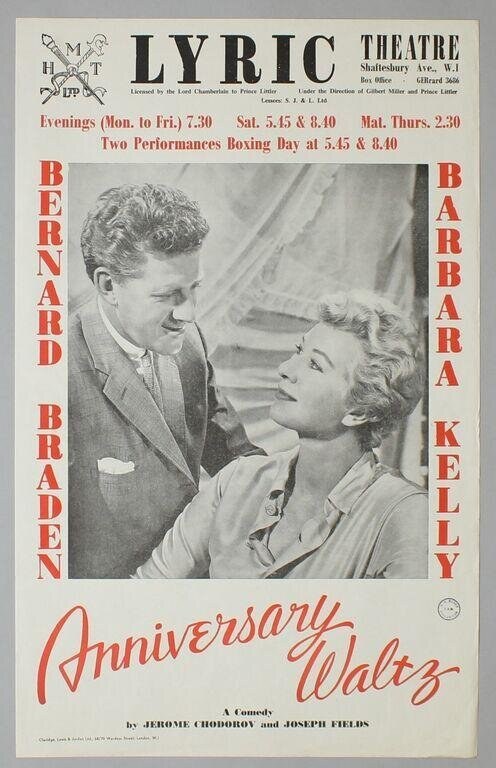
A theatrical poster for the comedy *Anniversary Waltz*, printed by Claridge, Lewis & Jordan Ltd. in 1955. The composition shows a man and woman in close embrace in what appears to be a domestic interior—the woman seated or reclining, the man leaning toward her with an affectionate expression. Both wear mid-century dress: he in a suit jacket, she in a light blouse. The photograph or still from the film is centered on the poster, surrounded by typography in red and black. The poster lists performance times at the Lyric Theatre, Shaftesbury Avenue, London, noting "Two Performances Boxing Day at 5.45 & 8.40." The names "Bernard Braden" and "Barbara Kelly" appear vertically down the left and right edges in red capital letters, identifying the stars. At the base, the credits state the play was "by Jerome Chodorov and Joseph Fields." The entire design is characteristic of mid-century British theatre advertising—functional, with clear hierarchy and period typography.
The dancing
The two figures are shown in an intimate moment rather than active dance. The woman reclines or sits, her head tilted back slightly, gazing upward in a pleased or surprised expression. The man leans in from above, his body angled toward hers, his face close to hers in what reads as a romantic or flirtatious gesture. Neither figure is in a dance frame or executing recognizable dance steps; the pose is one of courtship or romantic comedy rather than choreography. The composition emphasizes the personal relationship between the two characters rather than movement or technique.
The dance depicted
Despite the title *Anniversary Waltz*, the image does not depict dancing. The waltz is invoked thematically—as a romantic form associated with married couples and celebration—but the visual content is a dramatic comedy scene showing two actors in a romantic embrace. The work is theatrical advertising rather than a record of actual dance performance. The title suggests the waltz as cultural metaphor (a couple marking their anniversary through the emblematic dance), but no waltz choreography is visible.
How it was made
This is a printed theatre poster, most likely a lithograph or offset lithograph based on the reproduction quality and printing technique typical of 1955 British theatre advertising. The image combines a photographic still (from the play or a publicity shoot) with letterpress typography in red and black inks on a light ground. The technique allowed rapid, cost-effective reproduction for wide distribution to theaters and advertising sites, making it a functional document of mid-century commercial theatre culture rather than fine art.
About this work
This is a theatre poster advertising a mid-century comedy production at London's Lyric Theatre. The work sits at the intersection of theatrical promotion, romantic comedy, and dance as cultural symbol. *Anniversary Waltz* uses the waltz not as a dance to be shown but as a title and thematic anchor for a romantic comedy—the dance form serving as shorthand for married love and celebration. The image is included in a dance archive because waltz imagery and the cultural work waltzes do in representing partnership and occasion are part of dance history, even when the dance itself is absent from the frame.
How to look at it
The poster freezes a moment of romantic comedy: the stillness and intimacy of the embrace is theatrical in its clarity and directness. Note how the composition centers the two faces and bodies, with typography framing them—the design assumes the viewer recognizes the stars (Bernard Braden and Barbara Kelly) from their names and faces, and that the promise of romance and comedy will draw an audience. The absence of movement or dance steps is itself the point: the waltz is evoked by title and by the romantic scenario, not shown.
The artist
Claridge, Lewis & Jordan Ltd. was a London-based commercial printing firm specializing in theatrical posters and advertising materials during the mid-twentieth century. They were production specialists rather than designers; the visual concept would have been created by a theatre's in-house designer or an advertising agency, with Claridge, Lewis & Jordan executing the printing. This firm was part of the infrastructure of British theatre culture, producing hundreds of similar posters for West End productions.
The period
In the 1950s, the waltz retained significant cultural prestige as the dance of romantic comedy and marital celebration, even as newer social dances were emerging in clubs and popular music. The post-war period saw a revival of theatrical comedy and lighter fare; *Anniversary Waltz* was part of a trend toward domestic, romantic scenarios played for laughs. Theatre posters of this period used bold typography and photographic stills to advertise productions, with minimal graphic design—the focus on legibility and star names reflects the theatrical economy of the era.
Where it lives
This poster is held by the V&A (Victoria and Albert Museum) collections. It is a commercial theatre poster from the British post-war period, part of the holdings documenting theatrical advertising and popular entertainment design.
Questions about this work
Is there actual dancing in this poster?
No. The image shows an intimate dramatic scene between two actors, not a dance performance. The title *Anniversary Waltz* invokes the waltz as a romantic symbol, but the visual content is a comedy scene of courtship or affection between a man and woman.
Who were Bernard Braden and Barbara Kelly?
They were British and North American entertainers and actors who appeared in mid-century theatre and television. Their names on the poster were the main draw for audiences, as star power was central to theatrical marketing in the 1950s.
What was the original *Anniversary Waltz*?
It was a Broadway comedy by Jerome Chodorov and Joseph Fields that opened in 1954. This London production at the Lyric Theatre (1955) was the British staging of that American hit.
More dance artwork





